
Retail Channels in India: GT, MT and Quick Commerce
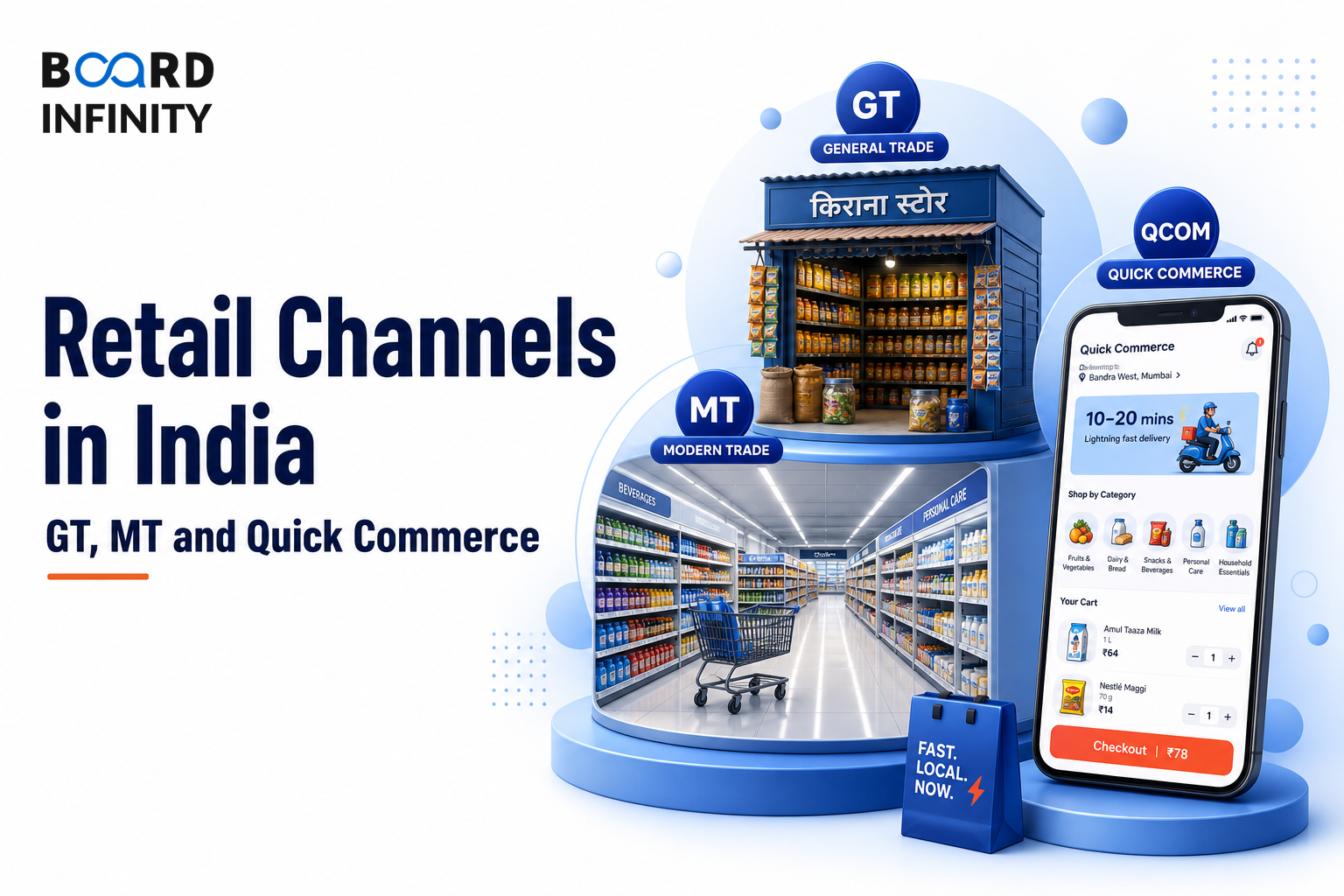
After Distribution Channel Levels Explained, the next interview question is what those channels look like in India. India's retail landscape is uniquely diverse, combining traditional formats with rapid digital adoption. In interviews, this matters because General Trade, Modern Trade, E-Commerce, Quick Commerce, D2C, Franchise, Wholesale/B2B and Direct Selling each play a distinct distribution role.
- General Trade (Kirana) means neighbourhood mom-and-pop stores. The backbone of Indian retail, with 12M+ stores and 80% of FMCG sales.
- Modern Trade is organised retail - supermarkets, hypermarkets with self-service format. Examples include DMart, Reliance Retail, Big Bazaar.
- E-Commerce covers online marketplaces and brand websites. Examples include Amazon, Flipkart, Meesho.
- Quick Commerce is ultra-fast delivery, 10-30 min, from dark stores. Examples include Blinkit, Zepto, Swiggy Instamart - $5B FY25.
- D2C Website means brand-owned online channels with direct customer relationship. Examples include Mamaearth, boAt, Lenskart.
- Franchise & Retail Chains, Wholesale / B2B and Direct Selling complete India's 8 retail channels.
India's Multi-Channel Retail Landscape
India's retail landscape is uniquely diverse, combining traditional formats with rapid digital adoption. The big picture is not one channel replacing another, but a multi-channel ecosystem where each format has a different role, scale and example set.
How to Read GT, MT and New-Age Channels
General Trade (GT) refers to General Trade (Kirana): neighbourhood mom-and-pop stores. It is the backbone of Indian retail, with 12M+ stores and 80% of FMCG sales. In any FMCG interview, this is the anchor channel rather than a side note.
Modern Trade (MT) means organised retail - supermarkets, hypermarkets with self-service format. DMart, Reliance Retail and Big Bazaar are the named examples. It is distinct from General Trade because the retail format is organised and self-service.
E-Commerce covers online marketplaces and brand websites. Amazon, Flipkart and Meesho are the named examples. D2C, or Direct-to-Consumer, appears separately as D2C Website: brand-owned online channels with direct customer relationship, with Mamaearth, boAt and Lenskart as examples.
Quick Commerce is ultra-fast delivery, 10-30 min, from dark stores. Blinkit, Zepto and Swiggy Instamart are the named examples, with $5B FY25 scale. This channel is different from regular e-commerce because the defining feature is ultra-fast delivery from dark stores.
B2B, or Business-to-Business, appears in Wholesale / B2B: bulk purchase channels for institutions and resellers. Metro Cash & Carry, Udaan and JioMart B2B are the named examples. Direct Selling is person-to-person sales through independent distributors, with Amway, Tupperware and Oriflame as examples.
Why the Channel Mix Matters
The table is not a ranking of better and worse channels. It is a map of formats: kiranas, organised self-service stores, online marketplaces, ultra-fast dark-store delivery, brand-owned websites, franchise outlets, bulk purchase channels and person-to-person sales.
For interview answers, the strongest framing is to show that India's retail market combines traditional formats with rapid digital adoption. Kiranas still dominate FMCG sales, while modern trade, e-commerce, quick commerce, D2C, franchises, B2B and direct selling serve distinct distribution roles.
Structuring a Retail Channels in India Interview Answer
"How would you frame India's retail channels for an FMCG brand choosing between kiranas, modern trade, e-commerce and quick commerce?"
Do not make the answer only about Amazon, Flipkart, Blinkit or Zepto. Start with General Trade because Kirana stores are the backbone of Indian retail, then layer Modern Trade, E-Commerce, Quick Commerce, D2C, Franchise, Wholesale/B2B and Direct Selling.
The most frequent error is treating quick commerce as a replacement for all retail channels. Quick Commerce is ultra-fast delivery, 10-30 min, from dark stores, while General Trade (Kirana) is 12M+ stores and 80% of FMCG sales; ignoring that difference costs points.
Conclusion
India's retail channel story is a multi-channel ecosystem: General Trade remains the FMCG backbone, while Modern Trade, E-Commerce, Quick Commerce, D2C, Franchise, Wholesale/B2B and Direct Selling each add a distinct distribution role. The best interview answer starts with kiranas and then explains how rapid digital adoption expands the channel mix.