
Scheduling, Critical Path & Resource Levelling
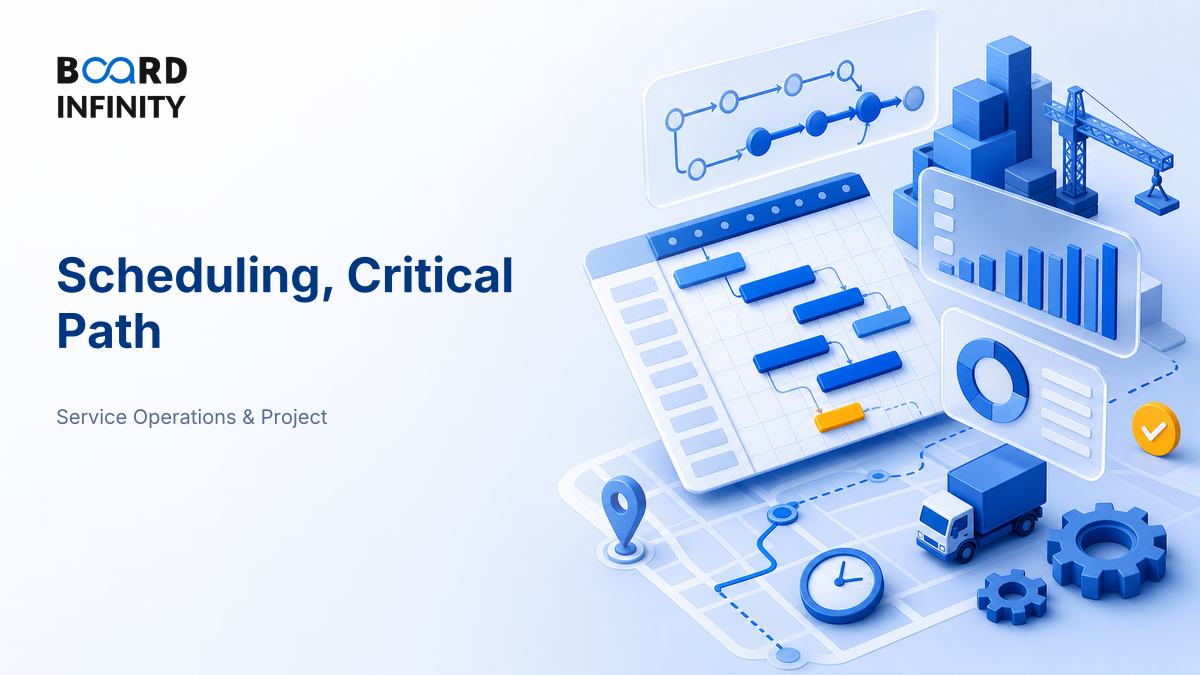
The biggest myth in project scheduling is that the best plan is the shortest plan. In reality, a schedule that ignores bottleneck people, shared machines or permit delays can look perfect on a Gantt chart and still collapse on Monday morning.
- Scheduling converts project work into a time-phased plan: what happens, in what order, by whom and by when.
- Critical path is the longest dependent chain of activities; delay here delays the whole project unless action is taken.
- Float is schedule breathing room; zero-float activities are critical, positive-float activities can move without delaying completion.
- Resource levelling adjusts start dates to fit limited resources; it improves feasibility but may extend the project.
- Crashing shortens duration by adding cost or capacity; it should be applied first to critical-path activities.
- The strongest interview answer separates logical dependency from resource constraint.
- The common trap: drawing the network and declaring the critical path without checking whether people, machines or materials are actually available.
Big Picture: A Schedule Is a Promise Plus Constraints
A good project schedule has two jobs. First, it reveals the logic of work - which activities must precede others. Second, it tests feasibility - whether the plan can actually be executed with available resources.
Core Explanation: CPM First Finds the Risk, Levelling Makes It Real
Scheduling begins with decomposing the project into activities, estimating each duration and linking dependencies. The result is usually shown as a network diagram or a Gantt chart.
Critical Path Method, or CPM, then calculates the earliest and latest time each activity can start or finish. Activities with zero total float form the critical path. They are not “important” in a vague sense - they are mathematically schedule-controlling.
Resource levelling comes after this logic check. It asks: even if two tasks can happen in parallel, do we have enough people, machines, approvals or materials to run them together?
The Four Scheduling Concepts You Must Not Mix Up
Students often use critical path, float, crashing and levelling as if they are the same idea. They are related, but each solves a different problem.
Worked Example: Finding the Critical Path and Levelling a Constraint
Suppose an operations team is launching a small warehouse automation project.
There are two main paths:
- A-B-D-F = 3 + 4 + 5 + 2 = 14 days
- A-C-E-F = 3 + 2 + 3 + 2 = 10 days
So the critical path is A-B-D-F. Activities C and E have 4 days of total float because their path can slip from 10 days to 14 days before delaying go-live.
Now add a real-world resource constraint: the same warehouse systems specialist is needed for both B and C. If the team runs B first and then C, the project still finishes in 14 days because C and E can fit inside their float. If they run C first and delay B, the critical path shifts and the project may extend. That is resource levelling in action: feasibility depends not only on activity logic, but also on who is available when.
Definitions: Say These Cleanly
- Schedule: A time-phased plan showing activity sequence, duration, start dates, finish dates and resource needs.
- Critical path: The longest dependent activity chain that determines the earliest possible project completion date.
- Total float: The time an activity can be delayed without delaying the project finish date.
- Free float: The time an activity can be delayed without delaying the next activity.
- Resource levelling: Adjusting activity timing to match limited resource availability, even if project duration increases.
- Crashing: Reducing project duration by adding resources or cost to activities that affect the critical path.
Metrics: How to Track Whether the Schedule Is Healthy
Do not say “we will monitor the project closely.” Name the measures. A professional schedule review usually checks time, float, resource pressure and milestone reliability.
Mini Case Study: L&T Construction and Airport Terminal Delivery
L&T Construction shows why large infrastructure scheduling is less about drawing dates and more about coordinating dependencies, specialist resources and parallel work fronts.

Consider a major airport terminal project. The visible output is a building, but the schedule is a dense network: civil works, structural steel, mechanical and electrical systems, baggage handling, fire safety, interior fit-outs, testing, statutory approvals and operational readiness.
The scheduling challenge is not simply “finish construction fast.” The primary driver is sequencing parallel work fronts without creating rework. Supporting drivers include specialist subcontractor coordination, material availability, safety clearances, inspection windows and handover discipline between packages.
In such projects, CPM identifies what truly controls opening readiness - for example, a path through structural completion, MEP installation, system integration, testing and approvals. Resource levelling then prevents the plan from assuming impossible simultaneous use of the same cranes, engineers, commissioning teams or inspectors.
Lesson: the project wins when the team manages both the network logic and the capacity reality. A candidate who says only “they used CPM” misses the real operating problem.
How AI Changes Scheduling, Critical Path & Resource Levelling
AI does not replace scheduling logic. It improves the estimates, detects risk earlier and solves capacity trade-offs faster.
For operations students, connect this with AI-led planning topics such as Using AI for Inventory Optimisation and Replenishment, where the same forecasting logic appears in a different operating context.
Interview Relevance
“You are managing a store rollout project. Several activities can run in parallel, but the same vendor team is needed for two of them. How will you build and control the schedule?”
Use this sentence in your answer: “I would first find the logic-driven critical path, then test the resource-constrained schedule, because the mathematically shortest plan may not be operationally feasible.”
Common Mistake
The single biggest error is treating CPM as the final schedule. CPM tells you what controls time, but it does not automatically prove that people, machines, vendors and approvals are available. Fix: after finding the critical path, always run a resource levelling check.