
Using AI in Service Operations and Workforce Scheduling
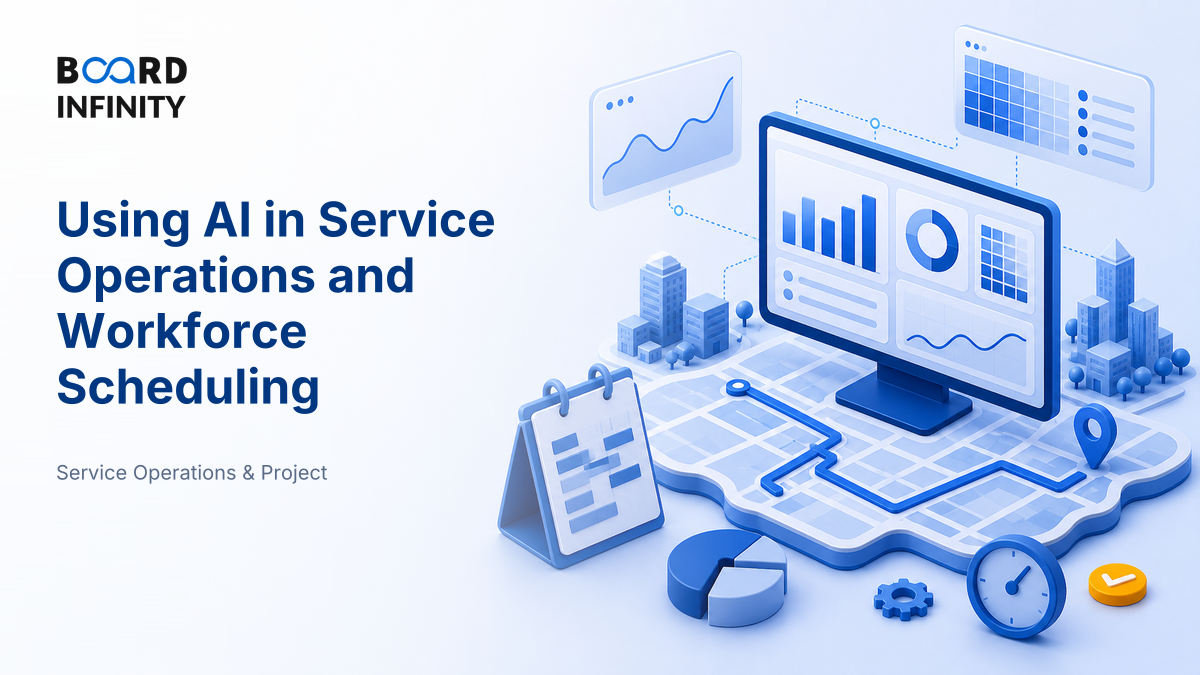
At 8:45 a.m., a hospital OPD desk has three counters open and a queue bending around the corridor. By 11:15 a.m., the rush has moved to diagnostics, but the same staff plan is still frozen on a spreadsheet made last Friday. AI in service operations is the difference between scheduling for what managers hope will happen and scheduling for what demand is already signaling.
- Service operations manage capacity, queues, staff, customer experience and service quality in real time.
- AI helps most where demand is variable - call centres, hospitals, quick commerce, hotels, field service and customer support.
- The core loop is: predict demand, translate demand into workload, optimize rosters, monitor execution, and learn from variance.
- Workforce scheduling is not just shift planning. It must match volume, skill, location, service-level targets and labour constraints.
- The best AI schedules are human-supervised: managers set constraints, fairness rules and escalation logic; AI proposes options.
- Track AI scheduling using service level, occupancy, schedule adherence, forecast accuracy, overtime rate and abandonment rate.
- The interview trap: praising AI automation without explaining operational constraints, employee fairness and service-quality trade-offs.
Big Picture: AI Converts Demand Signals into Staff Decisions
Service operations fail when demand moves faster than the operating plan. AI improves the system by reading demand signals early and converting them into staffing, routing, queueing and escalation decisions.
Core Explanation: Where AI Actually Helps Service Operations
Service operations are the activities that design, deliver and control customer-facing services. Unlike manufacturing, service demand is often perishable: an empty restaurant table at 8 p.m. or an idle agent during a quiet hour cannot be stored for tomorrow.
Workforce scheduling is the process of assigning the right number of people with the right skills to the right time slots and locations, while meeting service and labour constraints.
AI does not remove the operations problem. It improves four hard parts of it:
The real managerial skill is not saying “use AI.” It is knowing what decision AI should support. In a call centre, AI may forecast call volume and recommend agent rosters. In a hospital OPD, it may stagger nursing and billing capacity. In field service, it may route technicians by skill, geography and promised appointment windows.
If the issue is not workforce scheduling but physical work distribution across stations, revise line balancing and workstation design because the bottleneck logic is closely related.
The Four Operating Decisions AI Supports
AI in service operations usually sits at the intersection of demand, capacity, service quality and cost. A strong answer separates these decisions instead of treating AI as one magic layer.
Metrics to Track: How You Know AI Scheduling Is Working
Good AI scheduling should improve service quality without silently burning out employees or inflating labour cost. Use 4-6 metrics together; one metric alone will mislead you.
Notice the trade-off: a schedule can look “efficient” because occupancy is very high, but customers may wait longer and employees may fatigue. Service operations must optimize the system, not one KPI.
Worked Example: Converting Demand Forecast into Staff Required
Suppose a support centre expects 180 customer contacts per hour. Average handling time is 10 minutes, so one agent can handle about 6 contacts per hour. The manager wants to plan at 85% occupancy and expects 15% shrinkage for breaks, meetings and absence.
This is the bridge between analytics and operations: the AI forecast is useful only when it becomes a staffing number, a shift pattern and a control plan.
Definitions You Should Be Able to Say Clearly
- Service operations: Managing people, processes and capacity to deliver customer-facing services reliably and efficiently.
- Workforce scheduling: Assigning employees to shifts, tasks and locations to match demand, skills, rules and service targets.
- AI forecasting: Using machine learning to predict future service demand from historical patterns and live signals.
- Optimization: Choosing the best feasible schedule under constraints such as cost, skills, availability and service level.
- Shrinkage: Paid staff time unavailable for direct service because of breaks, leave, training, meetings or absence.
Urban Company: AI-Style Scheduling Logic in a Marketplace Service Operation
Urban Company shows why service scheduling is harder than filling shifts: the platform must match customer time slots, partner availability, skills, distance and service promise.

Situation: Home services are operationally complex because demand is local, time-bound and skill-specific. A haircut, appliance repair and deep cleaning request may all arrive in the same city, but they require different professionals, service times, tools and travel windows.
The move: A platform model like Urban Company relies on scheduling intelligence: customer slot availability, partner matching, location clustering, expected service duration, cancellation risk and quality controls. AI can improve this operating model by forecasting demand pockets, recommending partner allocation, reducing idle travel and protecting high-demand slots.
The lesson: The primary driver is not “AI” alone. The primary driver is a marketplace operating system that converts fragmented local demand into feasible service assignments. Supporting drivers include standardized service categories, partner training, customer ratings, app-based booking, routing logic and live exception handling.
So what: The case proves that AI scheduling is not simply a back-office roster tool. In many service businesses, scheduling is the product experience itself.
How AI Changes Using AI in Service Operations and Workforce Scheduling
By 2026, AI is changing this topic in three practical ways that matter for managers.
Student workflow: Take any service company before an interview - for example, a hospital chain, airline, hotel, contact centre or home-services platform. Put your notes, the company website text and recent public information into NotebookLM. Ask: “What are the likely demand spikes, service bottlenecks, staffing constraints and AI scheduling opportunities for this company?” Then convert the output into a three-part answer: demand signal, operating decision, metric to track.
If you want the closest adjacent AI operations topic, compare this with using AI for inventory optimisation and replenishment. Inventory AI decides how much stock to place; service scheduling AI decides how much human capacity to place.
Interview Relevance
“A hospital or contact centre has long queues in peak hours and idle staff in off-peak hours. How would you use AI to improve service operations and workforce scheduling?”
Use the phrase: “I would first separate the forecasting problem from the scheduling problem.” That single line signals maturity because many candidates mix the two.
Common Mistake
Mistake: Saying “AI will optimize staff and reduce cost” without mentioning service levels, labour constraints, skill mix or employee fairness. Why it hurts: it sounds like a tool-first answer, not an operations answer. Fix: always frame AI as “forecast - staff - execute - measure,” with human supervision and clear KPIs.