
How Service Operations Differ From Manufacturing
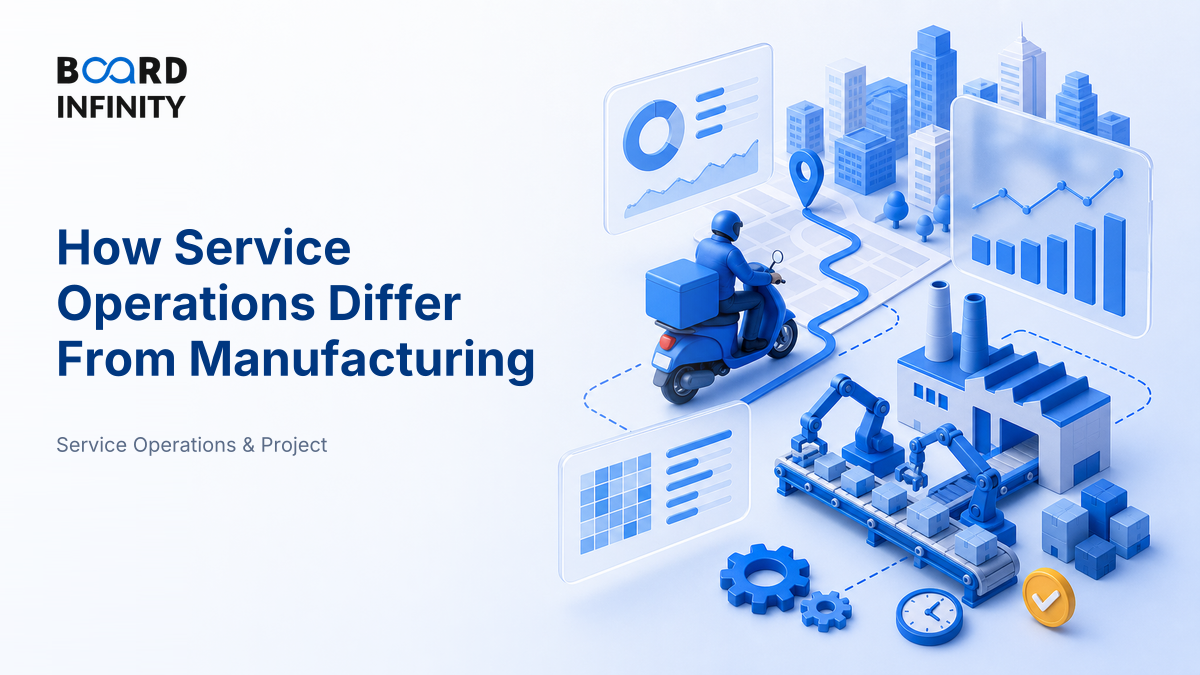
At 8:45 a.m., a hospital reception desk, a salon chair and a food delivery app all face the same problem: demand arrives unevenly, customers are present, and the “product” disappears the moment the slot is missed. A factory can store finished goods for tomorrow; a service operation cannot store yesterday’s empty appointment.
- Manufacturing converts inputs into tangible goods; service operations deliver intangible value through customer-facing processes.
- The biggest difference: manufacturing separates production and consumption, while services often produce and consume at the same time.
- Manufacturing can use inventory as a buffer; services use capacity, scheduling, queues and demand shaping.
- Quality in manufacturing is inspected mainly in the product; quality in services is judged during the customer experience.
- Service variability comes from both employees and customers, so standardisation must coexist with flexibility.
- Good service operations track service level, waiting time, utilisation, first-time-right rate and customer satisfaction.
- In interviews, compare the two on tangibility, inventory, customer involvement, variability, quality control and capacity management.
Big Picture
The cleanest way to remember the difference is this: manufacturing manages a thing through a process; service operations manage a customer through an experience. Both need capacity, quality, cost control and process design, but the operating logic changes when the customer is part of production.
Core Explanation
Manufacturing operations are activities that transform materials and information into tangible goods. Service operations are activities that deliver value through performances, experiences or outcomes, usually with direct customer participation.
The difference is not that manufacturing is “hard” and services are “soft.” Banks, airlines, hospitals, hotels and quick-commerce companies run extremely disciplined operations. The difference is where the uncertainty sits: in manufacturing, uncertainty is often in materials and machines; in services, it is also in customers, timing, mood, expectations and employee interaction.
The Six Differences You Must Be Able to Explain
That is why factory tools do not copy-paste neatly into services. A manufacturing manager may improve throughput by rearranging workstations and balancing the line; if you want that base logic, revise line balancing and workstation design. A service manager may still use process thinking, but must additionally manage queues, customer expectations and recovery when the experience fails.
The Operating Logic: Why Services Behave Differently
There are four mechanics behind almost every service-versus-manufacturing question.
For example, a restaurant cannot “manufacture” all dinner experiences at 3 p.m. and store them. It can prepare ingredients, train staff and design the kitchen, but the actual service quality is created when the guest, waiter, kitchen, payment system and ambience meet.
How to Measure Service Operations
In manufacturing, you may instinctively track defect rate, inventory turns and equipment utilisation. In services, the metrics must capture both operational performance and customer experience.
A Small Worked Example
A home appliance service centre has 30 technician slots today. It completes 27 visits. Out of those, 24 are completed within the promised time and 23 are fixed on the first visit.
- Capacity utilisation = 27 ÷ 30 = 90%.
- Service level = 24 ÷ 27 = 88.9%.
- First-time-right rate = 23 ÷ 27 = 85.2%.
The interview insight: 90% utilisation looks efficient, but if on-time service or first-time-right falls, the system is over-optimised for capacity and under-optimised for experience.
Definitions You Can Say in One Breath
- Manufacturing operations: Processes that transform inputs into tangible goods for later use, sale or distribution.
- Service operations: Processes that create value through customer experiences, performances or outcomes rather than stored goods.
- Service encounter: The moment of interaction where the customer experiences the service and judges its quality.
- Perishability: The inability to store unused service capacity for future sale.
- Service recovery: Actions taken to fix a failed service and restore customer trust.
Urban Company: Service Operations in a Real Indian Business
Urban Company shows how a service marketplace can standardise home services while still operating in highly variable customer homes.

Situation: Home services such as beauty, appliance repair, cleaning and grooming are operationally difficult because every customer home is different. The “workstation” changes every visit, the customer is present, and quality is judged not only by the final repair or treatment but by punctuality, hygiene, behaviour and trust.
The move: Urban Company built an app-based service model around partner onboarding, training, category-level SOPs, booking slots, customer ratings, transparent pricing and in-app issue resolution. The primary driver is process standardisation in a variable environment. Supporting drivers include digital demand aggregation, partner enablement, customer feedback loops and clearer service promises.
The lesson: Urban Company cannot inventory a haircut, facial or repair visit. It manages service quality by designing the encounter: who is assigned, when they arrive, what tools and steps they follow, how customers rate the experience, and how failures are recovered.
The strategic “so what”: service operations win when the company designs both the technical core and the customer experience wrapper. In Urban Company’s case, the operating advantage is not only app convenience; it is the combination of standardised processes, partner capability, trust signals and recovery mechanisms.
How AI Changes Service Operations Differently From Manufacturing
AI affects both factories and services, but the service impact is sharper because the customer is inside the system and data arrives continuously from bookings, chats, reviews, payments and service outcomes.
The risk is over-automation. In high-contact services, AI should improve the promise, routing and recovery, but human empathy still matters when the customer is anxious, angry or confused.
Before an interview, load this lesson plus a company annual report or website pages into NotebookLM and ask: “Identify where this company faces service perishability, demand variability, customer participation and service recovery challenges. Generate five interview questions with model answers.”
Interview Relevance
“How are service operations different from manufacturing operations? Explain with an example.”
A strong answer does not insult manufacturing as rigid or call services unstructured. It shows that both are process-driven, but the control levers differ.
Common Mistake
The most common mistake is saying “services are intangible, manufacturing is tangible” and stopping there. That answer is too shallow because it misses the operational consequences: no finished-goods inventory, live quality judgment, customer participation, demand variability and the need for service recovery. One-line fix: always convert each difference into a management implication.