
Swiggy Instamart: Creating a New Category
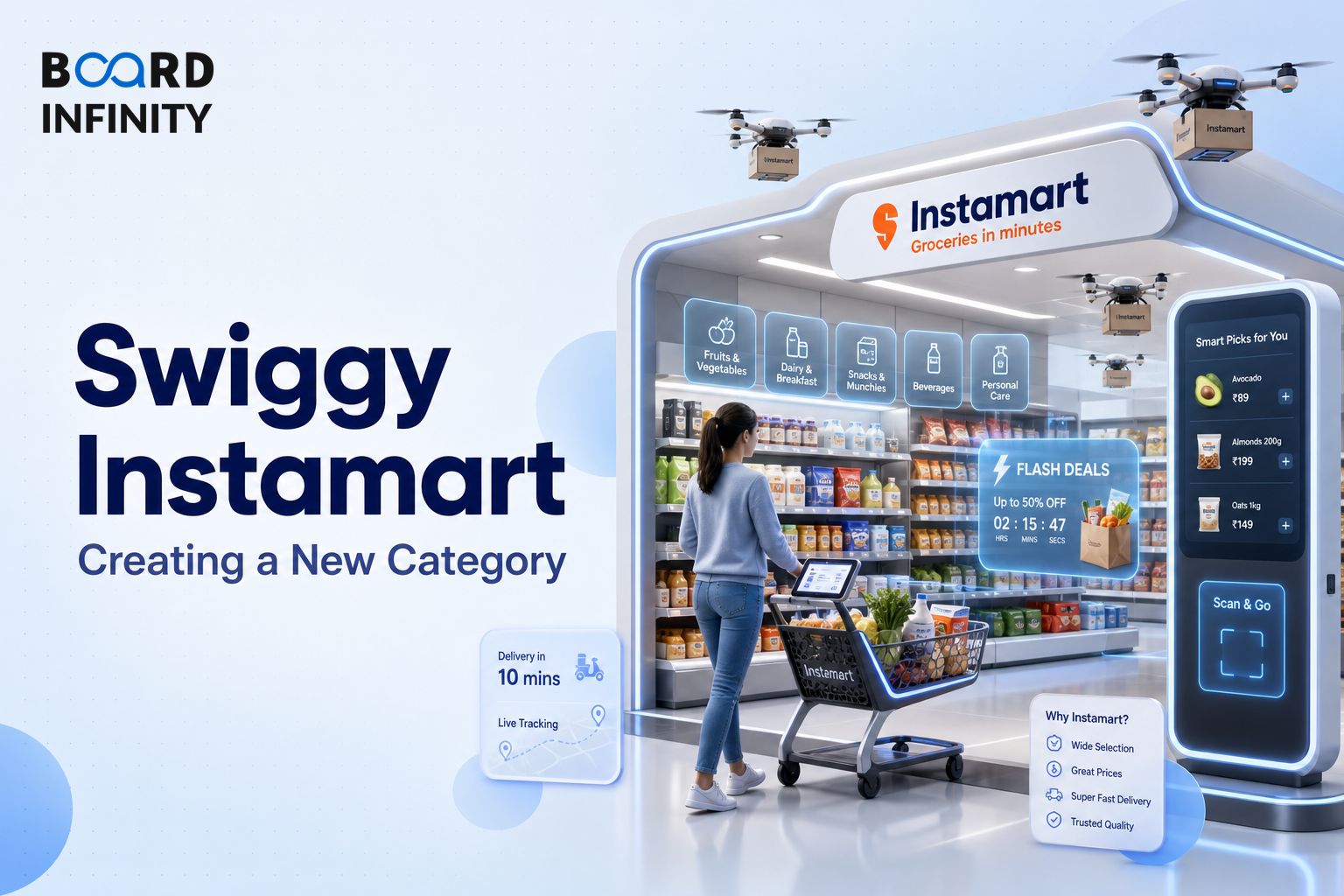
Zomato's Marketing showed how consistent, authentic brand voice can compound into a moat when a market feels commoditised. Swiggy Instamart answers a different interview question: how do you create demand for a behavior that didn't exist? This matters in interviews because it turns a campaign breakdown into a sequencing playbook for building a new consumer category.
- Swiggy launched Instamart in 2020 - its quick-commerce vertical promising grocery delivery in 15-30 minutes.
- The challenge was clear: how do you create demand for a behavior that didn't exist?
- The strategy was Behavioral Habit Creation across four phases: Launch, Habit Formation, Category Expansion, and Profitability Push.
- Swiggy first solved an acute need - the pandemic made instant delivery essential - before trying to expand the use case.
- Average Instamart user orders 3-4 times/week - comparable to subscription models.
- Quick commerce went from zero to a $5B+ market in India in under 4 years.
- The key lesson: trying to be profitable on Day 1 in a new category kills growth.
Company Context
Swiggy launched Instamart in 2020 - its quick-commerce vertical promising grocery delivery in 15-30 minutes. The challenge: how do you create demand for a behavior that didn't exist?
The big picture is a four-phase approach: solve an acute need first, build the habit, expand the use case, and then optimise economics.
Creating a new category requires a 4-phase approach: solve an acute need first - build the habit - expand the use case - then optimise economics.
Strategy: Behavioral Habit Creation
Swiggy Instamart's playbook is a masterclass in sequencing. The launch did not begin with a broad promise; it began by solving an acute need, where the pandemic made instant delivery essential.
Once users entered the category, the next phase was to build the 'Instamart habit' - make it easier than going to the kirana store. The tactics matched the habit goal: promise of 15-min delivery, app notifications for restocking reminders, and subscription pass with free delivery.
From Essentials to the Everything Store
After Habit Formation, the strategy moved beyond essentials to become the 'everything store'. Swiggy Instamart added electronics, beauty, pet care, late-night delivery, office supplies, and party essentials.
This changed the metrics focus from only new user acquisition and order frequency to AOV, SKU expansion, and category attach rate. The use case became broader only after the user behavior had started forming.
Profitability Push
In 2023-24, Swiggy Instamart shifted from growth-at-all-cost to unit economics. The tactics were reduced discounting, introduced Instamart Plus at ₹49/month, pushed private labels, and optimised dark store operations.
The metrics focus also changed to contribution margin and delivery cost per order. The sequencing matters: profitability came after the acute need was solved, the habit was built, and the use case was expanded.
Results
- Swiggy Instamart grew to ~₹5,000 Cr+ annualised GOV by FY24, making it one of the top 3 quick-commerce players in India.
- User behavior shift: Average Instamart user orders 3-4 times/week - comparable to subscription models.
- Category creation: Quick commerce went from zero to a $5B+ market in India in under 4 years.
Worked Example: Swiggy Instamart
The situation was that Swiggy launched Instamart in 2020 as a quick-commerce vertical promising grocery delivery in 15-30 minutes. The problem was how to create demand for a behavior that didn't exist.
The framework was Behavioral Habit Creation. Swiggy first solved an acute need with free delivery for first 3 orders, ₹100 off for new users, and focus on essentials. It then built the Instamart habit through 15-min delivery, restocking reminders, and a subscription pass, before expanding into electronics, beauty, pet care, late-night delivery, office supplies, and party essentials.
The outcome was that Swiggy Instamart grew to ~₹5,000 Cr+ annualised GOV by FY24, while the average Instamart user orders 3-4 times/week. The learning is that category creation depends on the right order of decisions, not just one aggressive launch tactic.
Structuring a Swiggy Instamart Interview Answer
"Swiggy launched Instamart in 2020. How did it create demand for a behavior that didn't exist?"
Do not jump straight to profitability. The strongest answer shows why trying to be profitable on Day 1 in a new category kills growth.
Conclusion
Swiggy Instamart is best understood as a sequencing playbook for category creation: solve an acute need, build the habit, expand the use case, and only then optimise economics. That is why its playbook matters for campaign, growth, and strategy interviews.
The most common mistake is treating Swiggy Instamart as only a discounting story or only a profitability story. That misses the key lesson: creating a new category requires the right sequence, and trying to be profitable on Day 1 in a new category kills growth.