Every recruiter sets a different test
TCS NQT runs 165 minutes across cognitive, programming logic and two coding questions. HackWithInfy is three hours of pure DSA. A single generic mock prepares a student for neither.
Flagship placement-readiness system
195 offline hours of company-specific preparation, built around the exact test each recruiter sets - and run on the same software your placement drive runs on.
One partner campus · B.Tech CSE · batch of 412
195 hours across seven modules
Product trackCoding round pass rate
▲ +46 pts








Approved by the bodies that govern skilling in India - and chosen by 150+ institutions to own their placement number.
 CII Approved Industry partner to deliver courses with academic credits
 Approved skilling partner by the National Skill Development Corporation
 Approved by the National Association of Software and Service Companies
TCS NQT runs 165 minutes across cognitive, programming logic and two coding questions. HackWithInfy is three hours of pure DSA. A single generic mock prepares a student for neither.
Test-case coverage, time and space complexity, edge cases. A student whose answer runs can still score badly, and usually never finds out why.
The top decile places itself. A batch's placement percentage is decided by the students nobody tracked week to week.
Open any module for its full topic list and the hours it carries on each track.
Syntax, control flow, functions, recursion, file handling and debugging - the ground a DSA track assumes is already solid.
View topicsArrays, strings, linked lists, stacks, queues, searching and sorting, drilled against timed exam-format sets from the first week.
View topicsTrees, heaps, graphs, recursion and dynamic programming, at medium to advanced difficulty with more than one approach per problem.
View topicsLow-level and high-level design, patterns, scale and trade-off reasoning. The module that separates salary bands.
View topicsOperating systems, DBMS, computer networks and OOP - the objective section of almost every service-based test, and the first technical round.
View topicsGD formats, HR and behavioural rounds, resume and elevator pitch, and mock interviews that come back with a score rather than an opinion.
View topicsQuantitative aptitude, data interpretation, logical reasoning and verbal ability, taught to the sectional cut-offs each recruiter applies.
View topicsThe full syllabus, not a summary. Hours shown are for the product-based track; the delivery section below carries the full split for both tracks.
The service track runs this as a full refresher. The product track keeps the same ten hours but spends them on debugging and clean code, since the basics are assumed.
Topics covered
The largest single block on the product track. Twenty extra hours there buy a much larger problem count rather than new topics.
Topics covered
Where a HackWithInfy or a product-company interview is won or lost. Same hours on both tracks; the difficulty ceiling is what changes.
Topics covered
Product track only. Service-based recruiters do not test it at entry level, so the service track spends those hours on aptitude and interview craft instead.
Topics covered
Almost every service-based test has an MCQ block drawn from here, and it is the first thing a technical panel probes.
Topics covered
Run as workshops, then scored on Infy Interview Coach. The service track carries double the hours because service-based recruiters weight communication heavily.
Topics covered
Includes the game-based formats Capgemini and Accenture use, which students almost never see before test day.
Topics covered
Not a generic syllabus. Pick a recruiter and you get their paper as a candidate meets it: how long it runs, which sections come in what order, the score that clears each role, and the rubric the code is marked against. Every pattern is re-verified before the season opens and loaded into the question bank on Infy Assess.
What it takes to clear
Ninja needs 60-70% overall, or one fully correct code with high aptitude accuracy. Digital needs two correct codes plus 70-80% in the advanced sections. Prime needs exceptional online performance and an advanced technical interview.
What the code is marked on
What it takes to clear
L1 (10 LPA) takes one hard plus one medium. L2 (16 LPA) takes one complex plus one medium. L3 (21 LPA) takes one complex, one hard and one easy or medium. The top 100 performers get a direct Specialist Programmer interview.
What the code is marked on
What it takes to clear
60-70% across all rounds, or one fully correct code carried by good English and strong game-based logic.
What the code is marked on
What it takes to clear
Turbo (6.5 LPA) and Elite (4.5 LPA) both take 70%+ with one full correct code, or 60-65% carried by strong aptitude.
What the code is marked on
What it takes to clear
One correct code, clear communication and sound logical reasoning.
What the code is marked on
What it takes to clear
One full solution, or one partial plus one near-complete solution, to qualify.
What the code is marked on
Training, assessment, interview practice and the campus drive itself all run on software Board Infinity builds and operates in-house. The scores that come out of the programme and the offers that come out of the season sit in one database, not four vendors' spreadsheets.
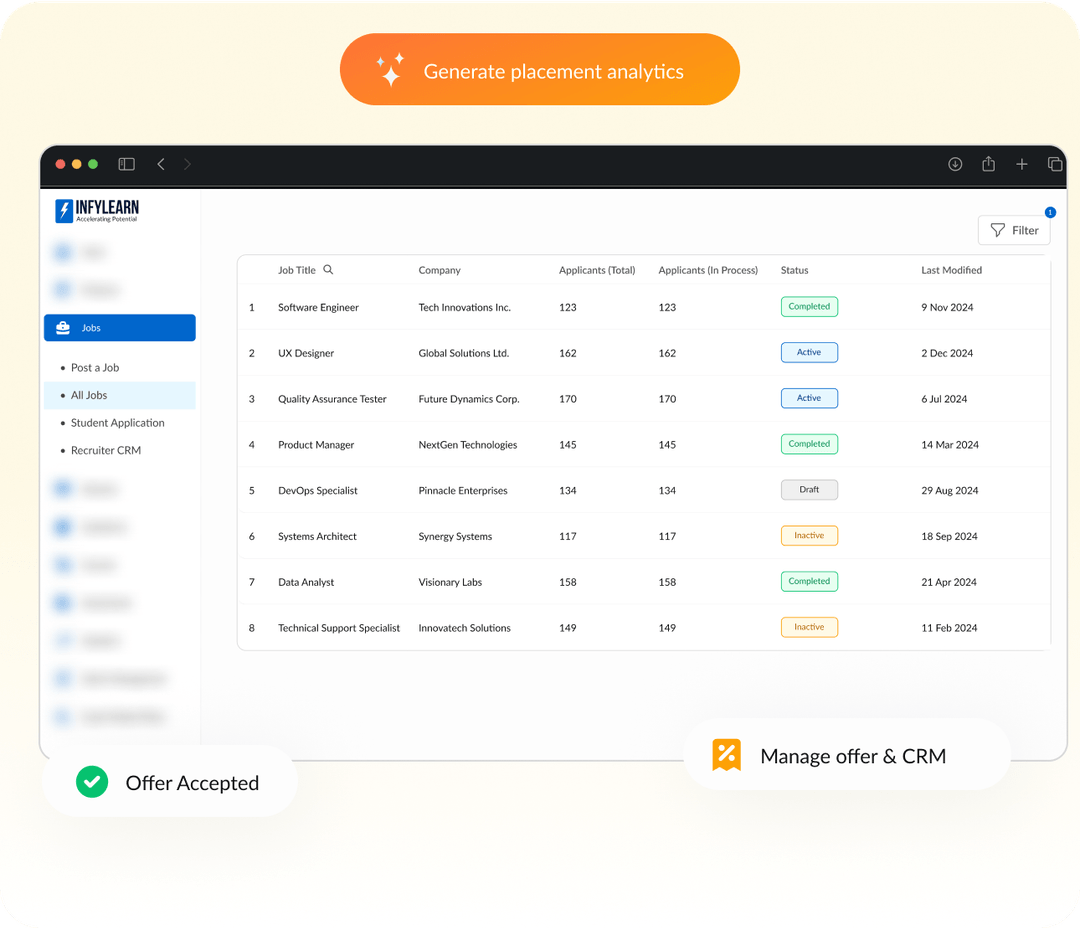
Infy Recruit - job management and recruiter CRM, live product
The drive itself. Jobs, applications, shortlists, interviews and offers in one place.
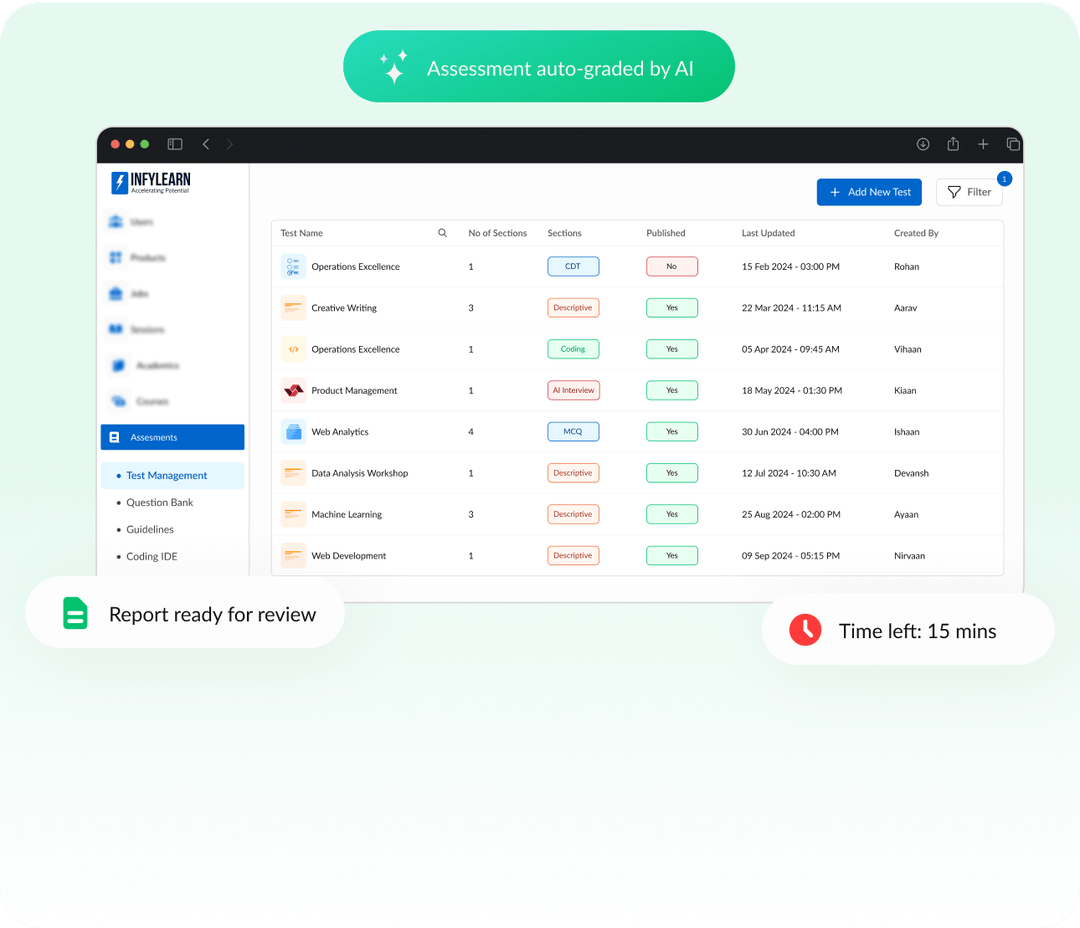
Infy Assess - test management, live product
Every company-pattern mock, coding round and cut-off check on this programme runs here.
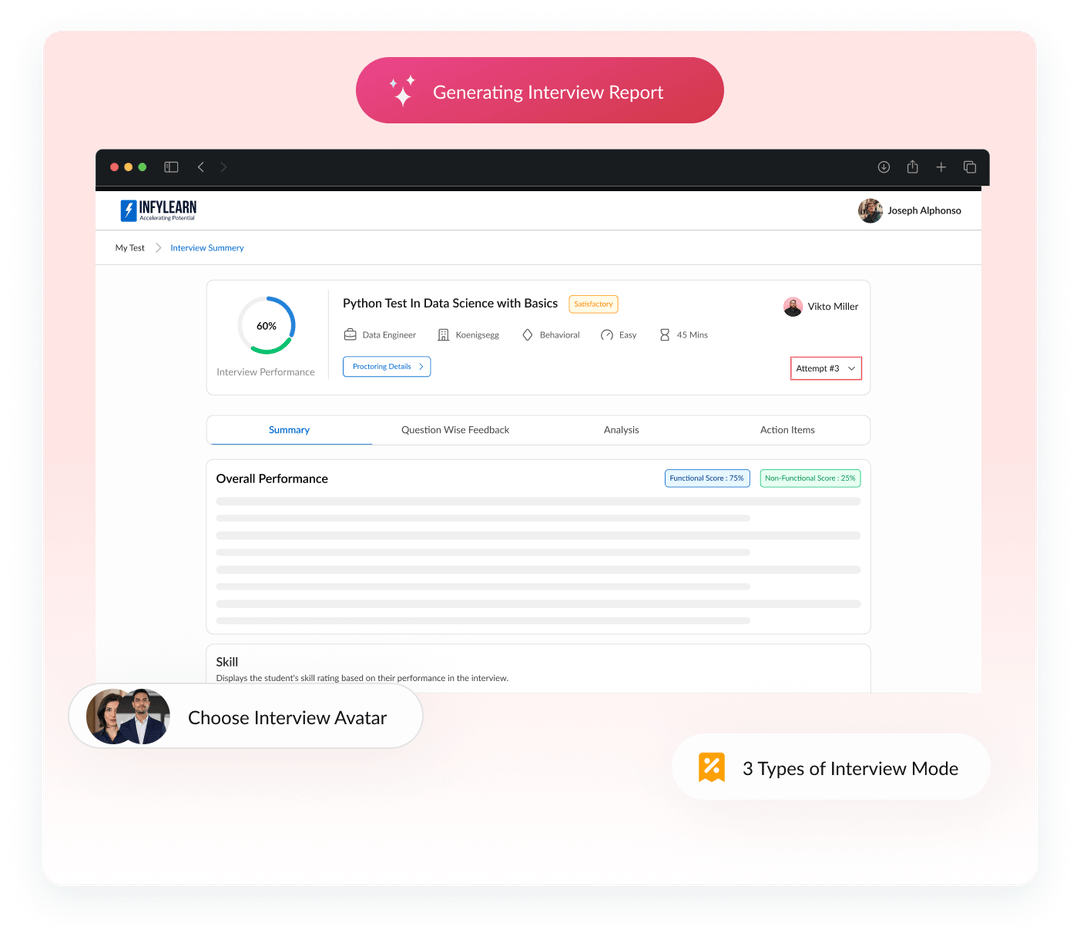
Infy Interview Coach - interview summary, live product
Where GD and interview practice stops being subjective and starts being scored.
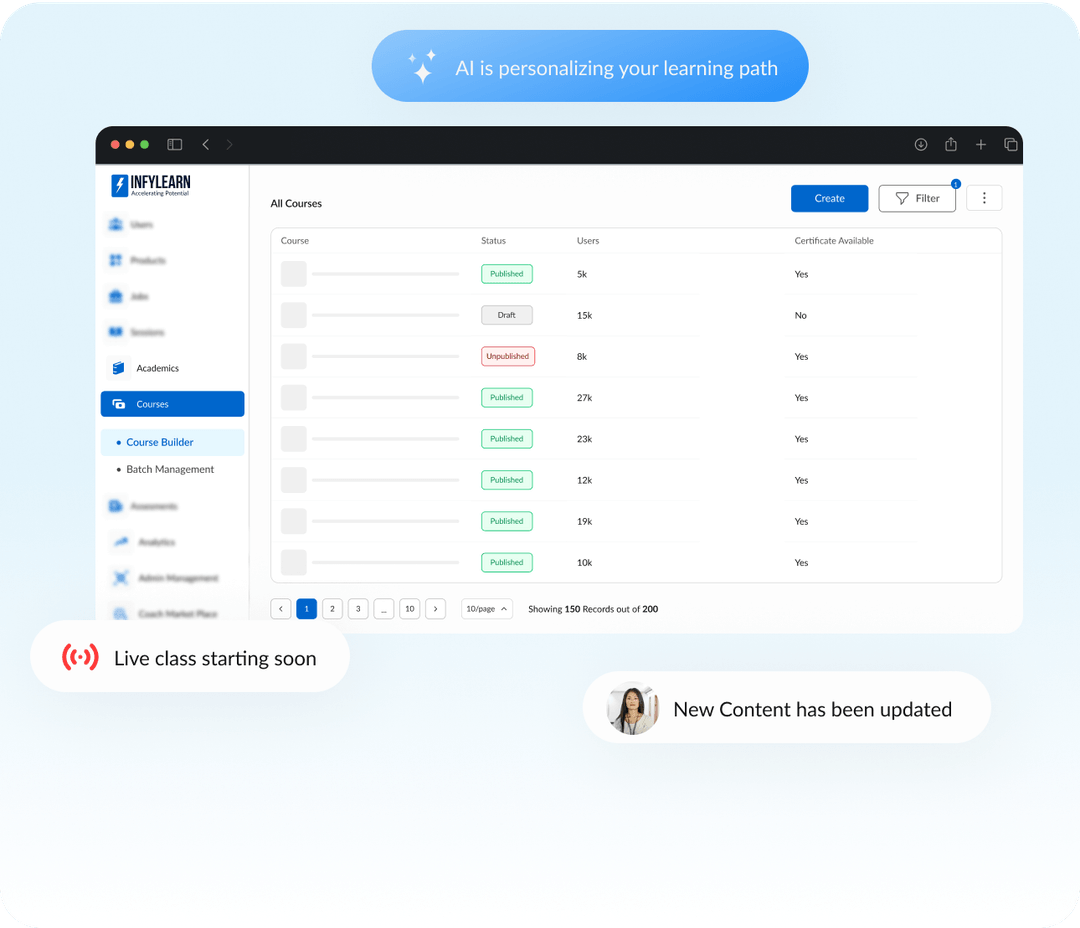
Infy LMS - course management, live product
The 150 self-paced hours, the practice bank and the attendance record.
The recruiter's test is proctored, timed and machine-marked. The drive is a workflow. We run both.
This is the difference between a trainer on a timetable and a programme that moves a batch's numbers. All eight are in the base commercials.
Every class taught on campus by a trainer with 5+ years of teaching experience.
Topic-tagged, so a student weak in Percentages drills Percentages, not a mixed set.
Produced in-house, so students revise from the same source their trainer taught from.
White-labelled to your institution and live for a full year after classes end.
Under exam conditions on Infy Assess - the reason readiness is a measurement.
Leaderboards and recognition - the cheapest intervention we know for holding attendance.
Extra sessions for students the data flags as at-risk. Included, not billed separately.
Batch, section and student readiness in one dashboard, plus a termly written report.
Commercials cover offline training, all assessments, learning material and twelve months of platform access. Trainer scheduling assumes a minimum of six hours per trainer per day.
Offers before and after Board Infinity ran the training. The institutions are unnamed because the agreements are; these are the figures we report to their boards.
A two-year B.Tech partnership from September 2023. Phase one worked the final year: a semester-long technical programme in the 6th, then a ten-day TCS-specific bootcamp in the 7th. Phase two moved upstream into the 3rd and 4th year with DSA and competitive programming, which is where the second jump came from.
Students placed in TCS per year. Board Infinity now runs training for the whole university - MBA, MCA, Pharmacy, Law and Forensic Science included.
A credit-based curriculum integrating technical, aptitude and soft skills, with a three-month DSA programme aimed squarely at AMCAT and HackWithInfy scores. 152 students from the cohort were eligible, and the placement cell projected close to half would convert an Infosys interview call.
Total conversions across the Infosys Specialist Programmer and Power Programmer tracks.
Focused placement training for the top 200 students, with a deliberate strategy around roles paying six lakh and above rather than raw offer count. The effect did not stay inside the cohort.
61% of alpha-cohort offers landed in the target bracket, and the wider batch nearly doubled its share.
A live dashboard through the season, and a written report at the end of it - built so your placement cell can take it into a board review without rewriting a line.
 Term report · 2026–27
B.Tech CSE · Batch of 2027 · Campus Recruitment Training
All three sit inside your academic calendar, are taught offline on campus, and are backed by a self-paced library and a proctored assessment bank.
For cohorts chasing TCS, Infosys, Wipro, Accenture, Capgemini and Cognizant. Carries a full programming refresher.
Concept clarity with selective practice, mostly easy to medium difficulty. One to two semesters, final year.
For cohorts chasing product companies and higher bands. Assumes the basics, adds system design and 20 more DSA hours.
Medium to advanced difficulty, heavy on optimisation and multiple approaches. Deeper time on recursion, trees, graphs and DP.
For management cohorts heading into consulting, finance, marketing, operations and product roles.
Sessions run 30 to 120 minutes depending on format. Company-specific sessions are added on demand.
What we would put in front of your academic council. Offline hours by module for each engineering track, with the assessment counts behind them.
| Module | Service track | Product track | Practice | Graded |
|---|---|---|---|---|
| Programming refresher / fundamentals & debugging | 10 h | 10 h | 10 | 5 |
| DSA - Basic | 30 h | 50 h | 20-30 | 5 |
| DSA - Core & Advanced | 40 h | 40 h | 15-20 | 5 |
| System Design (LLD & HLD) | – | 25 h | 5 | 5 |
| Computer Science Core (OS, DBMS, CN, OOPs) | 20 h | 30 h | 10 | 5 |
| Soft Skills, Communication & Interview Prep | 40 h | 20 h | 5 | 5 |
| Aptitude Skills & Problem Solving | 40 h | 20 h | 5-20 | 5 |
| Total offline teaching, plus 150+ self-paced hours | 180 h | 195 h | 80-85 | 30-35 |
Commercials include offline training, all assessments, learning material and twelve months of platform access. Request a proposal for costing against your batch count and track mix.
Institutions usually run this after, or alongside, one or two of the following - same calendar, same platform, same dashboard.
The 110-hour foundation from semester one. Quant, reasoning, verbal and communication, long before company-specific prep begins.
ExploreDomain depth for management cohorts. Finance, marketing, HR, operations, business analytics and product management.
ExploreApplied AI fluency for every career track. Prompting, AI tools for productivity, responsible AI and domain use cases.
ExploreTopper batches trained deep. Selected on a proctored pre-assessment, then 200+ hours against 5,000+ coding problems.
ExploreA training vendor gives you hours and attendance. We own the whole chain - the trainers, the content, the assessment engine, the AI interview platform and the campus-hiring software the drive runs on. Readiness is measured under proctored conditions and the offer data lands in the same system, so nobody has to reconcile four suppliers' numbers at the end of the season.
Yes, on Infy Assess. AI image and video proctoring flags multiple faces in frame, a student leaving the frame, gaze deviation and tab switching, with violations tracked live. The same proctoring is built into the AI mock interviews on Infy Interview Coach.
Readiness by recruiter, module-level scores by section and branch, a coding-quality trend that follows test-case coverage and complexity rather than pass or fail, an automatic at-risk register, and the live drive funnel from Infy Recruit - applications, shortlists, offers and salary bands. Plus a written report at the end of the season.
Accredited and approved by CII as an industry partner for academic credits, an NCVET-approved awarding body, and an approved partner of NSDC and NASSCOM. We are also an ILO partner on labour initiatives and a global Coursera instructor partner.
Six tests are mapped in full on this page: TCS NQT, Infosys HackWithInfy, Capgemini, Wipro Turbo and Elite, Accenture and Cisco. Cognizant, LTIMindtree, Tech Mahindra, HCLTech, IBM, Oracle and SAP are mapped for engineering cohorts, and Deloitte, EY, KPMG, PwC, Accenture Strategy, ZS Associates and EXL for management cohorts. If your top recruiters are not on that list, we build the pattern before the season opens.
No. The training stands on its own and plenty of institutions run it against their existing placement process. But when the drive runs on Infy Recruit, the training scores and the offer outcomes sit in one database - which is the only way to answer “did the training move the number” without stitching spreadsheets together.
Yes, and most institutions should. We split the cohort on a proctored diagnostic: students clearing the higher bar go onto the product track with system design and deeper DSA, the rest onto the service track with a full programming refresher. Both tracks share the aptitude, soft skills and interview modules, so the timetable stays manageable.
The PG and MBA last-mile track covers them. Twenty-four activities spanning resume and interview workshops, one-to-one reviews, mock GDs, five domain bootcamps, Advanced Excel and Tableau or Power BI, plus proctored aptitude, domain and psychometric testing on the LMS.
Earlier than most institutions run it. The Indore engagement moved from 153 placements to 241 precisely by pushing DSA and competitive programming down into the 3rd and 4th year instead of compressing everything into a final-semester bootcamp. One semester is remediation; two or three years is preparation.
They are the figures we report to those institutions' own boards, and the same numbers appear on the Board Infinity homepage. The institutions are unnamed here because the agreements are. We will name them, with their permission, on a call.
Tell us your cohort size, your top recruiters and your placement calendar. We come back with a track split, an hour allocation, a season timetable and commercials - usually within three working days.
For placement cells, deans and training coordinators.
A Board Infinity consultant will come back to you within three working days with a proposed plan and commercials.