Placement & training teams: 2026–27 campus calendars are being locked now. Request a proposal →

The employer side

Placement support
that fills the calendar.

A prepared batch still under-places if the right recruiters never arrive. This is the demand side: structured company outreach across 100+ hiring partners, hiring-market intelligence on who is actually recruiting your profiles this season, job descriptions matched to your cohort's readiness data - and the drive itself run end to end, from the eligibility list to the digital offer letter.

150+Institutions
15+IIMs & IITs
45+Top-100 NIRF
1 million+Careers Impacted
Institutions we deliver for

The credentials a placement committee checks first.

Approved by the bodies that govern skilling in India - and chosen by 150+ institutions to own their placement number.

CIICII Approved Industry partner to deliver courses with academic credits
NSDCApproved skilling partner by the National Skill Development Corporation
NASSCOMApproved by the National Association of Software and Service Companies
Why a prepared batch under-places

Three reasons the problem is pipeline, not preparation

Readiness is supply. Placement is demand.

Every other service on this site improves the batch. None of them puts a recruiter in your auditorium. A cohort can be genuinely well-prepared and still under-place, and when that happens the training is not the thing that failed.

Outreach is a full-time job that only exists for four months

A placement cell of two or three people cannot open new recruiters in September while running the drives already booked for October. So outreach becomes whatever is left after operations, which in a season is nothing.

Anchor recruiters shrink quietly

Three companies that took forty students each last year take twelve this year. Without hiring-market intelligence, an institution finds that out from its own results in December rather than from the market in June, when there was still time to replace them.

What we run

Eight workstreams, and six of them happen before a drive is booked.

Placement support is mostly invisible work done months early. The visible day is the easiest part of it.

Employer outreach

Managed outbound to recruiters relevant to your programmes, with positioning collateral written for your institution rather than a generic Board Infinity deck. Every approach is logged, so next season starts from a list rather than from memory.

Hiring-manager connects

Introductions into the 100+ companies already in our hiring network, for campus drives and for off-campus pools. Your own anchor recruiters stay entirely yours - this is about the ones you have never had a conversation with.

Hiring-market intelligence

Season-wise reads on which companies are hiring which profiles, at what volume, with what test pattern. It is the input that decides where outreach goes, and the reason a shrinking anchor recruiter is visible in June rather than December.

JD sourcing and matching

Roles sourced and then matched against your cohort's actual readiness data - who clears which cut-off, who fits which role family. A drive that your batch cannot convert costs a slot in the calendar and a relationship.

Drive management on Infy Recruit

Jobs, eligibility rules, applications, shortlists, interview scheduling, offers and digital offer letters in one white-labelled system - your institution's brand on the whole experience, and one database instead of four vendors' spreadsheets.

Placement-day operations

The unglamorous half: rooms, connectivity, assessment links and backups, panel confirmation, invigilation, slot issue, a live status board, and offer capture before the recruiter leaves the campus.

Placement dashboard and season reporting

A live funnel through the season, then a written season report: recruiter-wise summary, programme and branch split, new versus repeat recruiters, and the unplaced register - assembled so it can go into a board review or an accreditation visit unedited.

Off-campus and pooled drives

Not every recruiter will visit every campus. Pooled and virtual drives put your students in front of companies whose hiring volume would never justify a single-campus visit, which is where late-season placements usually come from.

The placement year

Four windows, and only one of them is the season

Placement cells are staffed for September to December and judged on it. The work that decides those four months happens in the other eight, which is the part we are actually being bought for.

Off-season · April to June

The quarter that decides the season. Nobody is running a drive, which is exactly why this is when the pipeline gets built and last year gets taken apart honestly.

6workstreams live

What runs in this window

  • ReviewLast season's post-mortemRecruiter by recruiter: who grew, who shrank, who did not come back and why
  • IntelHiring-market readWhich companies are hiring which profiles this year, at what volume and on what test pattern
  • ListTarget list builtMatched to your programmes and branch mix, not to our network's convenience
  • CollateralInstitution positioning packPlacement record, cohort profile, readiness data - written for your institution to send
  • OutreachNew-recruiter outbound opensThe long-lead conversations, started early enough that a September answer is still useful
  • PlanDraft drive calendarSequenced so your marquee recruiters are not competing with each other for the same week

Pre-season · July to August

Turning interest into confirmed dates, and making sure every confirmed date is one your batch can actually convert.

6workstreams live

What runs in this window

  • JDJob descriptions sourcedRole, eligibility, CTC band, process and timeline captured in a comparable format
  • MatchJD to readiness matchingCohort assessment data against each role's cut-off, so a mismatch is caught before it is booked
  • LockDrive calendar lockedDates, slots and sequence agreed with your cell and confirmed with each recruiter
  • BriefRecruiter briefingsWhat this cohort has been trained on, and what the readiness data actually says
  • SetupInfy Recruit configuredWhite-labelled to your institution, eligibility rules loaded, admin roles assigned
  • CommsStudent communication planEligibility, timelines and applications, so no student misses a drive for an inbox reason

In-season · September to December

Operations. Four months in which the only thing that matters is that every booked drive runs cleanly and every offer is captured.

6workstreams live

What runs in this window

  • OpsDrive-day operationsRooms, connectivity, assessment links, backups, panels, invigilation, slot issue
  • AssessAssessments and shortlistsCompany-pattern papers on Infy Assess, proctored, shortlists published the same day
  • SchedInterview schedulingPanel rounds sequenced and tracked live, so a delayed panel does not lose the afternoon
  • OfferOffer captureOffers and digital offer letters recorded before the recruiter leaves campus
  • ReviewWeekly funnel reviewWith your cell: what converted, what stalled, what the next fortnight needs
  • FillReplacement outreachWhen a booked drive falls through, the calendar gap gets worked the same week

Late season · January to March

The part most seasons run out of energy for, and where the unplaced register either gets closed or does not.

6workstreams live

What runs in this window

  • PoolOff-campus and pooled drivesCompanies whose volume would never justify a single-campus visit
  • PushUnplaced-student pushThe register worked name by name, against roles that actually match each profile
  • ReconOffer reconciliationAccepted, declined, retracted, multiple offers - reconciled to a defensible final number
  • ReportSeason reportFunnel, recruiter-wise summary, branch split, new versus repeat, unplaced register
  • PackBoard and accreditation packThe same data assembled for a governing body, NIRF or NAAC without a rewrite
  • HandoverRelationship handoverContact history stays in the recruiter CRM, so it survives a change of placement officer
Where the offers come from

Six hiring sectors, and each one is worked differently.

A single outreach motion aimed at “companies” gets you more of the recruiters you already have. These six behave nothing alike - in intake size, in how far ahead they commit, and in what actually persuades them - so each gets its own list, its own timing and its own pitch.

IT services and global capability centres

7 role families · The largest single source of engineering offers, and the most process-driven to work with
Software EngineerSystems EngineerData EngineerCloud & DevOps AssociateQA EngineerApplication Support EngineerSpecialist Programmer

How this sector is worked Volume hiring on published test patterns, so a drive is winnable on preparation alone - and bookable a season ahead.

Consulting and professional services

6 role families · Small intakes, long processes, and the offers a placement record is judged on
AnalystAssociate ConsultantRisk & Assurance AssociateTax & Audit AssociateTechnology ConsultantTransaction Services Associate

How this sector is worked Won on cohort quality rather than cohort size. Outreach here is a two-year relationship, not a season's email.

Banking, financial services and insurance

6 role families · Where a strong finance cohort converts at CTCs that move a median
Investment Banking AnalystEquity Research AssociateCredit AnalystOperations AnalystRisk AnalystRelationship Manager

How this sector is worked Highly profile-sensitive: the JD-to-readiness match matters more here than anywhere else on this list.

FMCG and consumer

6 role families · The classic management-trainee route, and the most competitive calendar to get onto
Management TraineeTerritory Sales OfficerBrand ExecutiveCategory AnalystSupply Chain AnalystTrade Marketing Executive

How this sector is worked Slots are decided months early and rarely reopen, which is exactly why this sector is worked off-season.

Manufacturing, automotive and infrastructure

6 role families · The sector most core-engineering batches are trained for and least often placed into
Graduate Engineer TraineeProduction EngineerDesign & CAD EngineerSite & Planning EngineerQuality EngineerPlant Operations Engineer

How this sector is worked Under-served on most campuses because it needs discipline-specific outreach rather than one generic approach.

Analytics, research and data

6 role families · The fastest-growing intake, and the one that will hire from any discipline that can defend a number
Business AnalystData AnalystResearch AssociateInsights AnalystBI DeveloperProcess Analyst

How this sector is worked Opens a route for branches with no traditional recruiter of their own, which is usually where the biggest gain sits.

No recruiter names on this page, deliberately. On a page about our own hiring network, a list of company logos would read as a claim that those companies are Board Infinity partners. The actual partner list, and which of them already recruit at institutions like yours, comes with the proposal - named, and under NDA.

The difference

Most vendors hand you a list of contacts.
A season is a system, not a list.

Introductions are the easy half and they decay the moment the person who made them moves on. What survives is the record: which company was approached, by whom, what they said, what they were sent, what their students scored, and what they did the following year. That is software, and we build and operate ours in-house.

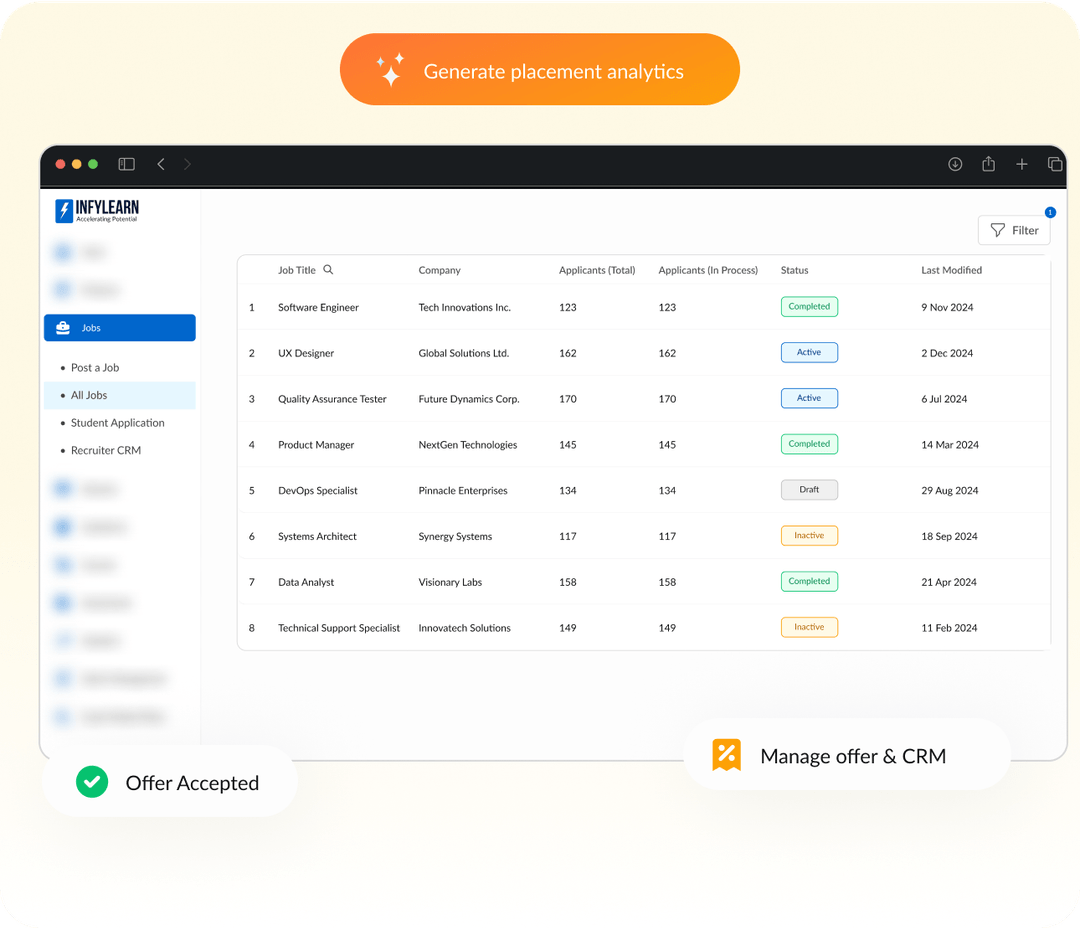
Infy Recruit - campus placement management, live product

Infy Recruit - campus placement management, live product

Where the drive actually runs

Infy Recruit

A placement season is a workflow with a hundred moving parts and a hard deadline. Run on spreadsheets it survives on one person's memory, and that person eventually changes job.

  • Centralised job management - post and manage every campus opportunity with structured criteria, eligibility rules, hiring stages and visibility controls
  • Application progress tracking - real-time across applications, shortlisting, interviews and offers, filterable and downloadable at any point
  • Real-time drive dashboards - offers, conversion rates and CTC trends, plus the one that actually gets used mid-season: exactly where the funnel is stalling
  • Recruiter CRM with history - a contact database with every conversation attached, so a relationship survives a change of placement officer
Also handles digital offer letters and acceptances, pre-application screening questions, role-based admin for your officers and for external recruiters, and bulk Excel or CSV export. White-labelled, so your institution fronts the whole experience.
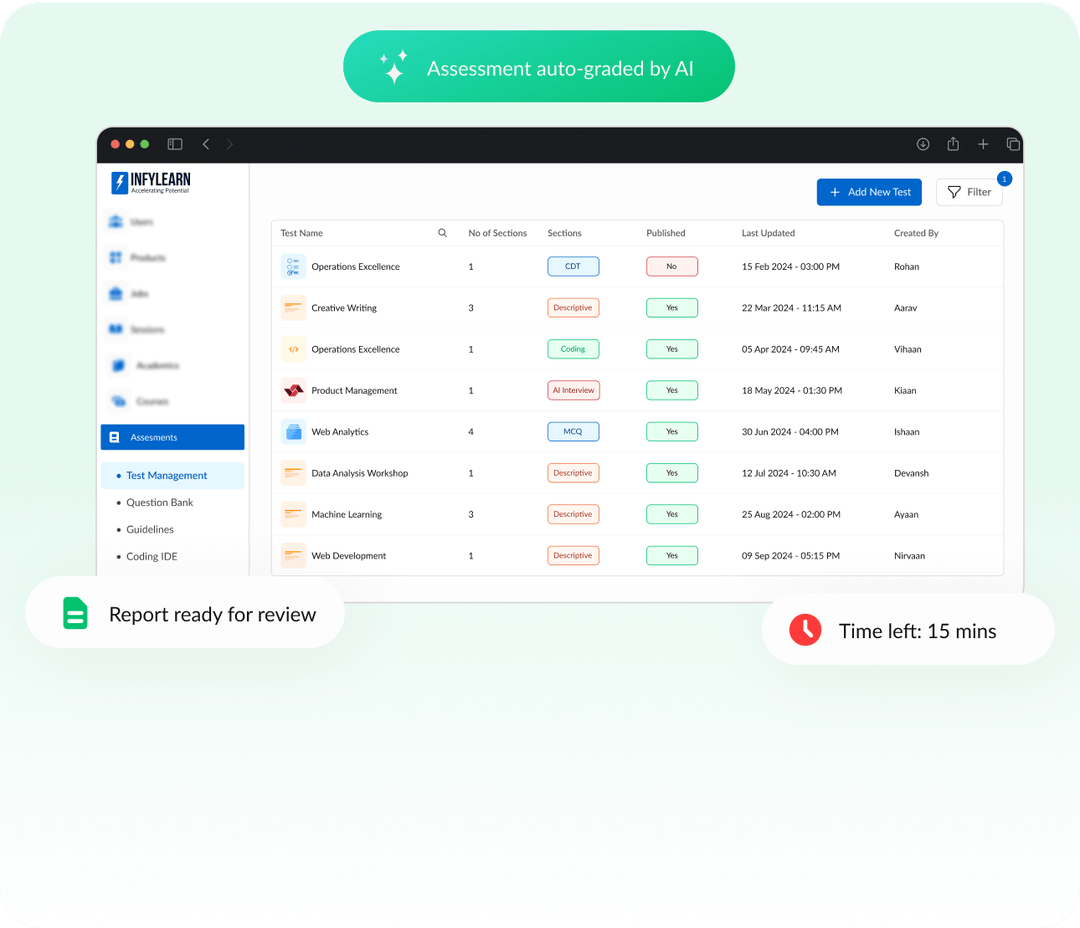
Infy Assess - assessment platform with AI proctoring, live product

Infy Assess - assessment platform with AI proctoring, live product

Why the shortlist is trusted

Infy Assess

Outreach gets a recruiter to come once. What gets them to come back is a shortlist that holds up against their own process.

  • Company-pattern papers - each recruiter's own structure, timing and negative marking, generated per student from a tagged bank
  • AI image and video proctoring - multiple faces, absence from frame, gaze deviation and tab switching, all flagged and logged for review
  • Real-time coding lab - live editor, multi-language, test-case validation and auto-evaluation, scored on correctness and complexity
  • Cohort benchmarking - per-student and cohort percentiles against the cut-offs a recruiter actually sets, which is what makes a JD match real
This is the layer that lets us tell a hiring manager what a cohort will convert at before they commit a slot - and be right often enough that they book the next season.

Why it matters on the demand side

A recruiter relationship is an institutional asset. Most campuses hold theirs in one person's inbox.

  • Every approach, reply and drive sits in a recruiter CRM you keep, so the relationship outlives the officer who built it.
  • Readiness data and offer data are in one database, which is the only way a JD-to-cohort match can be checked rather than asserted.
  • The season is auditable end to end - the number you report to a board is reconstructable line by line.
Included in every engagement

Eight things that are not add-ons

Placement support is the service where the change requests usually live. These eight are in the base commercials, so the season does not turn into a negotiation.

01

A named partner manager

One person accountable for your season end to end, who your placement cell can call. Not a ticket queue and not a different face each month.

02

Positioning collateral, refreshed yearly

Rewritten every season against your latest placement record and cohort data, so what goes out to a recruiter is current rather than last year's deck.

03

Weekly funnel reviews in season

A standing meeting with your cell through September to December: what converted, what stalled, what the next fortnight needs. Included, not billed as consulting.

04

Drive-day operations staffing

Our people on campus on drive days - rooms, connectivity, invigilation, slot issue, panel wrangling - rather than a process document handed to your two-person cell.

05

Proctored assessments for every drive

Company-pattern papers on Infy Assess with AI proctoring on every drive we run, at no per-test charge. It is what makes the shortlist defensible to the recruiter.

06

The recruiter CRM, and it is yours

Every approach, reply and drive logged in your white-labelled instance, exportable to Excel or CSV whenever you want, and it stays with you when the engagement ends.

07

Season report and board pack

The written season report plus the same data assembled for a governing body, NIRF or NAAC - with the evidence trail attached, so nothing has to be reconstructed later.

08

Replacement outreach when a drive falls through

A cancelled drive is a hole in your calendar, and working it is part of the engagement rather than a change request. Cancellations are reported, not quietly absorbed.

Commercials cover outreach, intelligence, drive operations, assessments and reporting for the scope agreed. Recruiter travel, hospitality and any venue costs are yours, billed at actuals and never through us.

The outreach motion

How a company goes from never heard of you to a confirmed date.

Six steps, in order, every time. The reason to write them out is that “we have relationships” is what every placement vendor says, and it is not a process anybody can hold you to.

01

Positioning collateral, about your institution

Not a Board Infinity deck with your logo on it. Placement record, cohort profile, branch mix, the readiness data the batch has actually produced, and what a recruiter gets by coming - written so your placement cell can send it under its own name.

Yours to send
02

A target list built from your programmes

Drawn from the hiring-market read, then filtered to what your batch can convert: the right sectors, the right intake sizes, the right test patterns. A list of impressive logos your students cannot clear is worse than no list.

Matched, not maximal
03

Structured outbound, and every touch logged

Sequenced approaches into the target list, through our own hiring network where we have a relationship and cold where we do not. Logged in the recruiter CRM, so a no this year is a warm start next year rather than a forgotten email.

Logged in the CRM
04

The hiring-manager conversation

Where introductions stop being contacts. What this cohort was trained on, what the assessment data says it will convert at, and which of their roles it fits - a specific conversation, which is the only kind that produces a date.

100+ partner network
05

JD to cohort match, before the slot is booked

The role's cut-off against your cohort's actual scores. If the match is weak we say so and either reshape the role or decline the slot, because a drive your batch cannot convert costs you a calendar week and costs the recruiter a season's goodwill.

Checked, not assumed
06

It lands in your calendar and in Infy Recruit

Confirmed date, eligibility rules, application window, panel plan and student communication, configured in the system your cell already runs the season on. The handoff from outreach to operations is a database record, not a forwarded email.

One system of record
Placement-day operations

A drive is won or lost on logistics nobody writes down.

This is the run sheet, because it is the part of the service a placement cell can check us against. A recruiter does not decide whether to come back on the basis of your training programme - they decide it on whether the day was competent.

T−7 days

The list stops moving

Eligibility list locked and published, students notified with the process and the timeline, panels confirmed in writing, assessment configured and dry-run in Infy Assess.

T−1 day

Everything that can fail is tested

Rooms and seating, network and a backup connection, assessment links and credentials, invigilator briefing, printed contingency lists in case the wifi is the thing that fails.

Morning

Pre-placement talk and assessment

Recruiter received and set up, pre-placement talk run to time, assessment slot opened under live invigilation with proctoring flags monitored rather than reviewed afterwards.

Midday

Shortlist out the same day

Papers auto-evaluated, shortlist reconciled against the recruiter's cut-off, published to students, interview slots issued. A shortlist that arrives the next morning has already cost you the afternoon.

Afternoon

Panels, tracked live

Technical, functional and HR rounds sequenced against panel availability, with a live status board so a panel running late gets absorbed instead of collapsing the queue.

Close of play

Offers captured on campus

Offers recorded and digital offer letters issued before the recruiter leaves, acceptances tracked from that moment. Offers confirmed by email a week later are how a final number becomes unverifiable.

T+1 day

The report, while it still matters

Funnel for the drive to your cell and a summary to the recruiter: applied, appeared, shortlisted, interviewed, offered - plus what to change before the next one.

Reporting

Every institution gets its own season report

A live funnel through the season and a written report at the end of it - and on this service the report is the deliverable your management actually reads, so it is built to survive a board review unedited.

Board InfinityTerm report · 2026–27
Sample

Placement Season Report

All programmes · Season 2026–27 · Placement Support

Companies approached148
Job descriptions received96
Drives run of those confirmed95%
Recruiters new this season19
Repeat recruiters retained92%
Students placed512

What's in the report

  • 01Season funnel - approached, responded, confirmed, ran, offered, placed, with every drop-off attributable to a named cause.
  • 02Recruiter-wise summary - roles, intake, offers and CTC band per company, and whether they grew or shrank against last season.
  • 03Programme and branch split - where offers landed and which branches are structurally under-served, which is what next year's outreach is built from.
  • 04New versus repeat recruiters - the single number that says whether the pipeline is growing or being maintained.
  • 05Unplaced register - every student without an offer, what was attempted, and what is still open in the late-season pool.
  • 06Board and accreditation pack - the same data assembled for a governing body, NIRF or NAAC, with the evidence trail attached.
Request a sample report
Delivery

Your calendar sets the rhythm. We fit it.

Most institutions have either the relationships or the operational bandwidth, rarely both. The two narrower models exist so you can buy the half you are short of.

Most impact

Full-season partnership

The whole year. Intelligence and outreach in the eight months nobody is watching, operations in the four months everybody is.

12months, one
continuous pipeline
01Off-seasonPost-mortem, market read, target list, collateral, outbound opensApr–Jun
02Pre-seasonJD sourcing, readiness matching, calendar lock, Infy Recruit setupJul–Aug
03In-seasonDrive operations, assessments, scheduling, offer capture, weekly reviewSep–Dec
04Late seasonPooled drives, unplaced push, reconciliation, season reportJan–Mar
05ThroughoutWorkstreams live at any point in the year8
06HandoverRecruiter CRM, contact history and the season pack stay with youYours

The only model where the pipeline compounds: this season's declines are next season's warm starts, and the recruiter CRM you keep is worth more each year.

In-season operations

For cells that have the recruiters and are short of hands. We run the drives; the relationships stay entirely yours.

4months of
drive operations
01Drive-day operationsRooms, connectivity, panels, invigilation, slot issue, status boardPer drive
02AssessmentsCompany-pattern papers on Infy Assess, proctored, same-day shortlistsPer drive
03Interview schedulingPanel sequencing tracked live, absorbed delays rather than lost afternoonsPer drive
04Offer captureRecorded on campus, digital offer letters, acceptance trackingPer drive
05Weekly funnel reviewWith your cell, through the seasonWeekly
06Season reportFunnel, recruiter-wise summary, branch split, unplaced register1

The fastest to stand up, and the one to pick if a season has already opened. No outreach, no intelligence - operations and reporting only.

Outreach and intelligence

For cells that run their own drives well and need new recruiters in the funnel. Everything up to the confirmed date, then we hand over.

8months of
pipeline building
01Hiring-market readWho is hiring which profiles, at what volume, on what pattern1 per season
02Target listBuilt from your programmes and branch mix, sector by sector1 per season
03Positioning collateralPlacement record, cohort profile and readiness data, for you to send1 pack
04New-recruiter outboundSequenced approaches, every touch logged in the recruiter CRM6 sectors
05Last season's post-mortemRecruiter by recruiter: who grew, who shrank, who did not return1
06Draft drive calendarSequenced so marquee recruiters are not competing for one week1

Starts in April and is largely finished by August. The entry point for institutions whose placement numbers are capped by demand rather than by ability.

Every model runs on Infy Recruit, white-labelled to your institution, and the recruiter CRM stays with you at the end of the engagement. Request a proposal for costing against your batch size, your programme mix and which of the three models fits your season.


Questions deans and TPOs ask

Frequently asked questions

We already have recruiter relationships - what do you actually add?

Breadth, cadence and bandwidth, in that order. Your anchor recruiters stay yours - we do not touch them. What we add is structured outreach into the 100+-company network and into sectors you currently have no route into, run on a schedule through the eight months your cell is not in a drive, plus the operational hands to run the season that outreach produces. If your placement number is capped by how many companies come rather than by how well your students do, this is the service that moves it.

How is this different from a training vendor?

It is the opposite side of the transaction. Every other service on this site improves your students; this one works on the companies. The honest version of the pitch is that most placement vendors sell you preparation and then describe the offers that follow as their outcome. We would rather be accountable for the thing we actually control: how many relevant companies were approached, how many confirmed, and how many drives ran cleanly.

Are the assessments proctored, and how?

Yes, on Infy Assess - AI image and video proctoring flags multiple faces in frame, a student leaving the frame, gaze deviation and tab switching, with every violation logged for review. It matters more on this service than on any other, because these are the scores a hiring manager is shown when we ask them to commit a slot. A percentile from an unproctored test is not something we would put in front of a recruiter.

What tracking does our placement cell actually get?

A live funnel through the season - approached, responded, confirmed, ran, offered, placed - plus a recruiter CRM with every conversation attached, drive-level dashboards showing where the funnel is stalling, and a written season report with the recruiter-wise summary, the programme and branch split, new versus repeat recruiters and the unplaced register. All of it in Infy Recruit, white-labelled, and yours at the end of the engagement.

What is Board Infinity accredited by?

Accredited and approved by CII as an industry partner for academic credits, an NCVET-approved awarding body, and an approved partner of NSDC and NASSCOM. We are also an ILO partner on labour initiatives.

Is this only for engineering campuses?

No. The six sectors on this page span technology and management hiring, and outreach is matched to your programmes and your cohort's readiness data rather than to a default list. In practice the biggest gains we see are on campuses whose non-flagship branches have no recruiter of their own - a management or core-engineering cohort that has never had a sector worked for it specifically.

Will you guarantee a number of drives or offers?

No, and you should be sceptical of anyone who does. Hiring volume is set by the companies, and a season where three anchor recruiters cut intake is not something a vendor can contract around. What we will commit to in the proposal is the input side - the size of the target list, the outreach cadence, the sectors covered and the operations we run - and report the funnel honestly against it, including the drives that did not happen and why.

What happens to the recruiter relationships if we stop working with you?

You keep them. Every approach and conversation is logged in a recruiter CRM inside your white-labelled Infy Recruit instance, exportable to Excel or CSV at any time, and the contact history is the institution's record rather than ours. That is deliberate: the argument for logging outreach at all is that it should survive both a change of placement officer and a change of vendor.

How late in the year can we start?

In-season operations can start inside an open season - that model exists for exactly this. Outreach cannot: a company that has not heard of you in June is not booking a slot in October, so starting outreach mid-season mostly builds next year's pipeline. If you come to us in September the honest recommendation is operations now, outreach from April, and we will say so rather than sell you both.

What does it cost?

It depends on which of the three models you take, your batch size and how many sectors you want worked, which is why there is no price on this page. Tell us your programme mix, roughly how many companies visited last season and where you think the ceiling is, and you get costing against that within three working days.

Next step

Let's put a costed plan against your season

Tell us your programme mix, roughly how many companies visited last season, and where you think the ceiling is. We come back with a target list size, a sector plan, an operations scope and commercials - usually within three working days.

  • A free hiring-market read for your programmes - who is recruiting your profiles this season, at what volume, on what pattern.
  • A named partner list, under NDA, showing which companies in our network already recruit at institutions like yours.
  • A sample season report so you can see exactly what your management will be reading in April.

Request a proposal

For placement cells, deans and training & placement officers.

Thank you - that's with us

A Board Infinity consultant will come back to you within three working days with a proposed plan and commercials.

The placement year Request a proposal