
60 Must-Know Marketing Terms for Interviews - The Complete MBA Glossary
A customer does not walk into a Lenskart store asking for “omnichannel retail” or “brand equity.” They ask, “Will these frames suit me, will the power be right, and can I trust this brand?” Marketing terms are simply the manager’s language for solving that real customer anxiety.
- Marketing terms are connected, not isolated: insight leads to segmentation, targeting, positioning, 4Ps, funnel execution, and metrics.
- STP comes before 4Ps: first decide whom to serve and what to mean, then design product, price, place, and promotion.
- Brand terms are not the same: awareness is knowing, image is perception, equity is commercial value, loyalty is repeat preference.
- Digital terms live in the funnel: SEO and content create discovery, SEM and ads drive traffic, CRM and remarketing improve retention.
- Metrics must be formula-backed: never say CAC, CLV, ROAS, NPS, conversion rate, or churn without knowing what is being divided.
- The best interview answers use examples: connect the term to a real brand decision, customer behaviour, and business outcome.
Think of this glossary as a marketing operating system. A term is useful only when you know where it sits in the chain from market understanding to profitable customer action.
The Core Idea: Learn the Terms in Clusters, Not Alphabetically
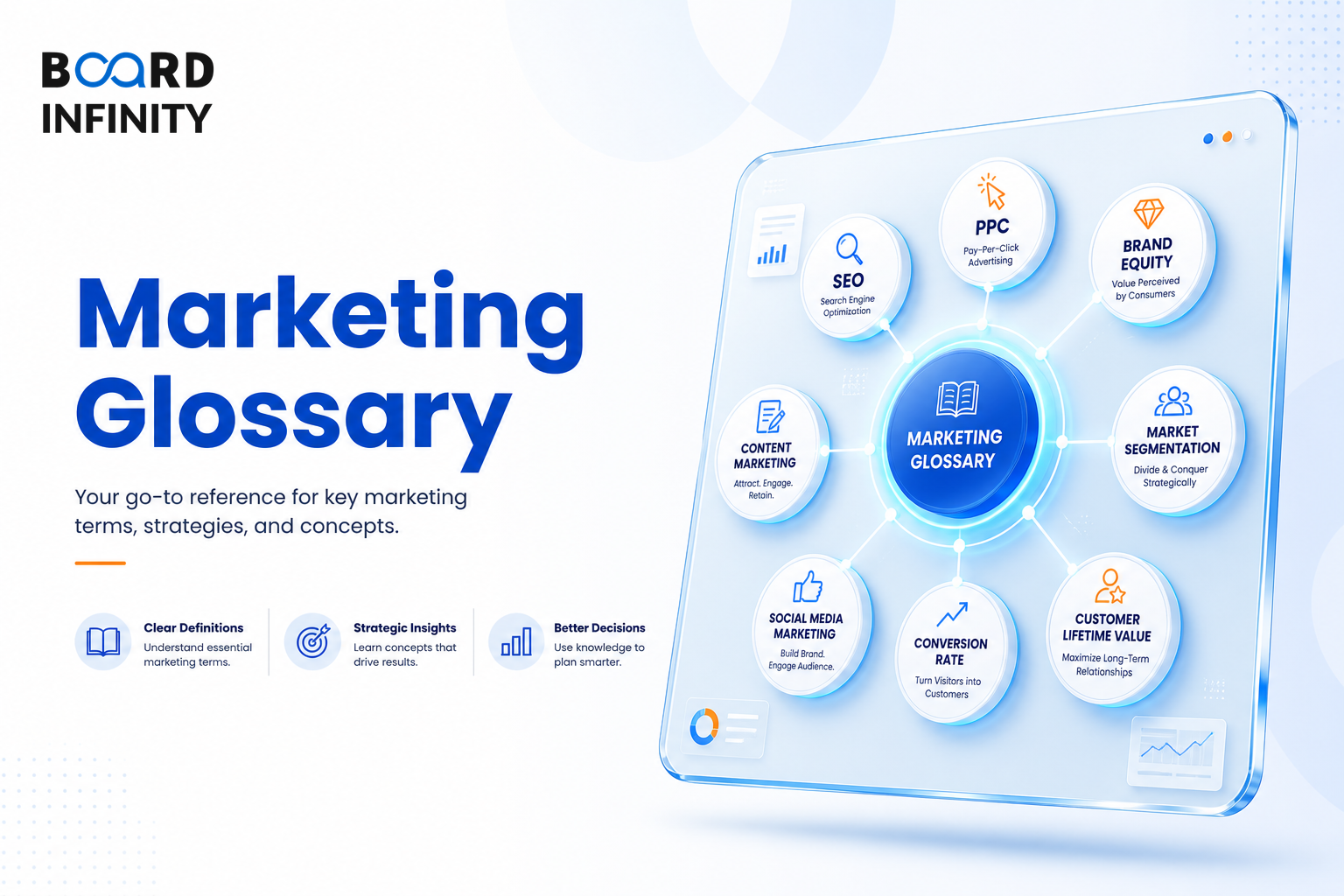
Alphabetical glossaries are easy to search but hard to remember. In interviews, terms appear as business problems: “How would you launch this?” “Why is this brand premium?” “Which metric would you track?” So revise the 60 terms in six clusters.
60 Must-Know Marketing Terms
1-10: Market, STP, and Strategy Terms
Example: Indigo’s marketing position is built around reliable, no-frills flying. The primary driver is operational standardisation, supported by simple fares, high aircraft utilisation, route discipline, and consistent service cues. The marketing lesson: positioning must be credible because operations must deliver it.
11-20: Customer Understanding and Market Sizing Terms
21-30: Brand Terms
When many Indian consumers say “Cadbury” while thinking of chocolate gifting, that is strong category-linked recall. The primary driver is decades of occasion-based association, supported by distribution, consistent purple visual codes, festive communication, and product familiarity. The so what: recall improves the chance of being considered before the shopper compares alternatives.
31-40: Product, Price, and Distribution Terms
41-54: Promotion, Digital, and Funnel Terms
55-60: Marketing Metrics You Must Know With Formulas
Quick worked example: If a campaign spends ₹5,00,000 and acquires 1,000 new customers, CAC = ₹5,00,000 / 1,000 = ₹500. If expected contribution per customer over time is ₹1,500, then CLV:CAC = 3:1, which is usually a healthy signal if cash flow and retention assumptions are realistic.
Definitions to Quote Accurately
- Porter on strategy: “Strategy is the creation of a unique and valuable position, involving a different set of activities.”
- Keller on customer-based brand equity: “The differential effect that brand knowledge has on consumer response to the marketing of that brand.”
- A crisp interview definition of marketing: Marketing creates, communicates, delivers, and captures value by understanding and serving chosen customers profitably.
Use these definitions sparingly. A quoted definition starts the answer; the real marks come from applying it to a brand, customer, and metric.
Case Study: Lenskart Turns Eyewear Into a Marketing System
Lenskart built trust in a complex eyewear category by combining omnichannel access, assisted discovery, technology-led trial, and a clear value proposition.

Situation: Eyewear is a high-friction category. Customers worry about frame fit, face shape, prescription accuracy, durability, price, and after-sales support. Pure online convenience alone is not enough because the product sits on the face and affects vision.
The move: Lenskart did not rely on one marketing lever. Its primary driver was an omnichannel trust model: online discovery plus assisted physical touchpoints. Supporting drivers included virtual try-on, eye-test services, a wide product ladder, house-brand control, repeat-purchase CRM, and consistent communication around fashionable yet accessible eyewear.
Outcome and lesson: Lenskart shows that marketing success is rarely one campaign. The primary engine is trust creation in a difficult category, supported by technology, retail presence, pricing architecture, supply control, and customer data. In an interview, this is the difference between saying “good branding” and explaining the business system behind the brand.
How AI Changes Marketing Terms
AI does not remove marketing vocabulary; it makes the terms more operational. The student who can connect old terms to new tools sounds current without sounding gimmicky.
Use NotebookLM or ChatGPT like a revision partner: upload this glossary and one company annual report, then ask, “Map 15 marketing terms to this company with evidence and likely interview questions.” Verify every factual claim before using it.
Interview Relevance
“Pick any five marketing terms from your CV or coursework and explain them using one real company example.”
If you forget a term, do not freeze. Say, “I will place it in the funnel first,” then reason from customer stage, brand objective, and metric. Interviewers reward structured recovery.
Common Mistake
The biggest mistake is giving dictionary definitions without business application. It costs candidates because marketing interviews test judgment, not memory. One-line fix: define the term, place it in the framework, give a company example, and name the metric.
What to Revise Next
This is the final glossary lesson, so your next step is a capstone review. Pick one company you admire and map it across STP, 4Ps, funnel, brand equity, and metrics. If you can explain that company end-to-end using these 60 terms, your marketing revision is interview-ready.