
Marketing Environment for Interviews: Micro, Macro & PESTEL Made Clear
In 2023, many Indian electric two-wheeler brands had to rethink pricing almost overnight when government subsidy rules changed. The product did not suddenly become worse - the marketing environment changed, and that changed customer value, demand, margins and messaging.
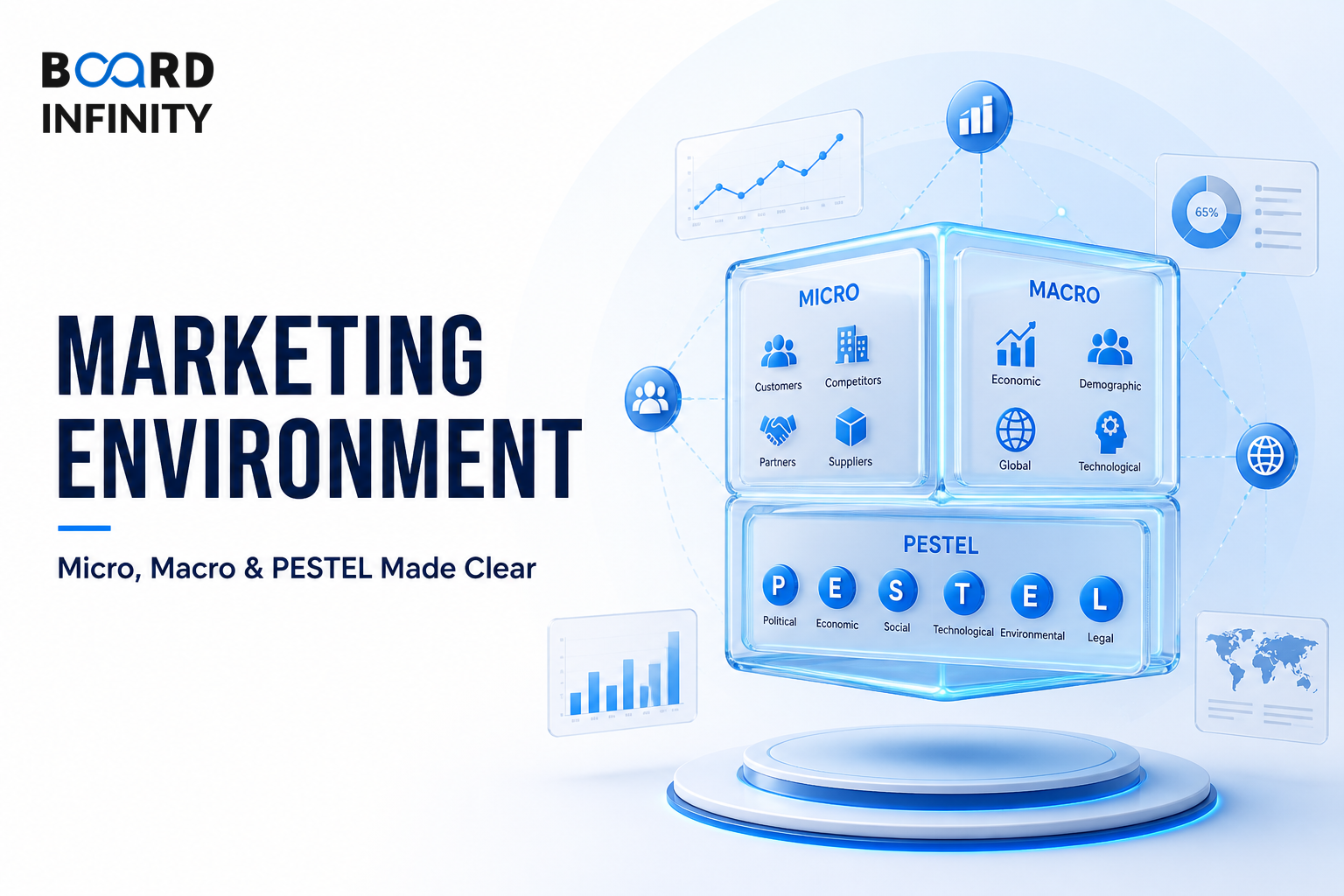
- The marketing environment is the set of outside actors and forces that affect a firm's ability to serve customers profitably.
- Micro environment = close actors: customers, competitors, suppliers, intermediaries, publics and the company itself.
- Macro environment = broad forces: Political, Economic, Social, Technological, Environmental and Legal factors.
- PESTEL is a scanning tool, not a strategy by itself. It tells you what is changing, why it matters and what to do next.
- Strong answers connect environment changes to STP and 4Ps: segment choice, positioning, product, price, place and promotion.
- The best interview structure is: define the environment, split micro and macro, apply PESTEL, identify opportunity/threat, recommend action.
- Common trap: listing PESTEL points without business impact. Always end each factor with “so what for the marketer?”
Big Picture
Marketing is not done in a vacuum. A brand wins when it reads the environment faster than competitors, converts external change into insight, and then adjusts its market offering.
Core Explanation: Micro, Macro and PESTEL
The marketing environment has two layers. The micro environment is close to the firm and directly affects daily execution. The macro environment is broader, often uncontrollable, and shapes the rules of the game.
1. Micro Environment: The Close Actors
The micro environment includes forces that interact directly with the company's ability to create, communicate and deliver value.
Example - Apple and Meta advertising: Apple's App Tracking Transparency policy changed how apps asked users for tracking permission. For Meta and many digital advertisers, this was not a product issue but an environment shift in technology, privacy norms and platform power. The strategic so what: marketers must track platform dependence because a channel partner can become a major external constraint.
2. Macro Environment: The Broad Forces
The macro environment contains larger societal forces that a single firm usually cannot control. The marketer's job is not to “solve” these forces, but to anticipate their effect on demand, cost, channels and brand trust.
3. PESTEL: How to Use It Without Sounding Theoretical
For every PESTEL factor, write three things: signal, impact and action. For example, “rising interest rates” is only a signal. The useful analysis is: consumer loans become costlier, discretionary purchases slow down, so the brand may need smaller pack sizes, EMI offers or stronger value communication.
Signals and Metrics to Track
Environment analysis becomes sharper when you combine qualitative scanning with measurable signals. These numbers do not replace judgement, but they prevent vague answers.
Definitions You Must Be Able to Say
Kotler and Armstrong define the marketing environment as “the actors and forces outside marketing that affect marketing management's ability to build and maintain successful relationships with target customers.”
Case Study: Ather Energy and the EV Scooter Environment
Ather Energy shows how an Indian mobility brand must read subsidies, charging infrastructure, consumer trust and competition together - not as isolated marketing issues.

Situation: Electric scooters in India are shaped by more than product design. Buyers evaluate running cost, battery safety, range anxiety, charging access, resale confidence and government incentives. In 2023, changes to electric two-wheeler subsidy support affected pricing across the category, while competition intensified from both EV start-ups and traditional two-wheeler manufacturers.
The move: Ather built around a premium, technology-led positioning with connected scooters, experience-led retail, charging ecosystem initiatives and service support. It later expanded appeal with the Rizta, a family-oriented scooter launched in 2024, signalling a shift from early adopters toward broader household use. The primary driver was reading the consumer's full adoption barrier, not just making an electric product. Supporting drivers included product reliability cues, charging visibility, retail education, financing options and brand trust.
Outcome or lesson: The lesson is not “EVs win because they are cheaper to run.” That is too shallow. EV adoption depends on a bundle of macro and micro forces - subsidy policy, battery technology, urban commuting patterns, competitor pricing, service confidence and channel education. A good marketer turns those forces into positioning, product portfolio and go-to-market choices.
How AI Changes the Marketing Environment
AI does not replace PESTEL. It makes environmental scanning faster, wider and more continuous.
- Always-on social and search listening: AI tools can cluster thousands of customer reviews, Reddit threads, YouTube comments and search queries to detect emerging concerns - for example battery anxiety, delivery delays or price sensitivity.
- Competitor and channel intelligence: AI can monitor competitor launches, marketplace pricing, ad creatives and customer sentiment patterns, helping marketers see micro-environment moves earlier.
- Scenario building for macro shifts: Teams can model “what if subsidy falls,” “what if input cost rises,” or “what if privacy regulation changes,” then test likely effects on price, demand and messaging.
Use Perplexity or NotebookLM to scan a company's annual report, recent news and customer reviews. Ask: “Create a PESTEL analysis for this company in India, then convert each factor into a 4P implication.” Verify every factual claim before using it.
Interview Relevance
“Choose any Indian consumer brand and explain how its marketing environment affects its marketing strategy.”
If you are short on time, answer using this sentence pattern: “Because of this environmental force, customer behaviour changes in this way, so the brand should adjust this marketing decision.”
Common Mistake
The biggest mistake is turning PESTEL into a laundry list: “Political, Economic, Social...” with no business implication. It costs candidates because it sounds memorised, not managerial. One-line fix: after every factor, add “therefore the marketer should...” and link it to STP or the 4Ps.
What to Revise Next
Now that you can read the market context, revise how marketers act on it. Go next to The Marketing Mix at a Glance: Understanding the 4Ps & 7Ps, then Customer Value & the Value Delivery Process. Together, these complete the journey from external forces to customer value creation.