
How to Explain Marketing’s Link with Sales, Finance, Product & Strategy in Interviews
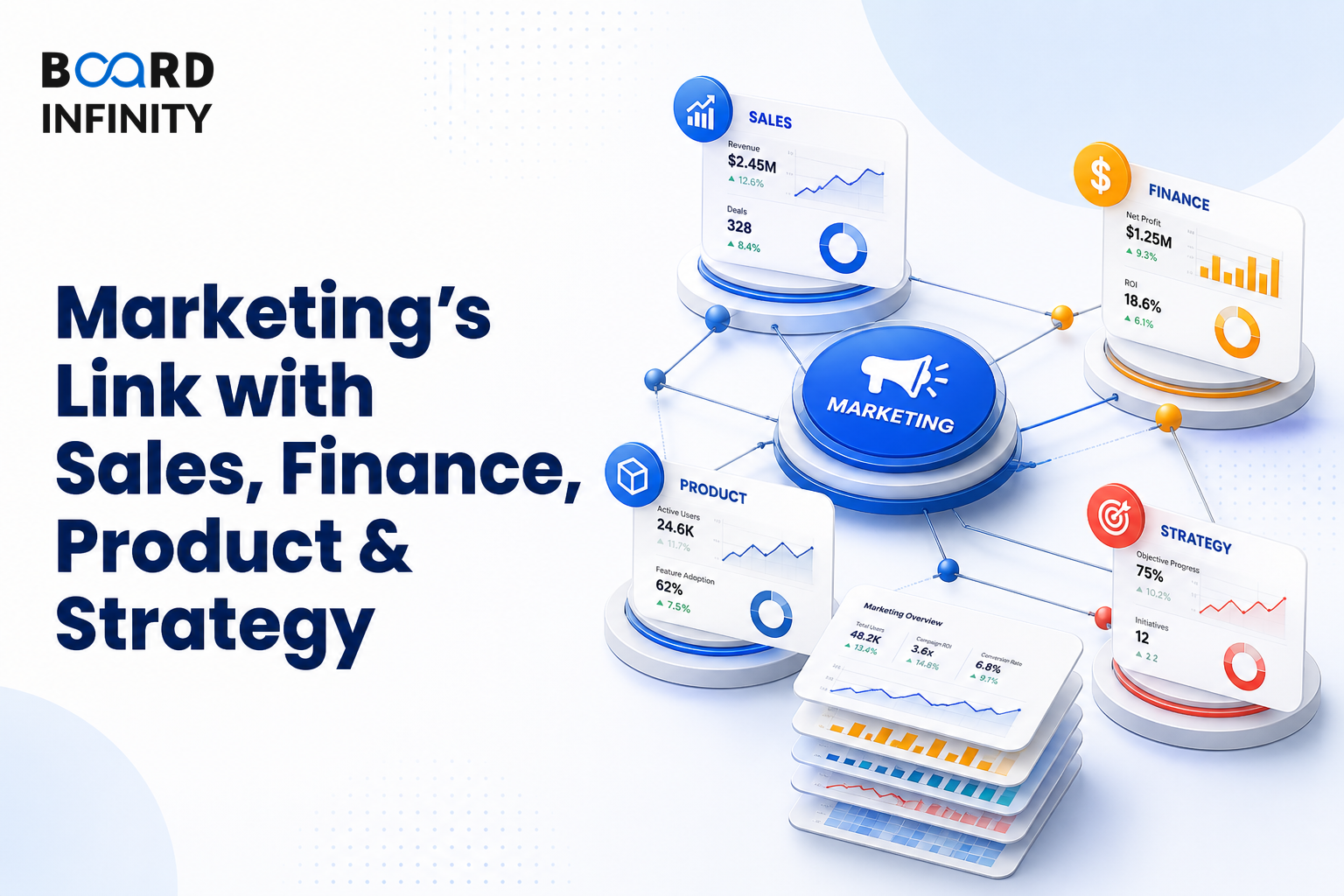
The biggest misconception about marketing is that it “comes in later” to make brochures, ads and social posts. In a well-run company, marketing is already present when the product is shaped, the sales pitch is written, the pricing model is defended and the growth strategy is chosen.
- Marketing connects functions by translating customer insight into business action. Sales uses it to sell, product uses it to build, finance uses it to fund and strategy uses it to choose where to play.
- Sales link: Marketing creates demand, qualifies leads, sharpens positioning and gives sales teams the right messaging, objections and proof points.
- Finance link: Marketing decisions must justify CAC, pricing, margins, payback and budget allocation - not just awareness.
- Product link: Marketing brings customer pain points, category trends, usage feedback and positioning gaps into product design and roadmap choices.
- Strategy link: Marketing informs segmentation, targeting, positioning, competitive advantage and market-entry choices.
- Best interview frame: explain the loop - customer insight to value proposition to go-to-market to revenue to feedback.
- Core trap: never describe marketing as only advertising. Show how it creates and captures customer value across the business.
The Big Picture: Marketing Is the Customer-Value Integrator
Marketing sits at the intersection of the market outside and the company inside. Its real job is to convert customer understanding into choices that sales can execute, finance can fund, product can build and strategy can scale.
The Core Explanation: Four Interfaces Every MBA Should Know
The simplest way to answer this topic is to treat marketing as an interface function. It receives market signals, translates them into business choices and coordinates execution across teams.
1. Marketing and Sales: From Demand Creation to Demand Conversion
Marketing helps sales by defining the target customer, creating awareness, generating leads, building credibility and giving sales teams a clear message. Sales completes the loop by sharing objections, lost-deal reasons, customer language and competitor moves.
In B2B, this link is visible in lead qualification, account-based marketing and sales enablement decks. In consumer businesses, it appears through retail visibility, trade schemes, influencer campaigns, marketplace listings and conversion-led promotions.
2. Marketing and Finance: From Spend to Return
Finance asks the question marketing must answer: “If we spend this money, what value comes back?” That value may be revenue, margin, retention, brand equity or customer lifetime value. Good marketers do not defend campaigns only through creativity - they defend them through unit economics.
3. Marketing and Product: From Customer Pain to Product Roadmap
Product teams build better when marketing brings evidence from the market: unmet needs, usage barriers, feature preferences, claims that customers believe and claims that customers reject. Marketing also helps product managers choose which benefits deserve prominence in packaging, onboarding and communication.
4. Marketing and Strategy: From Market Insight to Competitive Choice
Strategy decides where the company will compete and how it will win. Marketing strengthens strategy through segmentation, category sizing, competitor mapping, positioning, brand architecture and go-to-market design.
The Functional Map: What Marketing Gives and Gets
Use this table when you need a crisp, structured answer. It prevents a vague “marketing works with everyone” response.
Asian Paints is often studied not only as a paint brand, but as a market-intelligence-led business. Its marketing understanding of homeowners, dealers and colour trends supports product innovation, retail execution, service offerings and distribution decisions. The strategic so what: customer insight becomes stronger when it is connected to channel data, product design and execution capability - not kept inside the advertising team.
Metrics That Prove Cross-Functional Marketing Is Working
When a company says marketing is aligned with sales, finance, product and strategy, do not accept intent. Look for operating metrics that show the handoffs are working.
Definitions You Can Say in One Breath
Kotler and Armstrong: “Marketing is the process by which companies create value for customers and build strong customer relationships in order to capture value from customers in return.”
Michael Porter: “Strategy is the creation of a unique and valuable position, involving a different set of activities.”
Working definition for this topic: Marketing connects functions by converting customer insight into coordinated choices on product, pricing, selling, spending and growth.
Lenskart: Connecting Marketing, Sales, Finance, Product and Strategy
Lenskart shows how a marketing-led understanding of eyewear buying friction can shape product, stores, pricing and growth strategy in India.

Situation: Buying eyewear in India has high friction. Customers need eye testing, frame trial, trust in lens quality, style choice and price confidence. A purely online model could create awareness, but many customers still wanted physical reassurance before purchase.
The move: Lenskart built an omnichannel model around the customer journey. Marketing did not only run campaigns; it clarified the problem - make eyewear easier, more fashionable and more accessible. That insight connected multiple teams: stores and assisted sales for trial, product teams for frame variety and lens options, finance teams for unit economics and expansion discipline, and strategy teams for category growth through a direct-to-consumer plus retail model.
Outcome or lesson: The primary driver was solving eyewear-buying friction through an omnichannel experience. Supporting drivers included brand salience, product variety, pricing architecture, store execution and data-led customer understanding. The case proves the core idea: marketing becomes powerful when it coordinates the full value proposition, not just communication.
How AI Changes Marketing’s Connection with Sales, Finance, Product & Strategy
AI makes the marketing interface faster, more measurable and more personalized - but only if teams use it to improve decisions, not just generate content.
Practical student workflow: before a company interview, load the company’s annual report, investor presentation, recent campaign notes and two competitor pages into NotebookLM. Ask: “Create a one-page map of how this company’s marketing connects with sales, finance, product and strategy. Include likely interview questions and weak spots in the business model.” Then verify every fact manually before using it.
Interview Relevance
“Marketing is often seen as advertising. Explain how marketing connects with sales, finance, product and overall business strategy. Use an example.”
If the interviewer pushes back with “But isn’t sales responsible for revenue?”, answer calmly: sales converts demand, but marketing shapes the demand, proposition, targeting and evidence that make conversion easier and more profitable.
Common Mistake
The biggest mistake is treating marketing as a campaign or advertising function only. It costs candidates because the answer sounds junior and ignores business impact. One-line fix: always explain marketing as a customer-value loop connecting insight, product, sales, finance and strategy.
What to Revise Next
Now that you can explain marketing’s role across the business, revise the two topics that make this answer sharper and more current: responsible marketing and the Indian market context.