
Accretion and Dilution Analysis: Interview-Ready M&A Framework
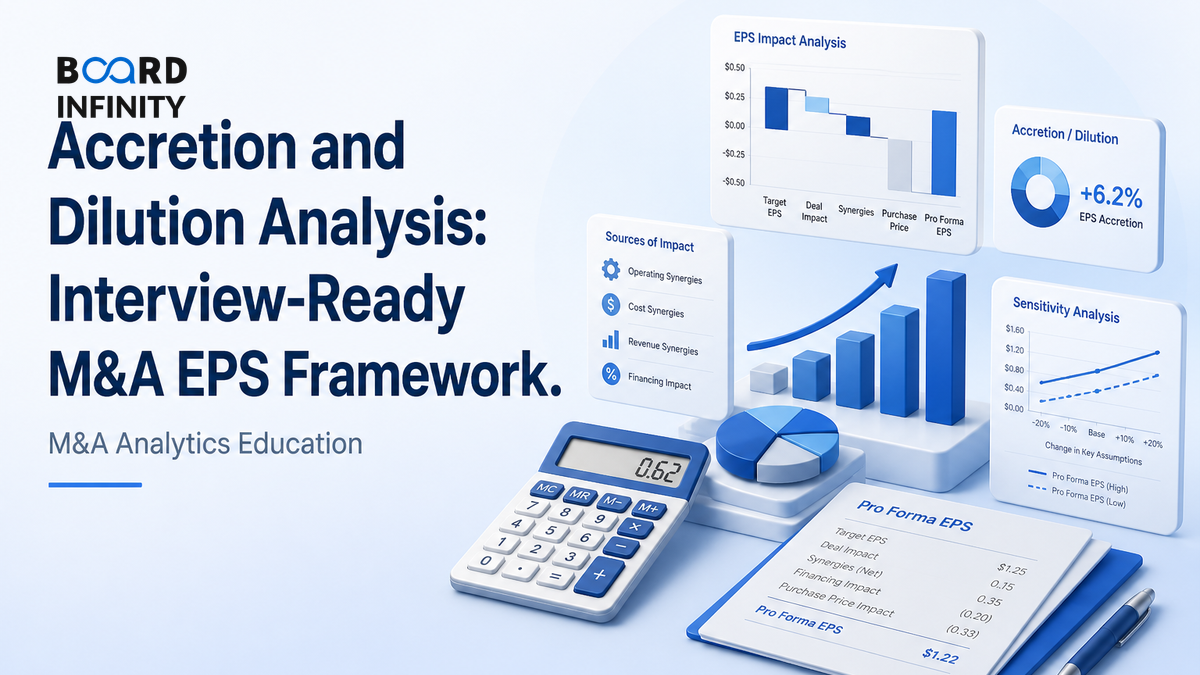
A deal is announced before market open: the buyer calls it “strategic,” the press release celebrates synergies, but the stock drops within minutes. What analysts are really asking is brutally simple - after buying this company, will each existing share earn more or less?
That is the heart of accretion and dilution analysis: the fastest first-pass test of whether an M&A deal improves or reduces the buyer’s earnings per share.
- Accretive deal means pro forma EPS after the acquisition is higher than the buyer’s standalone EPS.
- Dilutive deal means pro forma EPS after the acquisition is lower than the buyer’s standalone EPS.
- The master formula is: Pro forma EPS = Pro forma net income / Pro forma shares outstanding.
- EPS moves because of five drivers: target earnings, synergies, financing cost, tax impact, and new shares issued.
- Stock deals are often accretive when a high P/E acquirer buys a lower P/E target; they become risky when the target is expensive or loss-making.
- Debt can boost EPS if the target’s earnings yield exceeds after-tax interest cost, but it increases leverage and financial risk.
- The biggest trap: accretion is not the same as value creation. A deal can increase EPS and still destroy value if the price paid is too high.
Big Picture: The Deal Must Pass Through the EPS Funnel
Accretion and dilution analysis compresses an entire acquisition into one output: pro forma EPS. Think of the model as a funnel - deal inputs enter at the top, financing and accounting adjustments narrow the economics, and the final answer drops out as accretive, neutral, or dilutive.
Core Explanation: The Five Moving Parts
Accretion and dilution analysis compares the buyer’s EPS before the deal with its expected EPS after the deal. The analysis is usually built for Year 1 and sometimes Year 2 after closing.
The central equation is:
Pro forma EPS = Pro forma net income / Pro forma shares outstanding
The numerator and denominator both change in an acquisition. That is why candidates who only look at “target profit” often get the wrong answer.
The Formula You Should Write in an Interview
Use this clean version first. Then add complexity only if asked.
Pro forma EPS = (Buyer net income + Target net income + After-tax synergies - After-tax interest cost - Incremental deal costs) / (Buyer shares + New shares issued)
Then compare:
- If pro forma EPS > buyer standalone EPS, the deal is accretive.
- If pro forma EPS < buyer standalone EPS, the deal is dilutive.
- If pro forma EPS is roughly equal, the deal is neutral or break-even.
Interviewers usually expect the recurring earnings view, not a one-time transaction-cost view. Mention that one-time advisory fees, integration charges, and restructuring expenses should be separated from recurring EPS impact.
Worked Example: From Deal Inputs to EPS Accretion
Assume a buyer is acquiring a target with 50% debt and 50% stock. The numbers below are simplified, but the logic is exactly how the model works.
Now calculate the deal EPS:
Pro forma net income = ₹1,000 crore + ₹120 crore + ₹30 crore - ₹90 crore = ₹1,060 crore
Pro forma shares = 100 crore + 4.8 crore = 104.8 crore
Pro forma EPS = ₹1,060 crore / 104.8 crore = ₹10.11
EPS accretion = (₹10.11 / ₹10.00 - 1) × 100 = 1.1%
The deal is mildly accretive. But notice the insight: without after-tax synergies of ₹30 crore, pro forma EPS would be ₹1,030 crore / 104.8 crore = ₹9.83, which is dilutive. The synergy assumption is doing real work.
Key Metrics to Track in Accretion and Dilution Analysis
Do not stop at “accretive” or “dilutive.” A strong answer names the measures that tell whether the model is robust or fragile.
Debt, Cash, and Stock: Why Financing Choice Changes EPS
The same target can be accretive under one financing mix and dilutive under another. Financing choice changes the numerator through interest income or interest cost, and the denominator through new shares.
Definitions
- Basic EPS: CFA Institute formula: net income minus preferred dividends divided by weighted average common shares outstanding.
- Accretive acquisition: An acquisition where the buyer’s pro forma EPS is higher than its standalone EPS.
- Dilutive acquisition: An acquisition where the buyer’s pro forma EPS is lower than its standalone EPS.
- Pro forma EPS: Expected EPS of the combined company after adjusting for acquisition earnings, financing, synergies, taxes, and share issuance.
- Synergy: Incremental value or earnings expected because two businesses operate together rather than separately.
Mini Case Study: Tata Consumer’s 2024 Move into Packaged Food Platforms
In 2024, Tata Consumer Products announced acquisitions of Capital Foods and Organic India, making it a useful Indian case for understanding why EPS impact must be read alongside strategic fit.

Situation: Tata Consumer Products already had a strong India food and beverage platform through brands such as Tata Tea, Tetley, Tata Salt, and Sampann. In January 2024, it announced the acquisition of Capital Foods, known for Ching’s Secret and Smith & Jones, and Organic India, known for organic teas, infusions, and wellness products. The reported enterprise values were ₹5,100 crore for Capital Foods and ₹1,900 crore for Organic India.
The move: The acquisition was not just about buying current profits. The primary driver was portfolio adjacency - moving deeper into high-growth packaged foods, condiments, ready-to-cook, and wellness categories. Supporting drivers included Tata Consumer’s distribution reach, premiumization opportunity, cross-selling into modern trade and e-commerce, and the ability to scale acquired brands through a larger FMCG system.
The accretion-dilution lens: An analyst would ask three linked questions. First, how much current earnings do these businesses add? Second, what financing cost or share issuance is required to fund the acquisition? Third, how much synergy is realistic from distribution, procurement, and operating leverage?
Outcome or lesson: The case shows the exact tension accretion-dilution analysis is meant to reveal. First-year EPS may not capture the full value of buying a category platform, but a disciplined analyst still checks whether the buyer is paying too much, overestimating synergies, or hiding dilution behind strategic language.
Accretive Does Not Always Mean Value-Creative
This is the maturity point interviewers love. EPS is an accounting measure. Value creation is an economic measure.
A deal can be accretive because the buyer uses cheap debt, cuts investment, or buys a lower P/E business. But if the acquisition price is excessive, integration fails, or return on invested capital is below the company’s cost of capital, shareholders can still lose value.
How AI Changes Accretion and Dilution Analysis
AI does not replace the M&A model. It makes the analyst faster at building, checking, and challenging the model.
- Faster filing extraction: AI tools can pull net income, share count, debt, tax rate, and segment notes from annual reports, investor presentations, and deal announcements. The student still needs to verify every number against source documents.
- Better synergy challenge: LLMs can compare management synergy claims with past deals in the same sector, helping you ask whether cost savings, revenue synergies, and integration timelines are realistic.
- Sensitivity modelling: AI-assisted spreadsheets can generate scenarios for debt percentage, interest rate, acquisition multiple, synergy realization, and share price movement, making the accretion-dilution range visible instead of giving one false-precision answer.
Load the acquirer’s annual report, target financial summary, and deal press release into NotebookLM. Ask it to extract the inputs for an accretion-dilution model, then use ChatGPT to create a sensitivity table for financing mix, interest rate, and synergy realization. Verify all numbers manually before using them.
Interview Relevance
“A listed company wants to acquire a smaller profitable company. How would you determine whether the deal is accretive or dilutive to EPS?”
If the interviewer gives you no numbers, speak in drivers: high target earnings yield, low after-tax debt cost, low share issuance, and realistic synergies support accretion; high purchase multiple, expensive financing, and large stock issuance create dilution risk.
Common Mistake
Mistake: Saying “the deal is good because it is EPS accretive.” This costs candidates because EPS accretion can be created through leverage, accounting, or buying a low-growth business at the wrong price. Fix: say, “Accretion is a useful first-pass test, but I would confirm value creation through ROIC versus WACC, DCF, leverage impact, and synergy realism.”
What to Revise Next
Next, revise Leveraged Buyouts and How Private Equity Returns Are Made. Accretion-dilution teaches how deal financing affects EPS; LBOs take the next step and show how debt, cash flows, exit multiples, and operational improvement create investor returns.