
Working Capital Management & CCC: Interview-Ready Cash Cycle Framework
A profitable company can still feel broke. A festive-season retailer may show strong sales on paper, but if cash is locked in slow-moving stock and unpaid invoices, suppliers still need to be paid before the money comes back.
- Working capital management is the discipline of funding day-to-day operations without starving growth or wasting cash.
- Net working capital usually means current assets minus current liabilities; analysts often focus on operating items like inventory, receivables and payables.
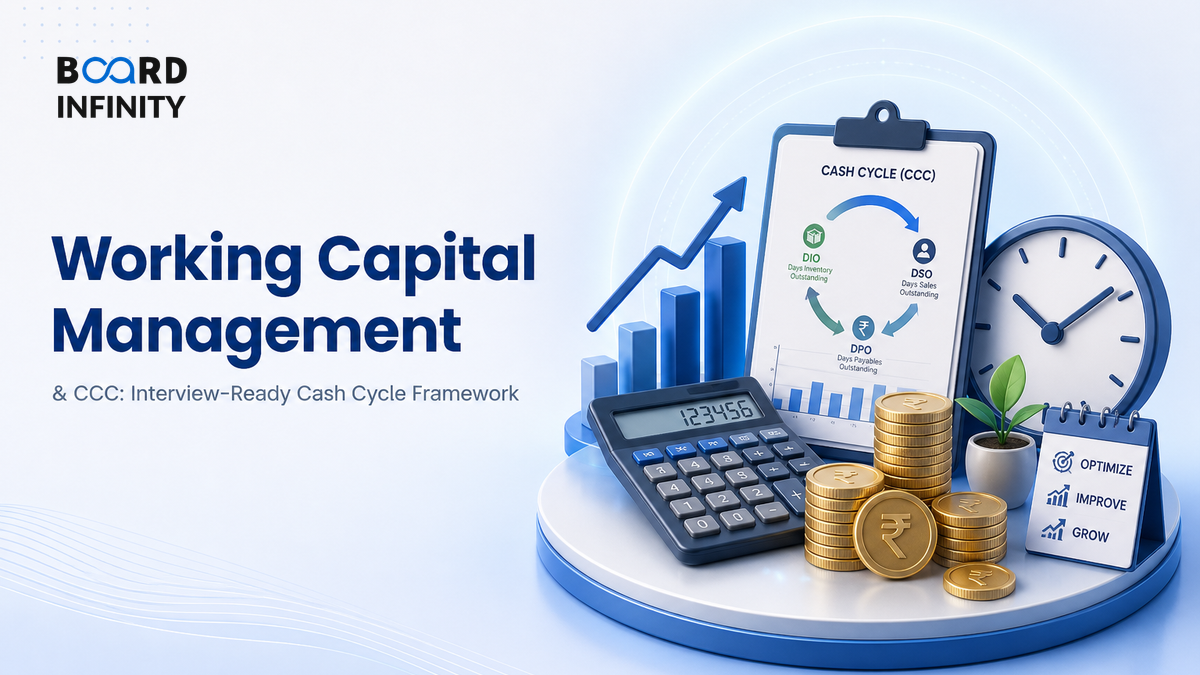
- Cash Conversion Cycle = DIO + DSO - DPO. It tells you how many days cash is tied up in operations.
- DIO measures inventory days, DSO measures receivable collection days, and DPO measures supplier payment days.
- A shorter CCC is usually better, but a negative CCC is healthy only if it comes from business model strength, not supplier abuse or stockouts.
- The three main levers are faster inventory turns, faster customer collections and responsible supplier-credit optimisation.
- In interviews, always connect working capital to cash flow, liquidity, growth and risk, not just ratios.
Big Picture: Profit Is an Opinion, Cash Timing Is a Discipline
Working capital management answers one practical question: how much cash must be tied up between buying inputs and collecting from customers? The Cash Conversion Cycle, or CCC, is the cleanest way to see that timing loop.
Core Explanation: The Three Moving Parts of Working Capital
The heart of working capital management is not “keep more cash.” It is release cash without breaking operations. That means managing three operating buckets carefully.
- Inventory - raw material, work-in-progress or finished goods waiting to be sold. Too much inventory traps cash; too little causes stockouts.
- Receivables - money customers owe after credit sales. Faster collection improves liquidity, but overly strict credit terms may hurt sales.
- Payables - money owed to suppliers. Longer payment terms help cash flow, but delaying critical suppliers can damage reliability and bargaining power.
Dell's classic direct-to-customer PC model reduced inventory by building after customer orders and collecting cash quickly, while supplier payments came later. The primary driver was the build-to-order model, supported by direct sales, supplier coordination and low finished-goods inventory. The strategic lesson: a short or negative CCC is powerful when it comes from business design, not just delayed payments.
The Formula You Must Be Able to Write
The Cash Conversion Cycle combines inventory, receivables and payables into one operating-cash measure:
CCC = Days Inventory Outstanding + Days Sales Outstanding - Days Payables Outstanding
Interpretation: lower CCC usually means better liquidity. But “lower” is not automatically “better” unless service levels, supplier health and sales growth remain intact.
Worked Example: Calculate CCC in 90 Seconds
Assume a company has the following annual figures: net credit sales of ₹120 crore, COGS of ₹84 crore, average inventory of ₹14 crore, average receivables of ₹10 crore and average payables of ₹12 crore.
Meaning: after considering supplier credit, cash is tied up for 39 days. If the firm reduces DSO by 5 days, it releases roughly ₹1.64 crore from receivables: ₹120 crore / 365 × 5.
Key Metrics to Track in Working Capital Management
Benchmarks vary sharply by industry: grocery retail, SaaS, auto manufacturing and construction cannot be judged with the same CCC. Use these metrics against peer companies, historical trend and operating context.
The Managerial Levers: What You Can Actually Change
Good working capital management is a set of operating choices, not a finance-department spreadsheet. The best actions reduce the cash cycle while protecting the customer promise.
Definitions to Say Cleanly
- Working capital: Current assets minus current liabilities, representing short-term capital available for daily operations.
- Operating working capital: Operating current assets minus operating current liabilities, excluding financing items like short-term debt.
- Cash Conversion Cycle: The number of days cash is tied between paying suppliers and collecting from customers.
- Operating cycle: The time from purchasing inventory to collecting cash from the customer.
Trent and Zudio: Working Capital Discipline in Value Fashion
Trent's Zudio-led value-fashion expansion shows how retail growth depends on inventory discipline, fast sell-through and low receivables.

Situation: Fashion retail is a working-capital trap. A company must commit to inventory before knowing exact customer demand, and unsold seasonal stock can quickly become markdown inventory. As Trent scaled Zudio and Westside, the challenge was not just opening stores; it was scaling without letting inventory absorb cash faster than sales could generate it.
The move: Trent's model emphasises private labels, tight assortment control, rapid store-level sell-through tracking and a retail payment model where customer receivables are naturally low because sales are largely immediate through cash, cards or digital payments. The primary driver is inventory discipline, supported by private-label economics, store productivity focus, vendor coordination and quick feedback from stores.
Outcome or lesson: The case proves a key interview point: working capital strength is not only a finance metric. In retail, it comes from merchandising, supply chain, store operations and payment behaviour working together.
How AI Changes Working Capital Management & the Cash Conversion Cycle
AI is making working capital management more predictive and more granular. The shift is from monthly ratio review to daily decision support.
- Inventory forecasting becomes SKU-location specific: machine learning can forecast demand by store, SKU, festival, weather and local trend, helping reduce DIO without increasing stockouts.
- Collections become risk-based: AI models can prioritise customers by payment probability, overdue risk and dispute likelihood, improving DSO through targeted follow-up instead of generic reminders.
- Cash forecasting becomes dynamic: treasury and finance teams can combine ERP data, sales orders, supplier due dates and bank balances to forecast liquidity gaps earlier.
Use NotebookLM: upload a company annual report, balance sheet notes and management discussion section. Ask: “Extract inventory, receivables, payables and liquidity comments. What working-capital risks could an interviewer ask about?” Then verify every number from the annual report before using it.
Interview Relevance
“A company is profitable but facing cash flow pressure. How would you analyse whether working capital is the problem?”
Use the phrase: “I would not optimise CCC in isolation; I would optimise it subject to service levels, growth, supplier reliability and bad-debt risk.” That sounds like a manager, not a formula machine.
The biggest mistake is saying “lower working capital is always better.” It costs candidates because it ignores stockouts, supplier damage and lost sales. Fix: say “shorter CCC is better only when achieved sustainably without hurting operations or relationships.”
What to Revise Next
Now connect cash timing to planning and liquidity. Revise Budgeting, Forecasting & Variance Analysis Inside a Real Company to understand how operating plans create working-capital needs, then revise Treasury & Liquidity Management Basics to see how companies fund short-term cash gaps.