
Leveraged Buyouts: Explain How Private Equity Returns Are Made in Interviews
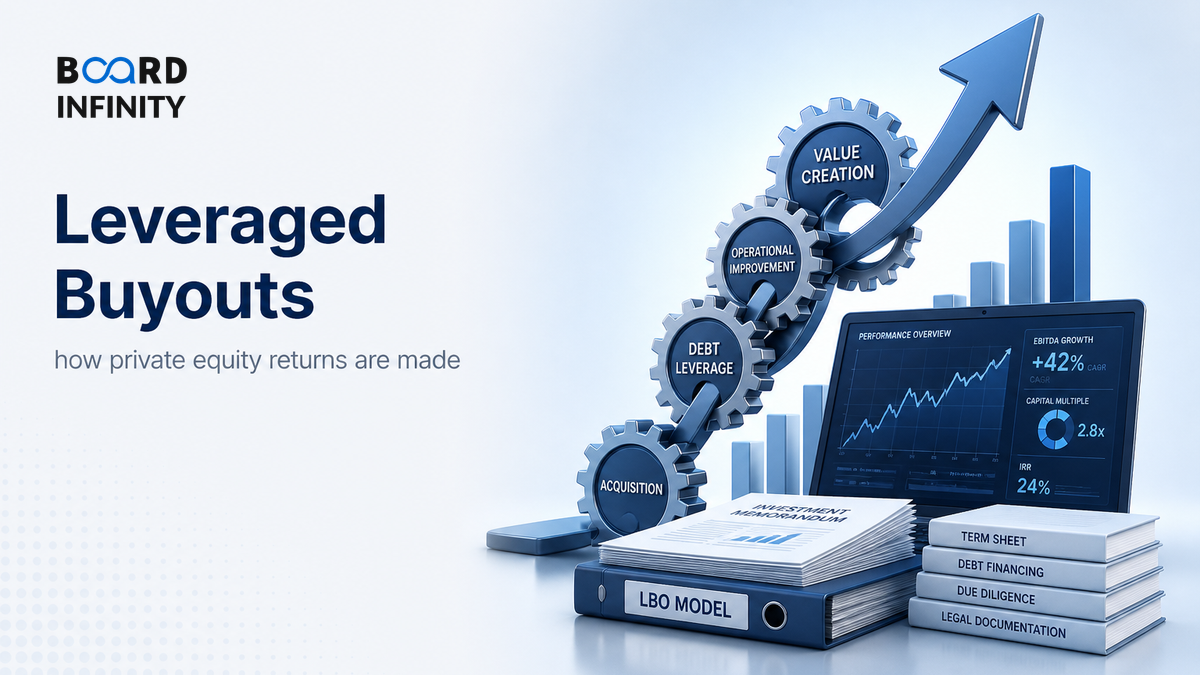
The biggest misconception about leveraged buyouts is that private equity returns come from “using debt and getting lucky.” In a real LBO, the debt is only the amplifier - the engine is a business that can generate cash, improve operations, and exit at a sensible valuation.
- An LBO is an acquisition funded with a large debt component, where the target company’s cash flows help repay that debt.
- Private equity returns come mainly from EBITDA growth, debt paydown, multiple expansion, and disciplined exit timing.
- Debt increases equity returns because the PE fund controls a larger asset with less equity - but it also increases bankruptcy and covenant risk.
- The two interview metrics to explain cleanly are IRR and MOIC: IRR captures speed of return; MOIC captures absolute cash multiple.
- A good LBO target has stable cash flows, low capex intensity, strong margins, defensible market position, and clear operational improvement levers.
- In India, classic debt-heavy LBOs are less common than in the US because of financing and regulatory constraints, so PE buyouts often rely more on growth and governance.
- The best answer is not “more debt means higher return”; it is “debt magnifies returns only if cash flows safely service it.”
Big Picture: An LBO Is a Return Machine, Not Just a Debt Deal
Think of an LBO as a value bridge. A private equity fund buys a company using equity plus debt, improves the business during ownership, uses cash flow to reduce debt, and sells the company later. The equity return is what remains after repaying debt at exit.
Core Explanation: How an LBO Actually Works
An LBO begins when a private equity sponsor acquires a company using a mix of sponsor equity and borrowed money. The target company’s future cash flows are expected to support interest payments, scheduled repayments, and eventual debt reduction.
The key intuition: debt sits ahead of equity. If enterprise value rises and debt falls, the equity slice can grow dramatically. But if EBITDA falls or debt cannot be serviced, equity can be wiped out quickly.
The Four Return Levers in a Private Equity Deal
Private equity returns are rarely created by one factor. A strong deal combines a primary value-creation driver with supporting drivers. In most LBOs, the return bridge has four levers.
The strongest PE answer distinguishes controllable levers from market-dependent levers. EBITDA growth and cash conversion are more controllable. Multiple expansion is less controllable. That is why good investors underwrite returns without assuming heroic exit multiples.
What Makes a Company a Good LBO Target
A good LBO target is not simply “cheap.” It must be able to survive leverage. The debt lenders care about downside protection; the PE sponsor cares about upside creation.
For Indian buyouts, add one more practical point: acquisition leverage can be more complex because Indian regulatory, tax and financing structures differ from classic US-style LBOs. As a result, many India PE deals create returns through growth, governance, digital transformation and market rerating, not only through heavy debt paydown.
Worked Example: How Debt Magnifies Equity Return
Use a simple LBO model in interviews. You do not need a full spreadsheet; you need the logic.
Here, the PE fund invests ₹320 crore of equity and exits with ₹790 crore of equity value. The return is not only from EBITDA growth. It comes from a combination of EBITDA growth from ₹100 crore to ₹130 crore and debt reduction from ₹480 crore to ₹250 crore. If the exit multiple also expanded, returns would be even higher; if the multiple contracted, returns would fall.
Approximate five-year IRR can be estimated as: (2.47)^(1/5) - 1 ≈ 20%. This is why PE investors obsess over both MOIC and time.
Key LBO Metrics You Should Be Able to Say and Use
If a discussion moves from concept to numbers, these are the metrics that matter. Ranges vary by sector, country, interest-rate environment and lender appetite, so use them as interview-safe guides rather than universal laws.
Definitions: Say These Cleanly
- Leveraged buyout: Acquisition funded significantly with debt, repaid from the target’s cash flows and exit proceeds.
- Enterprise value: Market value of operating assets, usually calculated as equity value plus net debt and other claims.
- EBITDA: Earnings before interest, taxes, depreciation and amortisation.
- MOIC: Total cash returned divided by total cash invested.
- IRR: Discount rate that makes the net present value of cash flows equal to zero.
Case Study: Blackstone and Mphasis - PE Returns Through Business Quality, Not Just Leverage
Blackstone’s investment in Indian IT services company Mphasis shows how PE returns can come from operational repositioning, sector tailwinds and governance, not only from debt engineering.
Situation: Mphasis was an Indian IT services company with strong capabilities but needed sharper strategic positioning after ownership changes in the technology services ecosystem. Blackstone acquired a controlling stake from Hewlett Packard Enterprise in 2016, making it one of the most closely watched PE control investments in Indian listed technology services.
The move: The primary value driver was business transformation - sharper focus on digital, cloud, application services and high-value enterprise clients. Supporting drivers included Blackstone’s global client access, professional governance, management focus, strong demand for digital transformation, and public-market interest in Indian IT services businesses.
Outcome and lesson: Mphasis became a widely cited Indian example of PE value creation through growth and strategic repositioning. The lesson is important: the best PE returns are not “debt plus exit.” They are better business plus sensible capital structure plus credible exit optionality.

How AI Changes Leveraged Buyouts and Private Equity Returns
AI is changing LBO work in three practical places: deal screening, diligence, and portfolio value creation.
- Deal sourcing: PE teams can use AI to scan filings, news, hiring trends, customer reviews and industry signals to identify companies with buyout potential earlier.
- Diligence: LLMs can summarise contracts, customer concentration, litigation notes, management commentary and earnings-call transcripts, helping teams spot risks faster.
- Portfolio operations: AI can improve pricing, demand forecasting, churn prediction, procurement analytics, sales productivity and working-capital control - all of which can lift EBITDA or free cash flow.
The caution: AI accelerates analysis, but it does not replace judgement. A model may highlight a margin-improvement opportunity, but the investment committee still needs to ask whether customers will accept pricing, whether systems can execute, and whether management can deliver.
Use NotebookLM for preparation: upload a company annual report, investor presentation and 2-3 news articles, then ask, “Build a PE buyout thesis: value drivers, risks, debt capacity, exit options and five interviewer questions.”
Interview Relevance
“Walk me through how a private equity fund makes returns in a leveraged buyout. Is leverage always good?”
If the interviewer gives numbers, always start with Enterprise Value - Net Debt = Equity Value. That one equation keeps the whole LBO answer grounded.
Common Mistake
The costly mistake is saying “more debt means better returns.” It costs candidates because it ignores default risk, covenants, interest coverage and cyclicality. The one-line fix: Debt improves equity returns only when the business can safely convert EBITDA into cash and repay debt.
What to Revise Next
This is a natural capstone topic because it connects corporate finance, valuation, strategy, operations and investor judgement. To finish the course, do a capstone review: take one real company, build a 10-minute investment thesis, estimate its value drivers, name the risks, and explain whether it is a good PE target.