
Sources of Corporate Funding in India: Interview-Ready Guide from Term Loans to Debentures
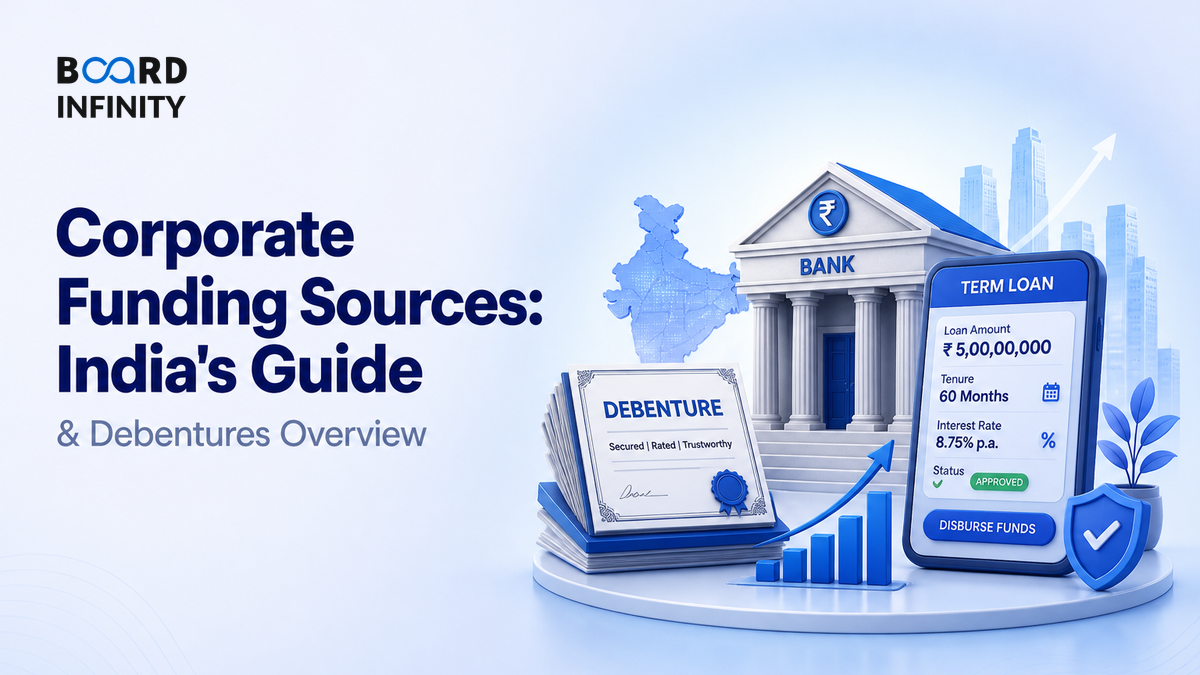
Why would a profitable company borrow money when it can simply use its own cash? Because corporate funding is not about finding money - it is about matching the right money to the right business need without damaging control, liquidity or credit quality.
- Corporate funding is the mix of internal accruals, debt, equity and hybrid instruments used to finance business needs.
- Term loans suit long-term assets with predictable cash flows; working capital loans suit short-term operating gaps.
- Debentures or NCDs let companies borrow from investors, often at scale, but require rating, disclosure, trustee oversight and repayment discipline.
- Equity has no fixed repayment but dilutes ownership and may signal that management wants balance-sheet flexibility.
- The best source depends on purpose, tenor, cost, risk, control, covenants and market access - not coupon rate alone.
- Track debt-equity, interest coverage, DSCR, current ratio and maturity concentration before recommending any funding route.
- Interview-safe line: “Match long-term assets with long-term capital, short-term needs with short-term finance, and always test the balance sheet after funding.”
Big Picture: Funding Is a Matching Problem
A company first identifies the funding need, then matches it to the right tenor, risk profile and capital source. A factory, a seasonal inventory build-up and a loss-making expansion should not be funded the same way.
Core Explanation: The Main Sources of Corporate Funding in India
Think of corporate funding as a capital stack. At the bottom are safer, internally generated funds. As the company needs more money or more flexibility, it moves to external debt, equity or hybrid instruments.
1. Internal Accruals
Internal accruals are profits retained in the business after expenses, taxes, interest and dividends. They are usually the cleanest source because they do not create repayment pressure or dilution.
Best used for: routine capex, small technology upgrades, maintenance spending, organic growth and buffer liquidity. The limitation is scale - internal cash may not be enough for a large acquisition, plant or infrastructure project.
2. Bank Finance: Term Loans and Working Capital Loans
Term loans are borrowings from banks or financial institutions with a fixed repayment schedule over a medium to long period. In India, they are commonly used for plants, machinery, warehouses, hotels, hospitals and other long-life assets.
Working capital finance includes cash credit, overdraft, bill discounting and short-term bank lines used to fund inventories, receivables and day-to-day operating gaps.
The clean rule: long-term assets should be funded with long-term capital; short-term operating gaps should be funded with short-term facilities. Funding a 10-year asset with a 90-day loan creates refinancing risk.
3. Debentures, Bonds and NCDs
A debenture is a corporate debt instrument acknowledging that the company has borrowed money and must repay it with interest. In India, investors often hear the term NCD, or non-convertible debenture, because it does not convert into equity.
NCDs may be secured or unsecured, listed or unlisted, and publicly issued or privately placed. Listed debt securities are regulated through SEBI disclosure and listing norms, while banks and external commercial borrowings are heavily shaped by RBI rules.
Best used for: larger companies with rating access, predictable cash flows and a need to diversify beyond banks. The trade-off is market discipline - rating downgrades, covenant breaches and weak disclosures can make future borrowing expensive.
4. Equity Funding: IPO, FPO, Rights Issue, QIP and Preferential Allotment
Equity raises permanent capital from shareholders. It has no fixed interest payment, which makes it valuable when the company wants to protect cash flows or reduce leverage. But it dilutes existing ownership and may reduce earnings per share in the short run.
Bharti Airtel announced a rights issue in 2021 to raise up to ₹21,000 crore. The strategic logic was not “equity is cheaper than debt”; it was balance-sheet flexibility for a capital-intensive telecom cycle, supported by 5G investment needs, industry consolidation and the need to protect credit quality. So what: equity is often chosen when strategic flexibility matters more than avoiding dilution.
5. Hybrid and Alternative Sources
Hybrid instruments combine features of debt and equity. Examples include preference shares, convertible debentures and optionally convertible instruments. Alternatives include leasing, supplier credit, asset monetisation, InvITs, REITs and project finance structures.
These are useful when a company wants to reduce upfront cash outflow, ring-fence project risk, or monetise mature assets while retaining operating focus.
Term Loans vs Debentures: The Comparison That Often Gets Asked
Both are debt, but they behave differently in sourcing, pricing, flexibility and disclosure. A term loan is negotiated mainly with a bank or financial institution; a debenture is raised from investors through a debt instrument.
How to Choose the Right Funding Source
A strong finance answer uses a sequence. Do not jump directly to “take debt” or “issue equity.” Walk through the purpose and constraints.
Key Metrics to Track Before Recommending Funding
Corporate funding is not complete until you test whether the company can survive the instrument after raising it. These are the five measures interviewers expect you to know.
Worked Example: Should the Company Use a Term Loan, NCD or Equity?
A company needs ₹100 crore for a new plant. Expected annual EBIT after expansion is ₹30 crore. Corporate tax rate is assumed at 25% for a simple classroom calculation.
The best answer is not “NCD because coupon is lower.” It is: a blended structure may be better because it protects coverage while reducing dilution.
Definitions: Say These Cleanly
- Corporate funding: The mix of capital sources a company uses to finance operations, assets, growth and obligations.
- Internal accruals: Profits retained in the business after meeting operating costs, taxes, interest and shareholder distributions.
- Term loan: A bank or institutional loan repaid over an agreed period through scheduled instalments.
- Debenture: A corporate debt instrument through which a company borrows and promises interest and principal repayment.
- NCD: A non-convertible debenture that remains debt and does not convert into equity shares.
- Equity funding: Capital raised by issuing ownership shares, with no fixed repayment obligation but ownership dilution.
- Hybrid capital: Funding that combines debt-like and equity-like features in one instrument.
Case Study: Tata Power Funding Its Renewable Growth
Tata Power used a mix of strategic equity, project finance and corporate funding discipline to support renewable energy growth without relying on one source of capital.

Situation: Renewable power requires large upfront investment, long asset lives and patient capital. A company funding such growth only through short-term borrowing would create a dangerous mismatch: cash outflows arrive immediately, while project cash inflows build over years.
The move: Tata Power Renewable Energy announced in 2022 that a BlackRock Real Assets-led consortium, including Mubadala, would invest around ₹4,000 crore in its renewable energy platform. This was not just “raising money.” It brought strategic equity into the renewables platform, while project-level debt and operating cash flows could support asset execution.
Outcome and lesson: The primary driver was matching the nature of capital to the nature of assets - long-term renewable assets needed long-term, risk-bearing capital. Supporting drivers included Tata Power’s operating track record, the credibility of strategic investors, the broader energy-transition theme and the ability to combine equity cushion with debt capacity. The lesson: capital-intensive growth is rarely funded well by one instrument; the funding architecture matters.
How AI Changes Corporate Funding in India
AI is changing the funding process less like magic and more like a sharper treasury analyst. The core finance logic remains the same, but the speed of analysis improves.
- AI-assisted credit assessment: Banks and NBFCs increasingly use data models to evaluate borrower behaviour, cash-flow patterns, GST-linked business signals and early warning indicators. The caveat is governance - models must avoid unfair bias and remain explainable for credit decisions.
- Smarter treasury and debt-market scanning: Corporate treasury teams can use AI tools to track yield movements, comparable NCD issuances, rating commentary, covenant language and refinancing windows faster than manual monitoring.
- Faster investor communication: LLMs can summarise draft offer documents, earnings calls and rating rationales, helping CFO teams prepare clearer QIP, rights issue or NCD communication. Human review is still essential because securities disclosures cannot tolerate hallucinated claims.
Load a company annual report, credit-rating rationale and recent investor presentation into NotebookLM. Ask: “Identify its funding sources, debt maturity risks, interest coverage trend and likely reasons for choosing debt versus equity.” Then verify every number in the original documents before using it.
Interview Relevance
“A manufacturing company in India needs ₹500 crore for expansion. How would you decide whether it should use a term loan, issue debentures or raise equity?”
Use the phrase “funding mix” instead of forcing one source. Real CFOs often combine internal accruals, bank lines, market debt and equity to balance cost, control and risk.
The biggest mistake is choosing the source with the lowest visible cost, usually the lowest coupon. That misses covenants, repayment pressure, refinancing risk, dilution, signalling and maturity mismatch. One-line fix: recommend funding only after matching purpose, tenor and post-funding credit metrics.
What to Revise Next
Once you understand how companies raise money, revise how they return money and how they manage cash inside the operating cycle. Go next to Dividend Policy, Buybacks & the Signalling They Send, then Working Capital Management & the Cash Conversion Cycle.