
Setting a Debt Policy: Answer Leverage Targets, Covenants and Rating Impact with Confidence
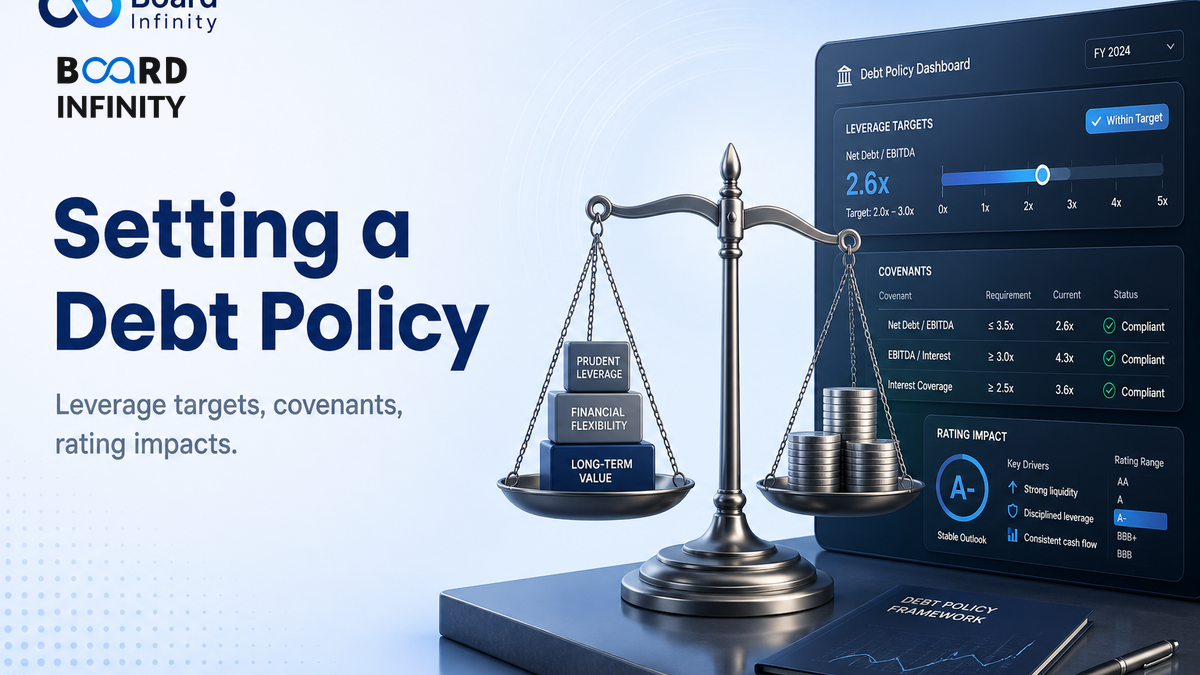
In 2020, Reliance Industries did something unusual for a company famous for giant capital bets: it publicly pushed toward becoming net-debt-free, using stake sales and a rights issue to reset its balance sheet. That is debt policy in action - not “avoid debt”, but decide how much debt protects growth without letting lenders, covenants or rating agencies start running the strategy.
- Debt policy is the company's rulebook for how much debt it will carry, on what terms, and with what rating risk.
- The target is not “maximum debt”; it is the range where the tax shield and cheaper funding outweigh distress risk and loss of flexibility.
- Interview answer anchor: business risk first, then cash-flow coverage, asset base, capex plan, covenant headroom and rating goal.
- Key ratios: Net Debt/EBITDA, Interest Coverage, DSCR, Debt/Equity, FFO/Debt and liquidity coverage.
- Covenants are lender guardrails - they can restrict dividends, extra borrowing, asset sales, related-party transactions and minimum ratios.
- Ratings matter because they influence funding access, coupon/spread, investor base and refinancing risk.
- The safest answer is a target range with headroom, not a single heroic leverage number.
Big Picture
A good debt policy converts strategy into financing discipline. It starts with the business model, translates risk into leverage capacity, designs covenants that the firm can live with, and checks whether the resulting balance sheet supports the desired credit rating.
Core Explanation
Debt creates value until it starts threatening value. It can lower the weighted average cost of capital because interest is tax-deductible and debt is usually cheaper than equity. But too much debt increases default risk, covenant pressure, refinancing risk and strategic inflexibility.
The practical CFO question is: “How much debt can this business carry through a bad year without losing control of its choices?” That is why a debt policy usually specifies five things:
The Trade-Off: Why the Best Debt Level Is a Range
Debt policy is built on a trade-off. At low leverage, the company may be underusing cheap debt and tax shields. At extreme leverage, lenders demand higher spreads, ratings weaken, covenants tighten and equity value becomes more fragile. The “right” zone sits before financial distress costs dominate.
How to Set the Leverage Target
Start with the company's operating risk, not with peer averages. Two firms with the same Debt/Equity ratio can have very different debt capacity if one has stable regulated cash flows and the other sells cyclical commodities.
Key Metrics to Track
Do not quote these as universal rules. A utility, bank, cement company, SaaS firm and steel company have different safe leverage. For interviews, use the ranges below as practical corporate-finance heuristics and always say “industry dependent.”
Worked Example: Debt Capacity in 60 Seconds
Suppose a manufacturing company has EBITDA of ₹1,000 crore, total debt of ₹2,500 crore, cash of ₹500 crore and annual interest of ₹250 crore.
The lesson: debt policy must examine the timing gap between borrowing today and earning EBITDA later. Many weak answers miss this.
Covenants: The Lender's Control Panel
A covenant is a contractual promise in a debt agreement. It exists because lenders cannot manage the company daily, so they protect themselves by defining what the borrower must maintain, avoid or report.
Good covenant design protects lenders without making normal business impossible. A company should negotiate headroom for seasonality, capex ramp-up, working-capital spikes and industry downturns.
Rating Impact: Why Leverage Becomes a Funding Cost Story
A credit rating is not just a label. It affects the investor base, coupon, refinancing flexibility and sometimes the ability to bid for large contracts. Rating agencies look beyond one ratio: they combine business risk, financial risk, liquidity, governance and event risk.
Reliance Industries' net-debt-free push around 2020 was not simply “debt is bad.” The primary driver was balance-sheet flexibility before another investment cycle, supported by Jio Platforms stake sales, a rights issue and strong operating businesses. The strategic so what: deleveraging can be a growth enabler when it lowers rating and refinancing risk.
Definitions
- Debt policy: A company's framework for debt level, maturity, covenants, liquidity and rating risk.
- Leverage: The use of debt financing to magnify returns, risks and fixed payment obligations.
- Covenant: A binding debt-agreement condition that restricts or requires borrower actions to protect lenders.
- Credit rating: An independent opinion on an issuer's relative ability and willingness to meet debt obligations.
- Rating headroom: The cushion between current credit metrics and the level likely to trigger a downgrade.
Bharti Airtel: Debt Policy Under a Telecom Investment Cycle
Bharti Airtel shows how a capital-intensive company can use equity, tariff repair, refinancing and operating cash flow to manage leverage while still investing in networks.

Situation: Indian telecom became intensely competitive after aggressive pricing disrupted the market. Airtel needed to keep investing in spectrum, 4G capacity and later 5G, while protecting balance-sheet flexibility in a sector with large upfront commitments and long payback periods.
The move: Airtel did not rely on one lever. The primary driver was improving operating cash generation through market repair and subscriber monetisation. Supporting drivers included a ₹21,000 crore rights issue announced in 2021, active refinancing, disciplined capex phasing, and management of spectrum-related liabilities. In the 2022 5G auction, Airtel acquired spectrum for ₹43,084 crore, making leverage discipline even more central.
Outcome or lesson: Airtel's case teaches that debt policy is dynamic. A firm can accept higher debt during a strategic investment cycle if it has credible cash-flow improvement, access to capital markets, manageable maturity walls and enough rating headroom. The best answer is not “telecom has high debt”; it is “telecom can carry debt only if ARPU, churn, capex intensity, spectrum payments and refinancing access support coverage.”
How AI Changes Debt Policy
AI is making debt policy more data-driven, especially for treasury teams, credit analysts and rating advisory work.
Student workflow: Load a company's annual report, latest investor presentation and a rating rationale into NotebookLM. Ask it to produce: “What leverage, coverage, liquidity and rating-risk questions should an interviewer ask me about this company?” Then verify every number manually before using it.
Interview Relevance
“A manufacturing company is planning a large capex project. How would you decide its debt policy, and how could the decision affect covenants and credit rating?”
Use this sentence: “I would not set debt policy from peer Debt/Equity alone; I would set it from downside cash-flow coverage and rating headroom.” It sounds like a CFO answer.
Common Mistake
The biggest mistake is treating debt policy as a single Debt/Equity ratio. That costs candidates because lenders and rating agencies care more about cash-flow coverage, liquidity, maturity profile and covenant headroom. One-line fix: always triangulate leverage from business risk plus cash-flow ratios plus rating impact.
What to Revise Next
Debt policy is the “how much borrowing is safe?” chapter. Next, revise where the money can actually come from and how payout decisions signal confidence or constraint.