
AI in Employee Engagement Explained
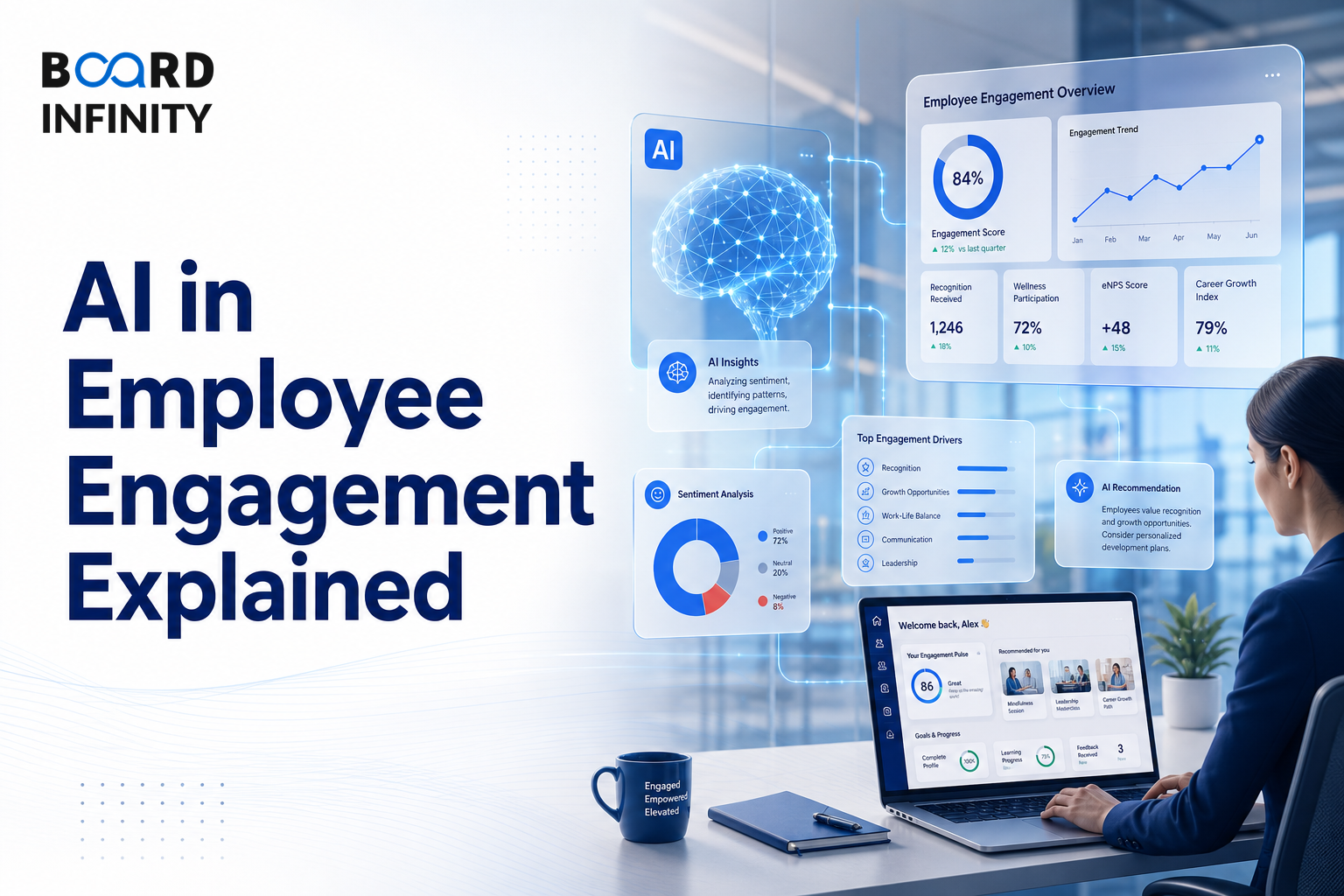
After AI in Recruitment, the next question is how AI supports employees after they join the organisation. AI in employee engagement matters because it moves beyond annual surveys to continuous, intelligent listening, helping HR detect sentiment trends and predict flight risk before disengagement becomes attrition. In interviews, this topic tests whether you can connect AI tools to real HR outcomes rather than describe them as generic dashboards.
- Employee engagement AI tools move beyond annual surveys to continuous, intelligent listening.
- They use natural language processing (NLP) to analyse open-text responses, detect sentiment trends, and predict flight risk.
- The core business value is enabling HR to act before disengagement becomes attrition.
- Amber by inFeedo is conversational AI where a chatbot conducts monthly check-ins, NLP analyses responses, and flags at-risk employees.
- Peoplebox links OKR progress to engagement scores and AI recommends interventions based on goal-engagement correlation.
- Leena AI resolves 80%+ of HR queries automatically, while Culture Amp benchmarks survey results against 3,000+ companies.
- Vantage Circle applies AI-driven peer recognition, reward recommendations, and wellness programme integration.
From Annual Surveys to Continuous Listening
Employee engagement AI tools move beyond annual surveys to continuous, intelligent listening. They use natural language processing (NLP) to analyse open-text responses, detect sentiment trends, and predict flight risk - enabling HR to act before disengagement becomes attrition.
What AI in Employee Engagement Actually Does
The big shift is from periodic survey reporting to always-on listening. Instead of waiting for annual survey results, these tools continuously collect signals through check-ins, open-text responses, engagement scores, HR queries, recognition activity, and related engagement inputs.
Natural language processing (NLP) is central to this shift. NLP analyses open-text responses, detects sentiment trends, and supports flight-risk prediction, so HR can identify employees who may be at risk before disengagement turns into attrition.
How the Main Tool Categories Differ
Amber by inFeedo represents conversational AI for engagement. Its chatbot conducts monthly check-ins, NLP analyses responses, and the system flags at-risk employees, with a strong India presence through use by 200+ Indian companies.
Peoplebox connects engagement with goal progress. It links OKR progress to engagement scores and uses AI to recommend interventions based on goal-engagement correlation.
Leena AI sits closer to the HR helpdesk chatbot category. It resolves 80%+ of HR queries automatically for leave, payroll, and policies, and includes multilingual support.
Culture Amp focuses on engagement analytics. It benchmarks survey results against 3,000+ companies, and driver analysis identifies what moves engagement.
Vantage Circle connects engagement with rewards and recognition. It uses AI-driven peer recognition, reward recommendations, and wellness programme integration.
Why It Matters for HR Teams
The core value of AI in employee engagement is not just faster reporting. It is the ability to detect sentiment trends, predict flight risk, and act before disengagement becomes attrition.
This is why the topic is important in placement interviews. A strong answer should explain the movement from annual survey snapshots to continuous listening, then connect specific tools to their AI capability and India presence.
Nuance: Engagement AI Is Not One Single Tool Type
AI in employee engagement spans multiple categories. Amber by inFeedo is conversational AI, Peoplebox is OKR + Engagement, Leena AI is an HR helpdesk chatbot, Culture Amp is engagement analytics, and Vantage Circle is rewards & recognition.
This distinction matters because each tool listens to different signals and creates different interventions. In many organisations, ownership may overlap across HR business partners, people analytics teams, HR operations, and rewards teams depending on the business model.
Structuring a AI in Employee Engagement Explained Interview Answer
"How do AI tools in employee engagement move beyond annual surveys, and how do they help prevent attrition?"
Do not describe engagement AI as just a survey dashboard. The stronger interview answer highlights continuous listening, NLP analysis of open-text responses, sentiment trends, flight-risk prediction, and timely HR intervention.
Conclusion
AI in employee engagement is best understood as a shift from periodic survey reporting to continuous, intelligent listening. The final takeaway is simple: the value lies in detecting sentiment trends and predicting flight risk early enough for HR to act before disengagement becomes attrition.
The most frequent error is treating AI in employee engagement as only an annual survey analytics tool. That misses the main shift to continuous, intelligent listening, NLP analysis of open-text responses, sentiment trends, and proactive flight-risk prediction before disengagement becomes attrition.