
Where AI Is Landing in Telecom & Digital Infrastructure
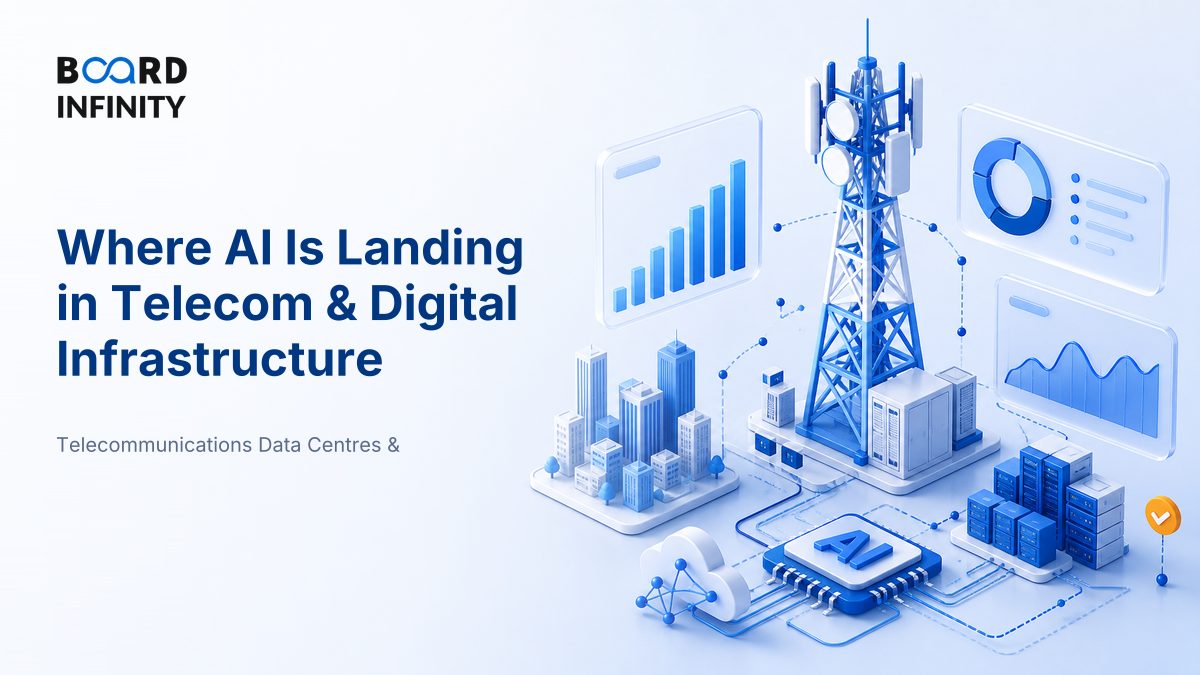
A telecom network used to wait for trouble: a cell site went down, customers complained, engineers traced the fault. The AI version is different - the network spots abnormal traffic, predicts congestion, flags spam, reroutes capacity and nudges the field team before the pain becomes visible.
- AI in telecom lands first where data is dense and decisions repeat: network operations, fraud, customer care, energy, field service and capacity planning.
- The core shift is from reactive to predictive: fix after failure becomes prevent, optimize and automate.
- Digital infrastructure expands the canvas: towers, fibre, data centres, cloud, edge nodes and private networks all become AI-managed assets.
- The best interview answer separates network AI, customer AI, infrastructure AI and enterprise AI instead of saying “AI improves efficiency”.
- Measure value with hard operating metrics: network availability, mean time to repair, energy per site, churn, first-contact resolution and fraud loss rate.
- The risk side matters: privacy, model bias, false positives, cyber exposure, vendor lock-in and explainability in regulated operations.
- India angle: AI is especially relevant because telecom scale, low ARPU pressure, spam control, 5G enterprise use cases and fibre/data-centre build-out all demand automation.
Big Picture: AI Turns Telecom from a Utility Pipe into a Learning System
Telecom and digital infrastructure are no longer just about spectrum, towers and fibre. They are becoming sensing systems: every call drop, tower alarm, billing anomaly, app complaint and enterprise traffic pattern becomes a signal that AI can learn from.
Where AI Is Actually Landing
The easiest way to revise this topic is to remember four landing zones. Each one has a different buyer, metric and risk.
1. Network operations - the biggest operating leverage
This is where AI monitors radio access networks, core networks and transport layers to detect anomalies, predict congestion and recommend fixes. In plain English: fewer outages, faster repair and better capacity utilization.
Typical applications include:
- Predictive maintenance - spotting failure patterns in towers, batteries, cooling units and fibre routes.
- Self-optimizing networks - adjusting parameters to improve coverage, handovers and capacity.
- Traffic forecasting - predicting spikes during events, festivals, commutes or app launches.
- Root-cause analysis - helping network teams locate whether a fault came from power, equipment, fibre, software or configuration.
2. Customer and revenue operations - where AI meets the user
AI also lands in the commercial layer: call-centre automation, next-best-offer engines, churn prediction, spam detection, KYC fraud monitoring and billing dispute triage. This is visible to customers, so accuracy and trust matter as much as efficiency.
3. Digital infrastructure - towers, fibre, data centres and edge
Digital infrastructure providers use AI to run distributed assets more efficiently. A tower company cares about uptime, energy, technician productivity and battery health. A data-centre operator cares about power usage, cooling, server workload and downtime risk. A fibre provider cares about route planning, cuts, restoration time and utilization.
4. Enterprise connectivity - private 5G, IoT and edge AI
For factories, ports, hospitals, campuses and warehouses, telecom operators increasingly sell outcomes, not just connectivity. AI can sit at the edge to support video analytics, predictive maintenance, worker safety, robotics and quality inspection. The telco opportunity is to bundle network reliability, edge compute and analytics.
The Four-Zone Interview Framework
When asked “Where is AI used in telecom?”, do not list random use cases. Use this matrix: high operational value on one axis, high trust or regulatory sensitivity on the other.
A useful interview line: “AI in telecom creates value where repeated decisions meet large machine-generated data, but the governance bar rises when AI touches customers, billing, privacy or service availability.”
Definitions You Should Be Able to Say Cleanly
The ITU Constitution defines telecommunication as: “Any transmission, emission or reception of signs, signals, writings, images and sounds or intelligence of any nature by wire, radio, optical or other electromagnetic systems.”
- Digital infrastructure: The physical and software backbone that stores, moves, processes and secures digital activity.
- AI in telecom: Machine learning and automation applied to network, customer, infrastructure and enterprise-connectivity decisions.
- Edge computing: Processing data near the source instead of sending everything to a distant cloud.
- Self-optimizing network: A network that monitors itself and automatically recommends or applies performance improvements.
Metrics That Prove AI Is Working
A strong answer does not stop at “AI improves efficiency”. It names the KPI. Telecom is an operations-heavy sector, so AI must show up in reliability, cost, revenue protection or customer experience.
Use one of these metrics in every answer. If you are discussing network AI, say availability and repair time. If you are discussing customer AI, say churn and first-contact resolution. If you are discussing tower or data-centre AI, say energy and uptime.
Mini Case Study: Bharti Airtel and Network-Level Spam Detection
Bharti Airtel used AI at the network layer to warn customers about suspected spam communication, showing how telecom AI can protect trust, not just reduce cost.

Situation: In India, unwanted commercial calls and fraudulent communication are a daily customer pain point. The problem is hard because the network must distinguish legitimate communication from suspicious patterns at huge scale without blocking genuine calls.
The move: Airtel announced a network-based AI-powered spam detection solution in 2024, positioning it as a service that can warn customers about suspected spam calls and messages before they respond (Bharti Airtel press release, 2024). The primary driver is network-level pattern recognition: the operator can analyze calling and messaging signals that a standalone handset app may not see as completely. Supporting drivers include customer-scale data, real-time alerting, integration with the communication experience and continuous learning from suspicious patterns.
Outcome and lesson: The strategic lesson is bigger than spam. Airtel is showing that telecom AI can become a trust layer. In a low-switching-friction market, customer trust is not soft branding - it can support retention, usage and willingness to adopt more digital services.
The India-Specific Angle
India makes this topic sharper because telecom combines massive user scale, intense price competition, 5G enterprise ambitions and fast-growing digital infrastructure. AI is not a premium experiment here; it is a way to run huge networks and customer operations without letting cost rise linearly with traffic.
Three India-specific mechanics matter:
- Scale pressure: Large subscriber bases generate huge network and service data, making manual monitoring impossible at the edge.
- Trust and compliance pressure: Spam, fraud, consent, privacy and commercial communication rules make AI governance important. If you need a quick regulatory lens, revise locating the regulator and what it controls.
- Infrastructure build-out: More fibre, towers, edge nodes and data centres create distributed assets that need predictive maintenance and energy optimization.
How AI Changes Telecom & Digital Infrastructure
1. From NOC dashboards to AI-assisted network operations
The network operations centre is shifting from alarm-watching to decision support. AI groups alarms, detects abnormal patterns, suggests root causes and recommends field action. The human role moves toward exception handling, service assurance and governance.
2. From generic customer care to intent-aware service
GenAI can summarize customer history, draft responses, guide agents, classify complaints and help customers troubleshoot devices or plans. The danger is over-automation: a telecom complaint often involves emotion, money and service disruption, so escalation design matters.
3. From passive infrastructure to predictive infrastructure
Towers, data centres and fibre networks are becoming AI-managed asset pools. AI can prioritize battery replacement, predict cooling stress, optimize field routes and plan capacity. For interview preparation, annual reports are useful because they reveal whether a company is asset-heavy, service-heavy or platform-heavy; use this method for reading an annual report for sector insight.
4. Student workflow using AI
Use NotebookLM like a sector analyst: upload a telecom operator annual report, one investor presentation and one regulator note, then ask: “Create a two-page brief on where AI could reduce cost, improve customer trust and create enterprise revenue. Separate facts from assumptions.” Cross-check the output using the discipline in using AI to research a sector without importing its errors.
Interview Relevance
“Where do you see AI creating the most value in telecom and digital infrastructure over the next three years?”
A polished answer sounds like this: “The biggest AI value in telecom is not one chatbot. It is a stack - predictive networks at the bottom, smarter infrastructure in the middle, customer trust at the front end and enterprise AI use cases on top.”
Common Mistake
The mistake: Saying “AI will improve customer service and reduce costs” without naming where, how and what metric changes. It sounds generic and could apply to any sector. The fix: anchor every AI use case to one telecom asset, one decision and one KPI.