
Regulation and the Bodies That Govern Telecom & Digital Infrastructure
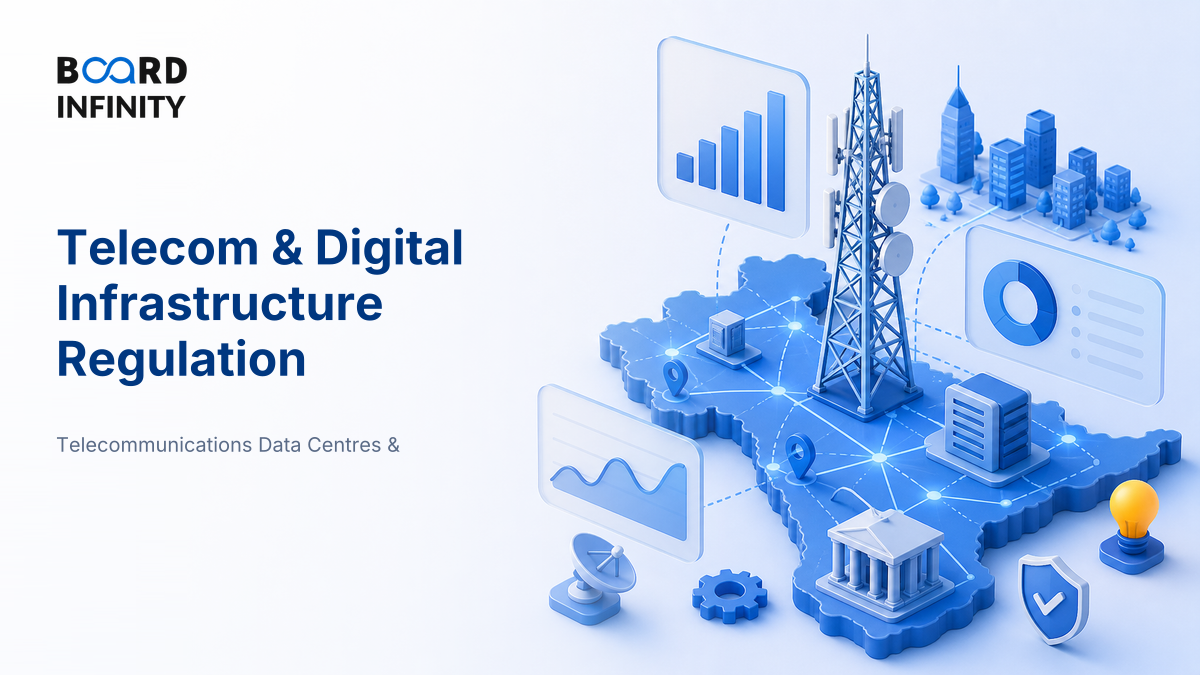
Who really controls your video call - the tower company, the telecom operator, the spectrum ministry, the cyber agency, or the competition regulator? Telecom and digital infrastructure look like private business, but the real operating system underneath is regulation: licences, spectrum, rights of way, cybersecurity, quality norms and dispute resolution.
- DoT is the policy, licensing and spectrum anchor for telecom in India; think “permission to operate and use airwaves.”
- TRAI is the sector regulator for tariffs, interconnection, quality of service and recommendations; think “market rules and consumer outcomes.”
- TDSAT handles sector disputes and appeals; think “specialised telecom courtroom.”
- MeitY and CERT-In matter when telecom becomes digital infrastructure - cloud, cybersecurity, incidents, platforms and data governance.
- CCI enters when market power, mergers, cartels or abuse of dominance are at stake.
- The smartest answer maps the asset first - spectrum, tower, fibre, data centre, cloud, satellite, app layer - and then identifies the controlling body.
- The common trap is saying “TRAI regulates telecom” as if it regulates everything. It does not.
Big Picture - Regulation Is the Hidden Stack Under the Network
Do not memorise regulators as a list. Visualise telecom and digital infrastructure as a stack: physical assets at the bottom, service rules in the middle, and market-security-consumer guardrails on top. If you want a more general method for this mapping, revise locating the regulator and what it controls before using this sector map.
Core Explanation - Who Governs What
The telecom and digital infrastructure sector is not governed by one super-regulator. It is governed by layered authority. One body may grant licences, another may frame service rules, another may handle cyber incidents, and another may investigate competition issues.
The easiest way to answer is to ask: What is being controlled? Spectrum is different from fibre. Fibre is different from a data centre. A data centre is different from a consumer app running on top of it.
The 2x2 Map - Sector-Specific vs Horizontal Regulation
Telecom answers become sharp when you separate sector-specific controls from horizontal controls. Sector-specific controls apply because the asset is telecom. Horizontal controls apply because every large digital business must follow them - competition, cybersecurity, consumer and data-related obligations.
This is why digital infrastructure projects feel messy. A telecom operator may satisfy central licensing requirements but still need local right-of-way permissions for fibre. A data centre may be less spectrum-heavy but more exposed to power, land, cybersecurity and data-governance requirements.
The Regulatory Lifecycle - From Permission to Dispute
For any telecom or digital infrastructure business, regulation follows a lifecycle. Use this lifecycle to structure answers on operators, tower companies, fibre networks, satellite broadband, data centres and cloud infrastructure.
Definitions - Say These Cleanly
- Telecommunication: The ITU Constitution defines it as “any transmission, emission or reception of signs, signals, writings, images and sounds or intelligence of any nature by wire, radio, optical or other electromagnetic systems.”
- Telecom regulator: A public authority that sets, monitors or enforces rules for telecom market conduct and consumer outcomes.
- Digital infrastructure: Shared physical and logical assets - networks, towers, fibre, data centres, cloud and security rails - enabling digital services.
- Right of way: Permission to lay fibre, install towers or use land and public assets for connectivity infrastructure.
Case Study - Indus Towers and the Regulatory Plumbing Behind 5G
Indus Towers shows why telecom infrastructure success depends not only on capital and engineering, but also on permissions, standards, local execution and regulatory coordination.

Indus Towers is a major Indian telecom tower infrastructure company, operating in the business of passive infrastructure that mobile operators use to host network equipment, as described by Indus Towers. Its work sounds simple - provide towers and related infrastructure - but the regulatory reality is layered.
Situation: As Indian networks densify for 4G capacity and 5G coverage, operators need more sites, better backhaul, faster permissions and reliable power. Tower companies sit in the middle: they are not always the customer-facing telecom brand, but without their sites, radio equipment cannot serve users.
The move: The tower-infra model depends on standardised site deployment, coordination with telecom operators, compliance with electromagnetic field norms, right-of-way approvals and local permissions. Government digital permissioning through the GatiShakti Sanchar portal is relevant here because right-of-way and infrastructure approvals can determine how quickly fibre and towers are deployed.
The result or lesson: The primary driver of tower infrastructure success is not “more towers” alone. It is regulatory execution at scale - supported by operator tenancy, site uptime, local permissions, power availability, safety compliance and faster coordination between central and state systems.
So what: In telecom infrastructure, advantage comes from combining capital discipline with regulatory fluency. A candidate who sees only “network rollout” misses the operating constraint; a candidate who sees permissions, standards and local execution sounds industry-ready.
How AI Changes Regulation and the Bodies That Govern Telecom & Digital Infrastructure
AI is changing this topic in practical, regulator-facing ways - not by replacing regulators, but by increasing what they can monitor and what companies must evidence.
Student workflow: Use NotebookLM or Claude to build a regulator map. Upload one company annual report, DoT or TRAI public pages, and your sector notes. Ask: “Create a table of regulators, what they control, company exposure, and likely interview questions.” Then verify every legal or numeric claim manually. For a safe research workflow, use AI to research a sector without importing its errors.
Interview Relevance
“If you were analysing a telecom tower company or data-centre company in India, which regulators and government bodies would you track, and why?”
A strong answer sounds like this: “I would not treat telecom regulation as one box. I would map it by asset - spectrum, tower, fibre, data centre, cloud - and then identify the body controlling permission, operations, competition, cyber risk and disputes.”
Common Mistake
The mistake: Saying “TRAI regulates telecom” and stopping there. Why it hurts: it ignores DoT’s licensing and spectrum role, TDSAT’s dispute role, MeitY and CERT-In’s digital-cyber layer, CCI’s competition role, and local right-of-way execution. One-line fix: always answer with “asset - permission - operating rule - market/cyber layer - dispute forum.”