
How Analytics Data Is Stored: Databases, Warehouses & Lakes
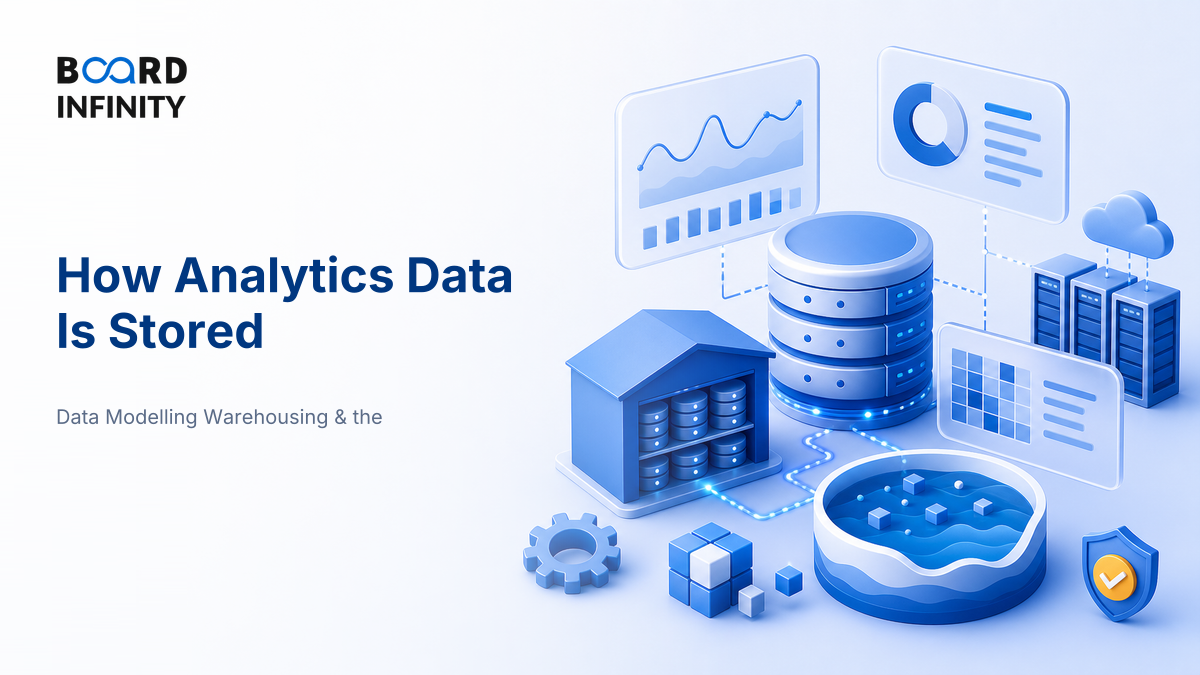
Every time you tap “Pay” on a UPI app, two very different worlds wake up: one system must confirm the transaction instantly, while another quietly stores history for fraud checks, merchant dashboards and regulatory reporting. The surprise is that good analytics usually starts by not analyzing the live transaction database directly.
- Database stores current operational data for applications - orders, payments, users, inventory.
- Data warehouse stores cleaned, structured, historical data optimized for business reporting and analytics.
- Data lake stores raw data in many formats - tables, logs, images, JSON, audio - before all use cases are known.
- The core flow is: operational database → raw lake → curated warehouse → dashboards, ML and decisions.
- Use a warehouse when the question is structured and recurring: revenue by city, CAC by channel, churn by cohort.
- Use a lake when the data is raw, large or semi-structured: clickstream logs, app events, support chats, images.
- The biggest interview trap: saying “warehouse and lake are the same storage with different names.” They solve different problems.
The Big Picture: Data Storage Is a Journey, Not a Box
Think of analytics storage as a pipeline. A live application needs fast, safe transactions. A business team needs clean history. A data science team needs raw signals. One storage layer rarely serves all three well.
Core Explanation: The Three Storage Layers
The cleanest way to understand this topic is to ask: What job is this storage layer hired to do?
1. Operational Database - Run the Business
A database is where applications store and retrieve current records. For example, an e-commerce app needs to check whether a customer exists, whether an item is in stock and whether payment succeeded.
Databases are usually optimized for OLTP - Online Transaction Processing. That means many small reads and writes, high concurrency and strong correctness. If a payment is debited twice or inventory goes negative, the business has a real problem.
2. Data Warehouse - Understand the Business
A data warehouse is built for OLAP - Online Analytical Processing. Instead of handling one order at a time, it answers questions across millions of records: “Which city had the highest repeat purchase rate?” or “Which channel gives profitable customers?”
Warehouses contain cleaned, joined and modeled data. They are usually structured into business-friendly tables such as fact_orders, dim_customer and dim_product.
3. Data Lake - Preserve the Raw Material
A data lake stores raw data at scale before every future use case is known. It can hold structured tables, semi-structured JSON, clickstream events, customer support transcripts, images and machine logs.
The value of a lake is optionality. You may not know today which app event predicts churn, which image improves quality inspection, or which support phrase signals dissatisfaction. The lake keeps the raw evidence available.
Warehouse vs Lake vs Lakehouse: The Simple Mental Model
The old trade-off was simple: warehouses gave structure and trust, lakes gave flexibility and scale. Modern lakehouse architectures try to combine both by adding warehouse-like reliability, governance and table formats on top of low-cost lake storage.
The Practical Architecture: Bronze, Silver and Gold
Many analytics teams use a layered pattern to stop the lake from becoming a dumping ground. The names vary, but the logic is consistent: keep raw data, clean it, then publish trusted business-ready datasets.
Definitions You Can Say in One Breath
- Data warehouse - W. H. Inmon: “A subject-oriented, integrated, time-variant, nonvolatile collection of data in support of management's decisions.”
- Database: An organized collection of related data stored electronically and managed for efficient access, update and control.
- Data lake: A storage repository that holds raw data in native formats until it is needed for analytics or AI.
- ETL: Extract, Transform, Load - data is cleaned before loading into the target system.
- ELT: Extract, Load, Transform - raw data is loaded first and transformed inside the analytics platform.
How to Choose the Right Store
In an interview or case, do not choose storage based on fashion. Choose it based on workload, data type, latency, governance and cost.
Metrics That Tell You Whether the Storage Layer Is Working
Analytics storage is not “good” just because it is modern. A strong architecture is measurable: it is fresh enough, fast enough, trusted enough and affordable enough for the decisions it supports.
Worked Example: Why Raw Data Usually Goes to a Lake First
Suppose a food delivery company generates 200 GB of raw app events per day. It wants to keep 90 days of raw events and also maintain a curated warehouse dataset that is 40% of raw size after cleaning and aggregation.
The lesson is not that lakes are always cheaper or warehouses are always expensive. The lesson is architectural: store raw breadth separately from curated business truth.
Case Study: NPCI and UPI - Separating Instant Payments from Analytics
NPCI's UPI ecosystem shows why payment transactions and analytics workloads must be separated: one protects real-time trust, the other extracts system-wide intelligence.

Situation: UPI is a real-time payments network connecting consumers, merchants, payment apps and banks. The core payment flow must be fast, reliable and correct. At the same time, the ecosystem needs reconciliation, fraud monitoring, bank reporting, merchant insights and regulatory visibility.
The strategic move: The important design principle is workload separation. Transactional systems focus on live payment authorization and status updates. Analytical systems consume copied, logged or processed data for reporting, risk analysis and trend discovery. This prevents heavy analytical scans from interfering with payment reliability.
Outcome and lesson: The primary driver is separation between OLTP reliability and OLAP insight. Supporting drivers include standardized transaction messages, partner-bank reconciliation, audit trails, access controls and governance around sensitive financial data. The “so what” for interviews: in high-trust businesses, analytics architecture is not a back-office IT choice - it is part of operating risk management.
Real Example: Zomato's Analytics Needs Multiple Stores
Zomato has to handle live orders, restaurant availability, delivery partner location signals, customer events and business dashboards. A transactional database is suited to order state changes; a lake can preserve raw app and logistics events; a warehouse can power cleaned metrics such as city-level demand, repeat ordering and campaign performance. The strategic point: customer experience depends on operational speed, while growth decisions depend on analytical history.
How AI Changes Analytics Data Storage
AI makes this topic more important, not less. Models are only as good as the data foundation feeding them.
- Vector databases become a new storage layer: AI applications store embeddings of text, images or documents so that systems can retrieve semantically similar information, not just exact keyword matches.
- Lakehouses become AI-ready foundations: GenAI and ML teams need raw data, curated labels, governance and lineage together. A lakehouse pattern helps connect large-scale data storage with model development.
- Metadata and governance get automated: AI tools can help classify sensitive fields, generate dataset descriptions, detect schema drift and suggest lineage, but humans must still validate access and compliance.
Use NotebookLM or ChatGPT: upload a company annual report, app description or business model note, then ask, “List the operational data, analytical data, likely warehouse tables and possible data lake sources for this business.” Convert the answer into a 60-second interview explanation.
Interview Relevance
“Explain the difference between a database, a data warehouse and a data lake. If you were designing analytics for an Indian fintech or e-commerce company, where would each be used?”
Use the phrase “separate systems of record from systems of insight”. It signals that you understand both business operations and analytics architecture.
Common Mistake
The costly mistake is treating database, warehouse and lake as interchangeable storage boxes. That answer sounds superficial because it ignores workload, latency, data quality and governance. One-line fix: always explain the business job first - run transactions, store raw signals or publish trusted analytics.
What to Revise Next
Now that you know where analytics data lives, revise the two ideas that make the architecture interview-ready: how transactional and analytical processing differ, and how warehouse tables are designed for analysis.