
Design a Warehouse Model for a Delivery Business - Interview Framework, Metrics and Case Study
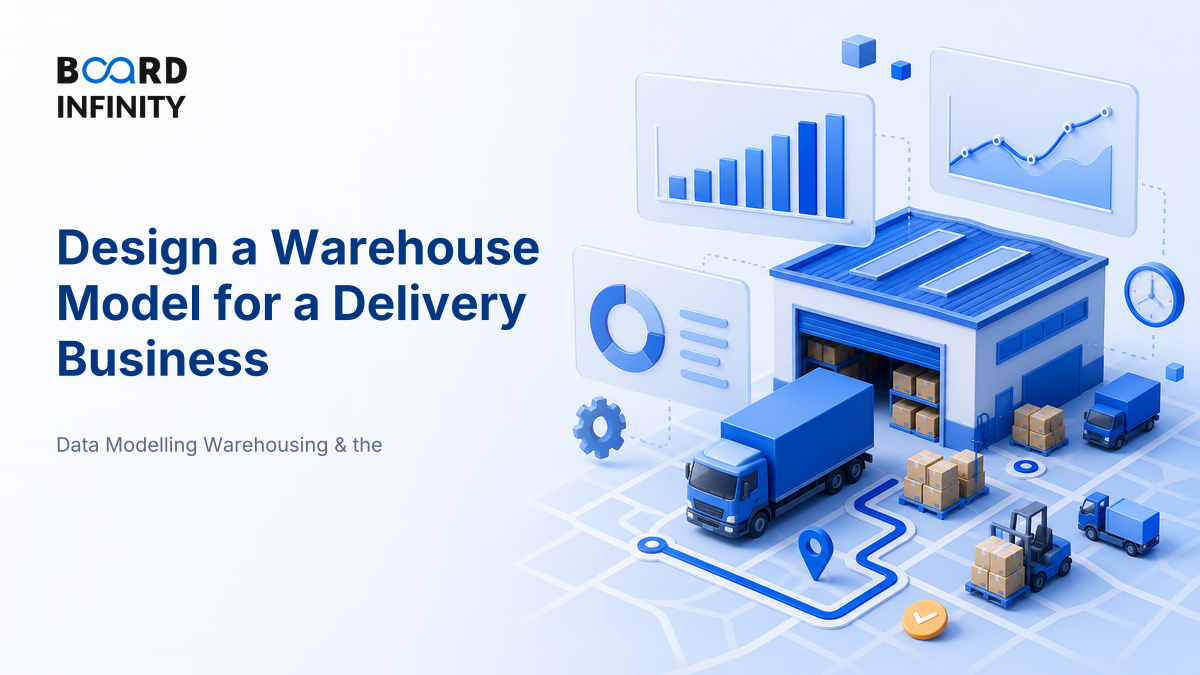
At 9 p.m., a poorly designed delivery warehouse looks like a traffic jam wearing a barcode - riders waiting, parcels piled near the gate, supervisors chasing missing scans. In a well-designed model, the same demand becomes a rhythm: inbound sorted before peak, fast-moving items near dispatch, vehicles leaving in waves, and exceptions visible before customers complain.
- A warehouse model for delivery is the design of nodes, flow, capacity, technology and KPIs that converts orders into reliable dispatches.
- The core trade-off is speed versus cost versus reliability - faster delivery usually needs more nodes, more inventory, or better sorting discipline.
- Do not start with building size. Start with customer promise, demand density, order profile and service geography.
- Common models include central warehouse, hub-and-spoke, regional fulfilment, cross-dock and dark-store networks.
- Capacity must be designed for peak waves and cut-off times, not average daily demand.
- Track warehouse success using on-time dispatch, order cycle time, pick accuracy, cost per order, space utilization and inventory accuracy.
- A strong interview answer shows the network choice, internal layout, operating process, technology layer and financial trade-off.
A delivery warehouse is not just a storage building. It is a promise engine: it decides whether the business can say “same day,” “next day,” or “two hours” without destroying unit economics.
Core Explanation: How to Design the Warehouse Model
The big idea is simple: design backward from the delivery promise. A two-hour grocery model, a next-day e-commerce model and a B2B spare-parts model cannot use the same warehouse design because their demand patterns, pick profiles, inventory depth and transport waves differ.
In a delivery business, the warehouse has five jobs: receive goods or parcels, store or stage them, pick or sort them, consolidate them by route, and dispatch them on time. The design question is: which of these jobs should happen where, at what scale, and with what control system?
The Five Design Decisions
Network Models: Which Warehouse Type Fits Which Delivery Promise?
Most delivery businesses do not choose a single pure model. They combine models: a large fulfilment centre for inventory depth, sortation hubs for consolidation, and local spokes for last-mile speed.
Internal Flow: The Warehouse Process You Should Draw
Once the network is chosen, the inside of the warehouse must be designed around movement. A strong answer names the flow clearly: inbound - quality check - put-away - pick - pack - sort - stage - dispatch - returns.
Key Metrics for a Delivery Warehouse
Metrics are where interview answers become real. A warehouse model is only good if it improves service at an acceptable cost.
Worked Example: Sizing Warehouse Capacity for Peak Demand
Use this as interview math, not as a universal benchmark. Suppose a delivery business expects average demand of 14,000 orders per day across a region. Peak demand is 1.5 times average, so peak daily demand is:
14,000 × 1.5 = 21,000 orders per day.
If one trained associate can process 35 orders per labour-hour and the warehouse runs two 8-hour shifts, one associate contributes:
35 × 16 = 560 orders per day.
Required processing staff before buffer:
21,000 / 560 = 37.5, rounded to 38 associates.
If you add a 15% buffer for absenteeism, training, rework and peak variability:
38 × 1.15 = 43.7, rounded to 44 associates.
The calculation does not end with labour. You must also check dock doors, packing benches, conveyor or sort capacity, staging space, vehicle loading slots and WMS scan stability. Capacity fails at the narrowest bottleneck.
Definitions You Can Say in One Breath
- ASCM: A warehouse is “a place to receive, store, and ship materials.”
- Chopra and Meindl: “A supply chain consists of all parties involved, directly or indirectly, in fulfilling a customer request.”
- Warehouse model: The planned design of nodes, flows, capacity, systems and metrics used to fulfil delivery demand.
- Cross-docking: A flow model where inbound goods are sorted and shipped out with minimal storage time.
Case Study: Xpressbees and the Hub-and-Spoke Logic of Indian Delivery
Xpressbees built its delivery proposition around a technology-enabled logistics network that connects fulfilment, sortation and last-mile movement for Indian e-commerce.
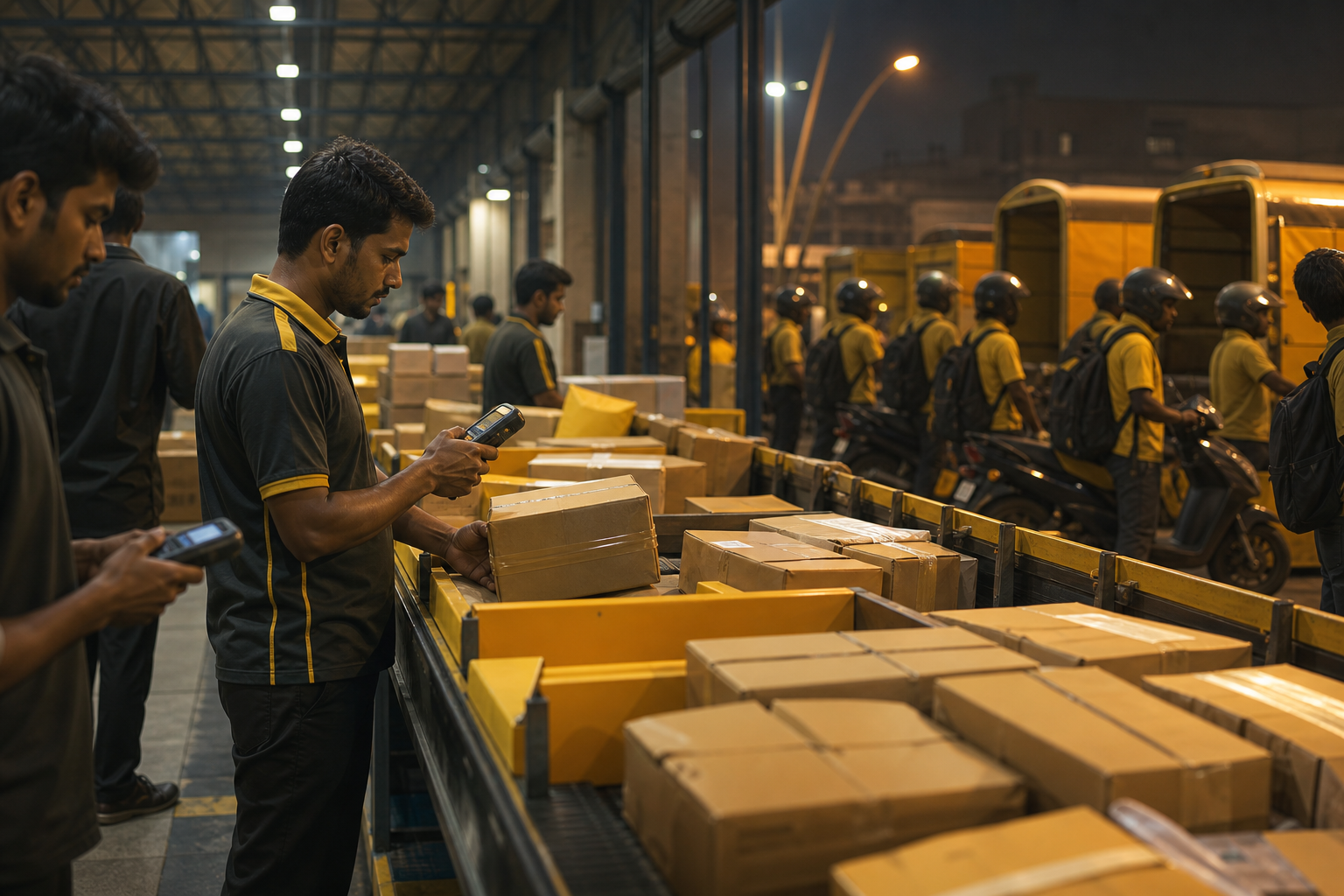
Situation: Indian e-commerce delivery is difficult because demand is fragmented across metros, tier-2 cities and long-tail pin codes. Customers want faster delivery, sellers want predictable pickups, and platforms want lower failure rates without carrying excessive fixed cost everywhere.
The move: Xpressbees expanded as a third-party logistics player using a hub-and-spoke logic: larger hubs and sortation centres consolidate flows, while local delivery nodes handle last-mile distribution. The primary driver is network orchestration - matching parcel flows to the right hub, route and delivery station. Supporting drivers include scan-based visibility, client diversification beyond one platform, line-haul scheduling, and local last-mile execution.
Outcome and lesson: The lesson is not “more warehouses mean faster delivery.” The lesson is that a delivery business needs the right role clarity per node: some facilities store, some sort, some stage, and some only enable last-mile reach. When those roles are confused, costs rise and service still fails.
So what: A good warehouse model separates the job of each node. A shallow answer says “open warehouses near customers.” A complete answer says “place the right type of node near the right demand cluster and control the flow through technology and KPIs.”
How AI Changes Warehouse Model Design
AI does not remove warehouse fundamentals. It makes the trade-offs sharper because planning can now happen at pin-code, SKU, route and time-band level.
- Demand forecasting becomes granular: ML models can forecast orders by pin code, category, daypart and event. This helps decide whether a city needs a regional fulfilment centre, a cross-dock, or only a delivery spoke.
- Slotting becomes dynamic: AI can recommend moving fast-moving SKUs closer to pick paths before a sale period, festival spike or weather-driven demand change.
- Exceptions become visible earlier: Computer vision, scan analytics and anomaly detection can flag aging parcels, wrong-route bags, repeated picker errors or route congestion before SLA failure.
Use NotebookLM or Claude like a placement analyst: upload the company annual report, website service pages and this lesson, then ask, “Map the likely warehouse network model, list key trade-offs, and generate five interview questions on cost versus SLA.” Verify every factual claim before using it.
Interview Relevance
“You are advising a delivery start-up that wants to expand from one city to five cities. How would you design its warehouse model?”
Always say the model may be phased: start with one central facility and cross-dock partners, then add regional hubs only when demand density justifies fixed cost and inventory duplication.
Common Mistake
The biggest mistake is designing the warehouse from the building outward - “take a large warehouse near the city and deliver from there.” It costs candidates because it ignores SLA, demand density, node roles, bottlenecks and unit economics. The fix: start with the delivery promise, then design the network, flow, capacity, systems and metrics backward from that promise.
What to Revise Next
This is a natural capstone topic, so revise by integrating the full operations journey: demand forecasting, facility location, inventory policy, warehouse layout, transportation planning, last-mile delivery, service-level metrics and cost-to-serve. As a final drill, take one Indian delivery company and explain its warehouse model in five minutes using the framework above.