
Transactional versus Analytical Processing
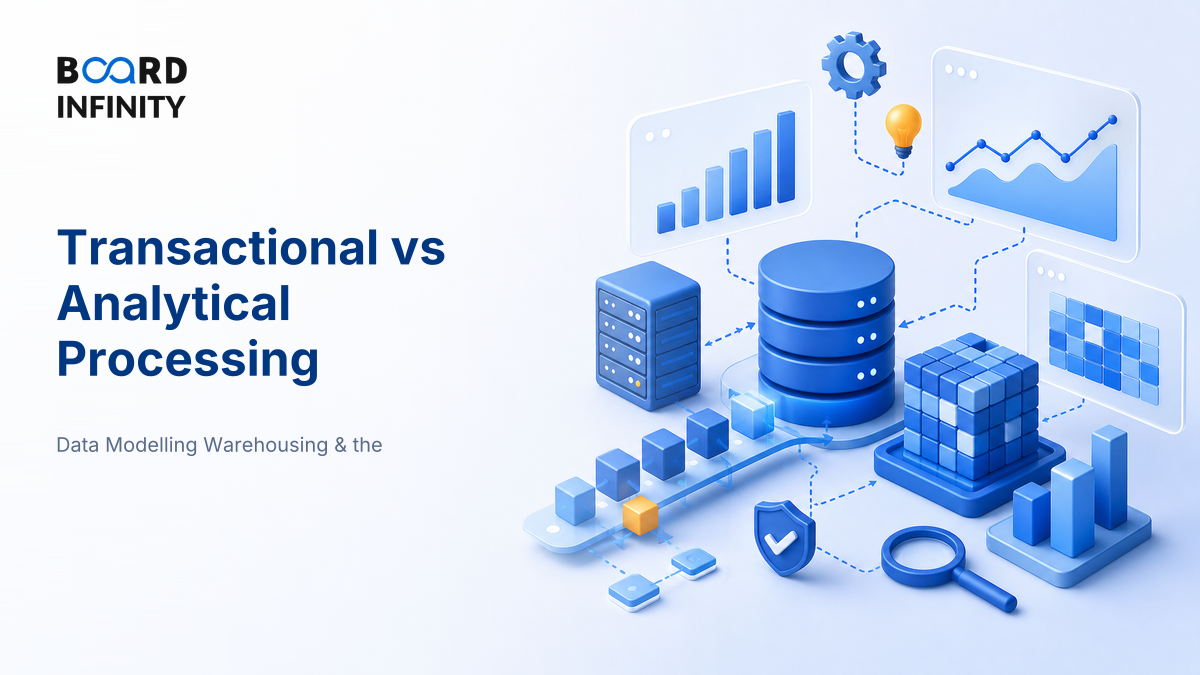
Should the same database that confirms your UPI payment also answer, “Which city, merchant category and time slot drove last month’s payment growth?” It sounds efficient, but mixing those two jobs blindly is how systems become slow, reports become unreliable, and business teams lose trust in data.
- Transactional processing records day-to-day events - payments, orders, bookings, inventory updates - with speed and correctness.
- Analytical processing studies historical, integrated data to answer business questions - trends, cohorts, profitability, churn, fraud patterns.
- OLTP is write-heavy, concurrent, current-state focused and ACID-driven; OLAP is read-heavy, aggregate-heavy and decision-focused.
- The simplest memory hook: OLTP runs the business; OLAP understands the business.
- OLTP usually uses normalized operational schemas; OLAP often uses dimensional models, star schemas, columnar storage or data lakehouse designs.
- The design mistake is not choosing one over the other - it is forcing one system to do both jobs without separation, replication or workload management.
- In interviews, answer using purpose, data shape, workload, users, architecture and metrics - not only “transactions vs reports.”
The big picture is simple: every digital business has two engines. One engine must be fast and trustworthy at the moment of action. The other must be broad and reflective after the action has created data.
Core Explanation: OLTP Runs, OLAP Reasons
Transactional processing is about operational truth. When a customer pays, a train seat is booked, or a warehouse unit is picked, the system must update the right record once, immediately and safely.
Analytical processing is about decision truth. It asks questions across time, customers, products and channels: “What changed?”, “Why did it change?”, “Which segment is profitable?”, “Where is fraud emerging?”
A useful example is IRCTC ticket booking. The booking system must prevent the same seat from being sold twice - that is an OLTP problem. Later, railway planners may analyze route-wise demand, seasonal patterns and cancellation behaviour - that is an OLAP problem. The strategic “so what” is clear: the first protects the transaction; the second improves planning.
The 2x2 Matrix: Where Each Workload Belongs
Most confusion disappears when you classify a workload by two questions: how fresh must the data be, and how complex is the query?
The top-left quadrant is important in 2026. Some businesses need real-time analytics, such as instant fraud scoring during a card payment or live delivery-time prediction. These are analytical computations close to the transaction, but they still must not compromise the transaction system’s reliability.
The Architecture Pattern: Separate, Sync and Govern
The standard architecture is not “one giant database.” It is a controlled flow from operational systems to analytical systems.
Why this matters: a production system optimized for thousands of tiny updates is rarely ideal for scanning years of data. A warehouse optimized for large scans is rarely the safest place to run customer-facing transactions.
Definitions You Can Say in One Breath
- OLTP: Systems that record many small concurrent business transactions with high correctness, availability and low latency.
- OLAP: Systems that analyze integrated historical data through complex read-heavy queries for reporting, diagnosis and decisions.
- Transaction: A logical unit of work that fully succeeds or fully fails to keep data correct.
- ACID: Atomicity, Consistency, Isolation and Durability - properties that keep database transactions reliable under failures and concurrency.
- ETL/ELT: Processes that move, transform and load operational data into analytical platforms for trusted analysis.
How to Measure Whether the Design Is Working
Use separate metrics for the two engines. OLTP success is felt by customers and operations; OLAP success is felt by decision-makers and analysts.
Case Study: PhonePe Separates Payment Reliability from Payment Intelligence
PhonePe shows why a digital payments company must protect transaction processing while using analytical processing for fraud, growth and merchant insights.
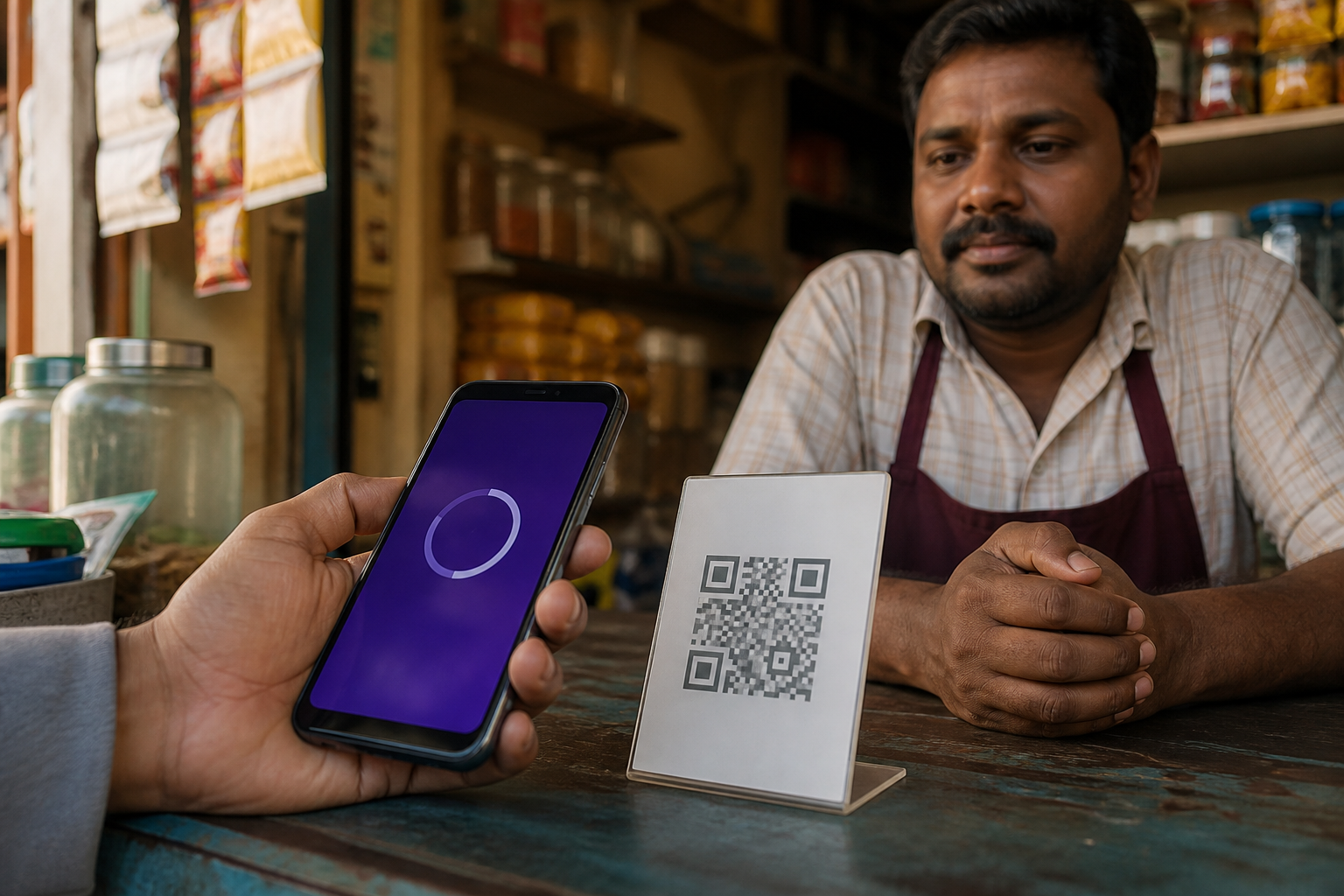
Situation. In UPI and digital payments, the customer moment is unforgiving: a payment either succeeds, fails or times out. The operational system must coordinate app request, payment routing, bank response, ledger update and user notification with high availability and correctness.
The strategic move. A payments firm like PhonePe cannot let heavy business analysis run directly on the same operational path that confirms payments. The sensible design is to keep payment authorization and transaction recording in highly reliable OLTP systems, then stream or replicate transaction events into analytical platforms for fraud monitoring, merchant dashboards, growth analytics, cohort behaviour and product experiments.
Outcome or lesson. The primary driver is workload separation: customer-facing payment reliability is protected from heavy analytical queries. Supporting drivers include event streaming, strong data governance, reconciled transaction states, fraud models near the transaction path and analytical stores built for large-scale querying. The lesson for interviews: payments businesses win not because they “have data,” but because they separate mission-critical recording from decision-oriented analysis.
How AI Changes Transactional versus Analytical Processing
1. AI is moving some analytics closer to the transaction. Fraud scoring, credit risk checks, dynamic delivery promises and personalization may run in milliseconds while the transaction is still active. This creates real-time analytical workloads, but the OLTP system must still remain the protected system of record.
2. AI is making analytical systems more conversational. Business users increasingly ask natural-language questions over warehouses and lakehouses: “Show me repeat purchase drop-off by city and cohort.” The risk is metric inconsistency, so governed semantic layers and reconciled definitions become more important.
3. AI improves data operations. Machine learning can detect pipeline failures, unusual transaction patterns, reconciliation breaks and dashboard anomalies faster than manual monitoring. The value is not replacing OLTP or OLAP; it is making the handoff between them more reliable.
Load a company annual report, app reviews and this lesson into NotebookLM. Ask: “List five transactional workloads and five analytical workloads for this company, then suggest which metrics prove the separation is working.” Use the output to build an interview-ready example.
Interview Relevance
“Explain the difference between transactional and analytical processing. If you were designing data systems for an e-commerce or payments company, how would you decide what belongs where?”
If the interviewer gives a business scenario, do not answer abstractly. Identify the transaction first, identify the decision second, then map each to OLTP or OLAP.
Common Mistake
The mistake: saying “OLTP is for small data and OLAP is for big data.” That is shallow and often wrong. The real distinction is workload purpose: OLTP records concurrent business events correctly; OLAP analyzes integrated data for decisions. One-line fix: always compare purpose, workload, data shape, users and metrics together.
What to Revise Next
Now that you can separate operational transactions from analytical decisions, revise how analytical data is structured for business use.