
Resume Keywords by Role and ATS Optimisation for Marketing
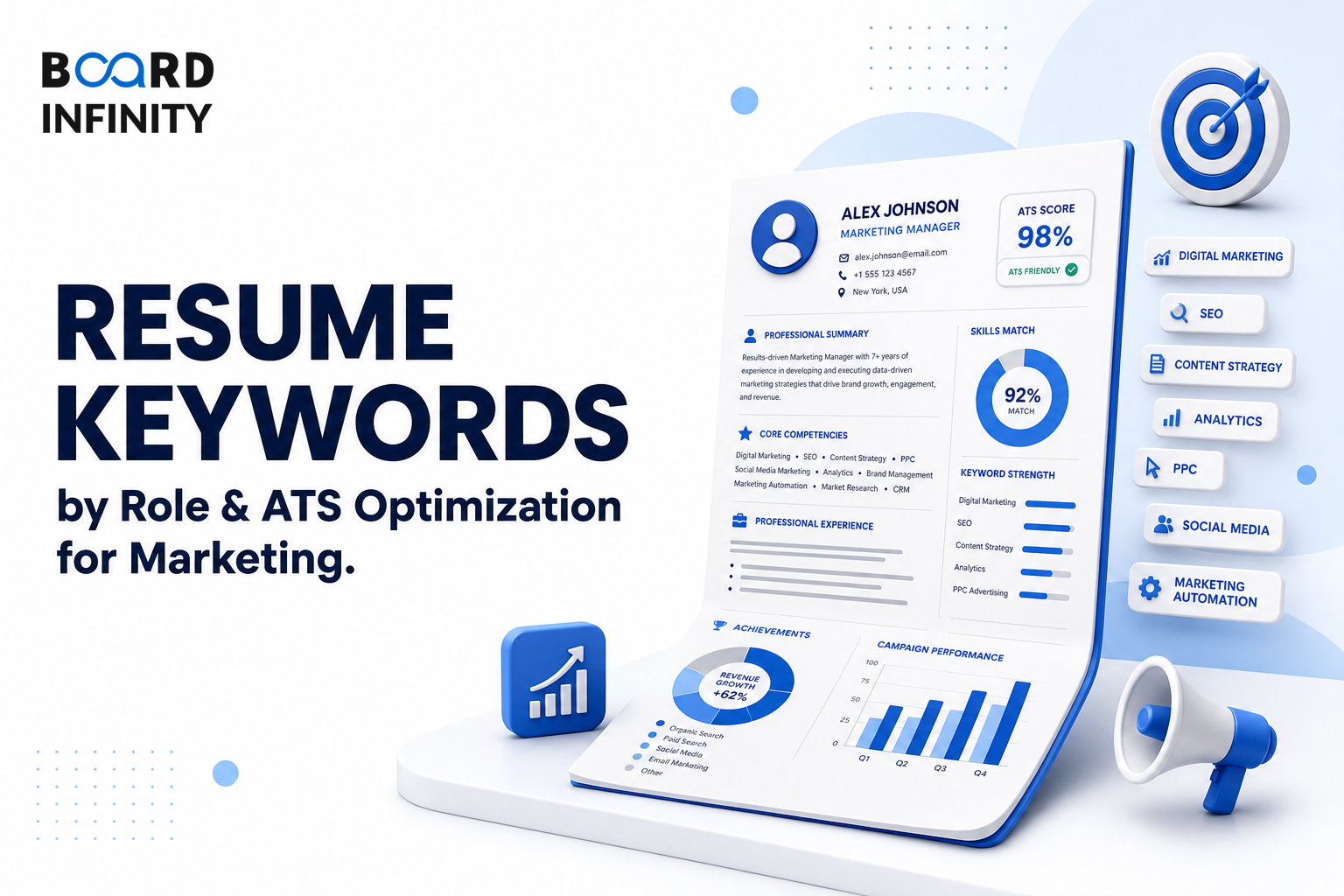
After preparing for behavioural and resume-based marketing interview questions, the next practical question is whether your resume even reaches the recruiter. Applicant Tracking Systems, or ATS, filter resumes before a human ever sees them, so role-specific keywords matter. This reference guide shows how to mirror marketing job-description language naturally across your summary, skills section, and experience bullets without turning your resume into a keyword dump.
- ATS stands for Applicant Tracking System, a resume-filtering tool used before human review.
- Use keywords naturally in three places: the resume summary, skills section, and experience bullets.
- Mirror the exact language of the job description where it is relevant, especially role-specific phrases such as performance marketing, brand positioning, keyword research, or content strategy.
- Bold keywords that appear in the job description so the recruiter can quickly see fit after the ATS screen.
- Choose keywords by role, not by popularity. A Brand Manager resume should not read like an SEO Specialist resume.
- Tools and platforms such as Google Ads, Meta Ads Manager, GA4, Instagram Reels, YouTube Shorts, Meta Business Suite, LinkedIn, and Google Search Console should appear only when they match your experience.
ATS Optimisation: The Big Picture
ATS optimisation is not about gaming software. It is about making your resume easier to match with a marketing job description before a recruiter reads it. The best resumes combine role-specific keywords, credible placement, and natural wording.
Applicant Tracking System (ATS): a system that filters resumes before human review by scanning for relevant role, skill, tool, and experience signals from the job description.
Use this simple flow to move from job description to ATS-ready resume.
How ATS Keyword Matching Works for Marketing Resumes
In marketing resumes, ATS matching typically looks for language that signals role fit: channels, tools, metrics, research methods, campaign responsibilities, and customer or revenue outcomes. For example, a Digital Marketing Manager posting may include performance marketing, Google Ads, Meta Ads Manager, GA4, attribution modelling, CTR, CPL, CPM, retargeting, and lead generation. If your resume uses very different wording for the same work, the match can become weaker before a recruiter even opens the file.
The practical rule is simple: do not write for the ATS alone. Write for the ATS first and the recruiter second. The ATS helps decide whether the resume is surfaced, while the recruiter checks whether the keywords are supported by real marketing work.
Target role keyword + credible context + proof of work. Example structure: "Used Google Ads and GA4 to support performance marketing, track conversion rate optimisation, and improve funnel visibility."
Role-Wise Marketing ATS Keyword Bank
The keyword bank below is meant to help you tailor your resume by role. Do not copy every term into one resume. Select the terms that appear in the job description and match work you can explain in an interview.
Where to Put Keywords in a Marketing Resume
Marketing resumes usually have three keyword zones: summary, skills, and experience. The same keyword can appear in more than one zone, but the best placement depends on how strong your evidence is. A tool you have used belongs in skills; a tool you used to execute or optimise campaigns belongs in experience bullets.
A good bullet does more than mention the keyword. It connects the keyword to an action. For instance, "managed content calendar" is stronger than listing content calendar alone, and "supported keyword research using Google Search Console" is clearer than only writing SEO.
How to Tailor Keywords by Marketing Track
Different marketing roles signal different types of business impact. Brand roles are closer to positioning, equity, portfolio, and communication. Digital, growth, SEO/SEM, CRM, and e-commerce roles are more tool, channel, funnel, and optimisation heavy. Research, trade, and category roles often rely on consumer, retail, distribution, and market analysis language.
Tool and Platform Keywords Recruiters Recognise
Tools should not be added just because they are popular. Add them when they appear in the job description and when you can discuss what you used them for. In many marketing interviews, tool keywords become follow-up questions, so every tool on your resume should be defensible.
Worked Example: Tailoring a Digital Marketing Resume
Here is a complete example of how a candidate can convert a generic marketing resume into a role-aligned, ATS-friendly resume for a Digital Marketing Manager position.
This same approach works for other marketing roles. For a Social Media Manager role, the candidate would prioritise content strategy, Instagram Reels, YouTube Shorts, engagement rate, community management, content calendar, Meta Business Suite, and LinkedIn strategy. For an SEO/SEM Specialist role, the keyword set would shift toward keyword research, on-page SEO, technical SEO, Google Search Console, Quality Score, negative keywords, landing page alignment, and PPC management.
ATS-Friendly Bullet Templates for Marketing Roles
Use templates to make keywords sound natural. The template should not hide weak experience, but it can help you translate real work into the language recruiters and ATS screens expect.
Action verb + role keyword + channel/tool/method + business or marketing context. Example: "Supported keyword research using Google Search Console to improve search intent alignment and technical SEO visibility."
Acronym and Metric Keywords to Handle Carefully
Marketing resumes often contain acronyms. Use the acronym when the job description uses it, but make sure you can explain it in an interview. If the acronym is central to the role, pair it with context in a bullet rather than leaving it isolated in the skills section.
Conclusion
Marketing ATS optimisation is a matching exercise: identify the job-description language, choose the role-specific keywords you can defend, and place them naturally in summary, skills, and experience bullets. A strong resume does not use every marketing keyword; it uses the right keywords for the target role and backs them with credible work.
The most frequent error is keyword stuffing: copying a full keyword bank into the resume without context. It can weaken both ATS relevance and recruiter trust because the resume stops sounding role-specific and becomes difficult to verify in interviews.