
GD/PI Do's and Don'ts: 48-Hour Interview Prep Checklist
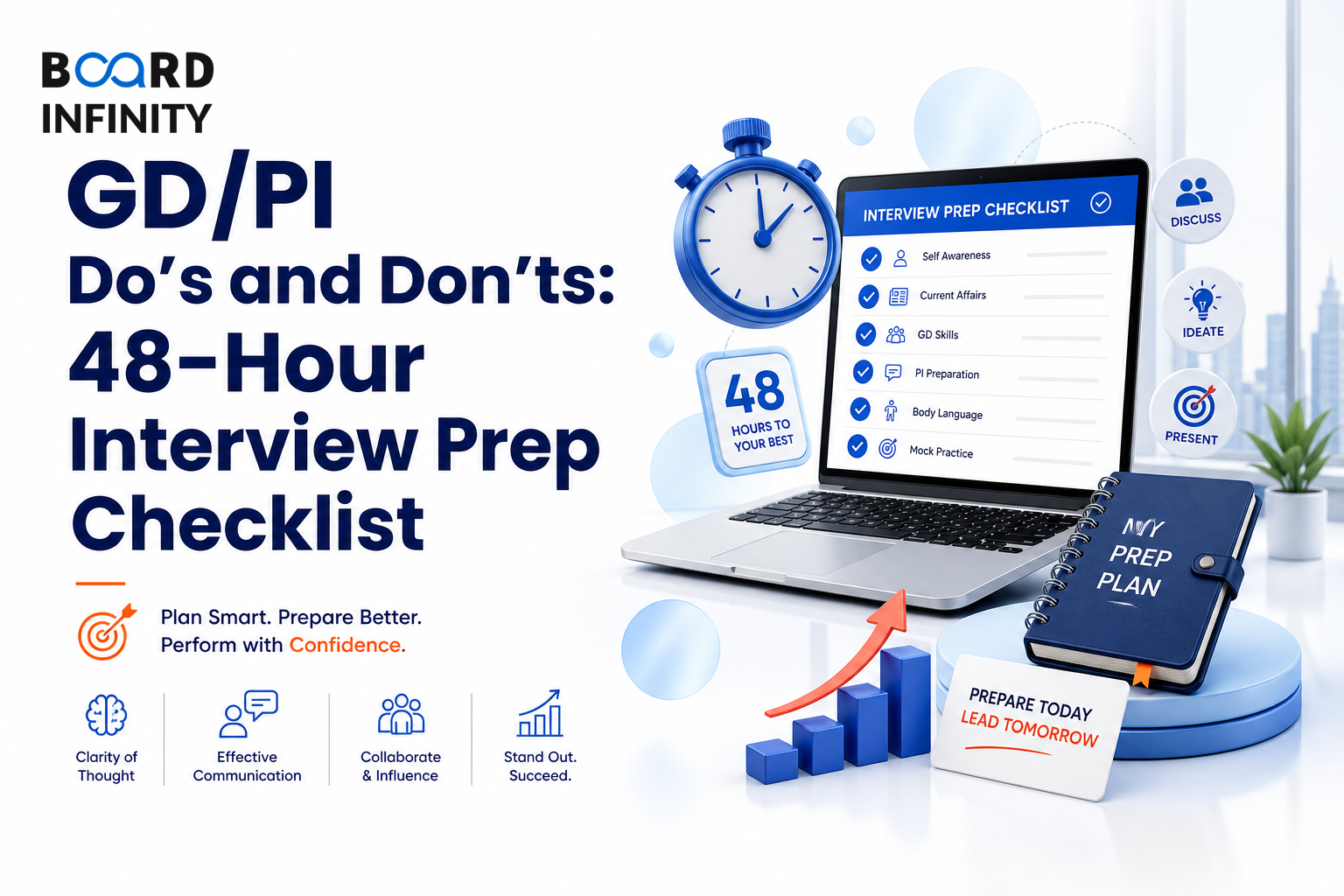
After LinkedIn optimisation for marketing roles, the next filter is whether you can speak like a business-ready candidate in a GD or PI. A GD means Group Discussion, where assessors observe how you structure ideas and respond to others; a PI means Personal Interview, where they test your thinking in depth. This checklist turns the final 48 hours into a focused revision sprint so your answers are India-specific, quantified and linked to business outcomes.
- Use frameworks such as 4Ps, STP, BCG, Ansoff and Porter, but apply them to the situation instead of merely naming them.
- Localise every marketing answer to India, especially for FMCG, where rural India cannot be ignored because 65% of the population lives there.
- Quantify wherever possible: "target 15% market share in 18 months" is stronger than "grow significantly".
- Link recommendations to business outcomes such as revenue, profit and market share, not just visibility or advertising activity.
- Prepare named Indian examples such as HUL Shakti, Jio, Amul, Nykaa and Zomato in a Challenge - Strategy - Outcome format.
- In the last 48 hours, revise frameworks, metrics, India data, case studies, company research and mock Q&A in a timed sequence.
Big Picture: The Last-Mile GD/PI Prep System
The final 48 hours are not for reading everything again. They are for converting your preparation into answer-ready material: frameworks you can apply, numbers you can quote, examples you can explain and mock answers you can deliver in 2-3 minutes.
What Good GD/PI Marketing Answers Must Do
A strong GD/PI answer is not the one with the most buzzwords. It is the one that makes the assessor believe you can diagnose a business situation, choose the right marketing lever and explain why that lever improves revenue, profit or market share.
The source checklist gives five clear behaviours: use frameworks, quote Indian data, link to business outcome, show customer-first thinking and know Indian case studies cold. These behaviours matter because marketing interviews often punish vague enthusiasm. A candidate who says "we should advertise more" has not yet shown targeting, channel logic, budget thinking or expected ROI, which means Return on Investment.
What Weak Answers Usually Do Wrong
The main danger in a GD or PI is sounding polished but generic. Marketing is not only advertising; it includes product, pricing, distribution and communication. If your answer treats marketing as only promotion, you miss the full business system.
The other common weakness is failing to localise. In any FMCG discussion, which means Fast-Moving Consumer Goods such as frequently purchased consumer products, rural India must be considered because 65% of the population lives there. This does not mean every answer must become rural-only, but it does mean an India strategy that ignores rural demand, distribution or pricing can look incomplete.
Framework Revision: Apply, Do Not Recite
During hours 1-4, revise the core frameworks and apply each to one Indian brand. The point is not to prove that you remember theory. The point is to show that a framework helps you decide what the business should do next.
4Ps means Product, Price, Place and Promotion. STP means Segmentation, Targeting and Positioning. BCG refers to the Boston Consulting Group matrix, a portfolio lens. Ansoff is used to think about growth options. Porter refers to competitive strategy lenses. In a GD/PI, define the framework quickly, then move to the brand, market and outcome.
Metrics Revision: Speak In Numbers
During hours 5-8, revise the metrics named in the checklist: CAC, LTV, ROAS, NPS and Market Share. CAC means Customer Acquisition Cost, LTV means Lifetime Value, ROAS means Return on Ad Spend and NPS means Net Promoter Score. You do not need to overload every answer with metrics, but you should know which metric proves the recommendation is working.
Metrics are useful because they force clarity. "We will grow significantly" is weak because it cannot be evaluated. "We will target 15% market share in 18 months" is stronger because it sets a measurable business goal.
India Data Revision: Localise Every Answer
During hours 9-12, memorise 5 key numbers across FMCG market size, digital ad spend, D2C stats and IPL revenue. D2C means Direct-to-Consumer, where a brand sells directly to customers rather than only through intermediaries. IPL means Indian Premier League, a major Indian cricket property often discussed in marketing and sponsorship contexts.
The checklist does not ask you to dump numbers randomly. Use numbers when they sharpen the decision. For example, in an FMCG discussion, the fact that 65% of the population lives in rural India can change how you think about distribution, pricing and communication.
Use the pattern: "Because this market has this quantified reality, the business should choose this marketing action, and the expected outcome should be measured through revenue, profit or market share."
Case Study Bank: Prepare Indian Examples Cold
During hours 13-16, prepare Indian case studies in a compact Challenge - Strategy - Outcome format. The checklist names HUL Shakti, Jio, Amul, Nykaa and Zomato. You do not need to force all of them into one answer; instead, select the example that best matches the question.
The nuance is important: a named example is useful only when it proves a point. If the GD topic is about rural distribution, an example should help you discuss distribution. If the PI question is about customer-first thinking, the example should help you explain customer need before selling.
Company Research: Make The Answer Employer-Specific
During hours 17-20, study the target company's brand portfolio, recent campaigns, financials and recent news. This is where a generic marketing answer becomes a company-ready answer. If you know the portfolio, you can avoid suggesting something that does not fit the business.
Financials and recent news also help you link your ideas to business outcomes. In many interviews, the better candidate is not the one who gives the longest answer, but the one who can say why a recommendation fits the company's current business context.
Mock Q&A: Build A Timed Structured Answer
During hours 21-24, practise the top 5 questions aloud and time yourself for 2-3 minute structured answers. Speaking aloud matters because GD/PI performance is judged in real time. A good answer must be short enough to follow and structured enough to remember.
Worked Example: Turning A Generic FMCG Answer Into A Strong One
Use this as a model for how to improve an answer without inventing unnecessary detail. The situation is a GD prompt asking how an FMCG brand should grow in India.
The learning is that frameworks, data and outcomes must work together. A framework without India context sounds academic; India context without business outcome sounds descriptive; a business outcome without a clear marketing action sounds unrealistic.
The most frequent error is giving a polished but generic answer: "increase advertising" without channel, budget, targeting or expected ROI. It costs points because it confuses marketing with only advertising and fails to show how the recommendation will improve revenue, profit or market share.