
LinkedIn Optimisation for Marketing Roles
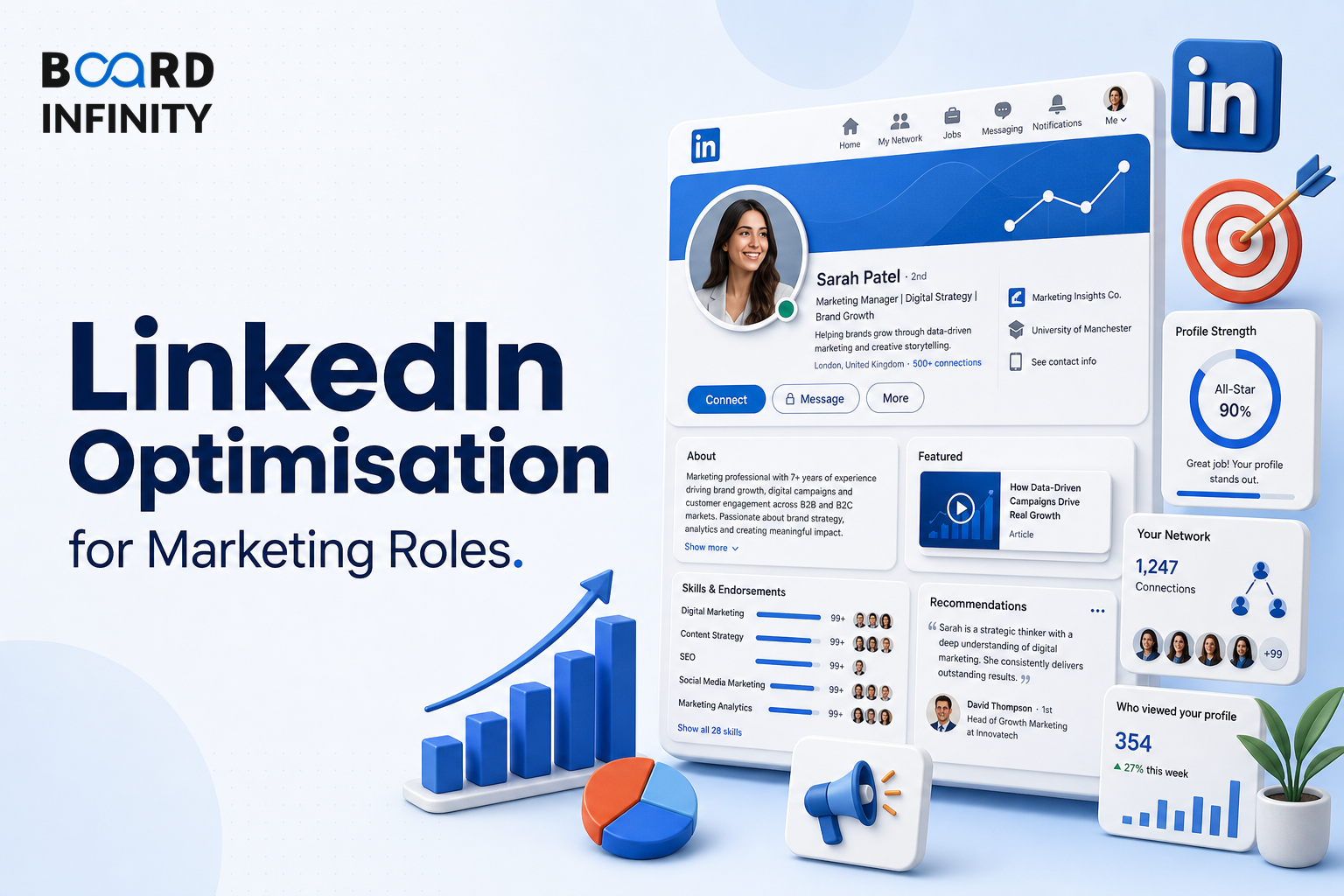
After learning Resume Keywords by Role & ATS Optimisation for Marketing, the next question is: where else do those keywords matter? LinkedIn is your digital resume, and recruiters from HUL, Swiggy, agencies, and startups regularly source candidates directly from LinkedIn. For marketing interviews, this matters because your profile is not just a networking page - it is searchable evidence of positioning, skills, quantified impact, and role clarity.
- LinkedIn optimisation is a recruiter-search problem: use the same role keywords recruiters search for in your headline, summary, skills, and experience.
- A strong marketing headline should include 3-4 searchable keywords, not generic phrases like "Marketing Enthusiast" or "Aspiring Professional".
- Your summary should be in first person, run 3-4 paragraphs, and cover who you are, quantified accomplishments, role interest, and a call to action.
- Skills should match your target function, such as Brand Strategy for brand roles, Google Analytics for digital roles, and Consumer Insights for research roles.
- Visibility comes from consistent content: 2-3 posts per week, thoughtful comments, Creator Mode, and profile completion.
- Warm outreach before applying converts 5-10× better than a cold portal application when done through 2-3 relevant people and a focused 15-minute chat request.
LinkedIn as a Recruiter Search Funnel
Think of LinkedIn as a funnel: a recruiter searches, your profile appears, the headline earns a click, the summary and skills prove fit, content builds credibility, and warm outreach converts attention into conversations.
Why LinkedIn Optimisation Matters for Marketing Roles
Marketing hiring is often keyword-led because recruiters need to identify candidates by role, category, tool, and function. For example, a recruiter may search for terms like Brand Strategy, Digital Marketing, Consumer Insights, Performance Marketing, or FMCG. FMCG means Fast-Moving Consumer Goods, a category where products are bought frequently, and the source specifically connects this keyword to brand management profiles.
LinkedIn also matters because marketing is a visibility-driven function. A profile that only says "open to opportunities" does not show market thinking, campaign understanding, or consumer orientation. A profile that combines keywords, quantified results, relevant skills, and thoughtful content gives recruiters more reasons to shortlist you.
The key nuance is that LinkedIn is not a replacement for a resume or application. It works best as a discovery and trust layer. Your resume may pass an Applicant Tracking System, or ATS, which is software that screens resumes for relevant keywords, but LinkedIn helps recruiters and hiring managers see whether your positioning and activity match the role.
Headline Optimisation: Your Searchable Positioning
Your headline is the most important search and click element on LinkedIn. It should tell recruiters what role you are targeting, what domain you understand, and which keywords match the opening. The source rule is simple: include 3-4 keywords recruiters search for.
For a Master of Business Administration, or MBA, student targeting marketing, a strong structure is: "MBA Marketing | Aspiring Brand Manager | FMCG, D2C, Digital | Institution Name". D2C means Direct-to-Consumer, a business model where brands sell directly to customers rather than only through intermediaries. The point is not to copy a template blindly, but to make your role intent searchable.
B2B means Business-to-Business, where one business sells to another business. SaaS means Software as a Service, where software is accessed as an ongoing service. These definitions matter because a recruiter looking for a B2B SaaS growth marketer is unlikely to find a profile that only says "Aspiring Professional".
If you are targeting recruiters at HUL, Swiggy, agencies, or startups, your headline should help them immediately understand whether you fit brand, digital, growth, research, sales, or content roles. Generic motivation words do not create search relevance.
Summary Optimisation: Turn Interest into Proof
The LinkedIn summary should be written in first person and should usually have 3-4 paragraphs. It is not a cover letter pasted into LinkedIn. It is a structured pitch that answers four questions: who are you, what have you accomplished, what are you looking for, and how should people engage with you?
ROAS means Return on Ad Spend, a marketing metric that compares revenue generated to advertising spend. A line like "led a social media campaign that reached 500K users and drove 3× ROAS" is stronger than "worked on social media" because it shows reach and efficiency. In interviews, the same habit helps you answer with outcomes rather than activities.
A good summary also shows focus. If you are interested in FMCG brand management, say that. If you are targeting performance marketing, say that. Recruiters do not have to guess your direction.
Skills Optimisation by Marketing Function
Skills are search signals and credibility signals. They help LinkedIn understand your profile, and they help recruiters quickly check whether your background matches the role. The source recommends adding role-specific skills and seeking endorsements for them.
P&L means Profit and Loss, a view of revenue, costs, and profitability. SEO means Search Engine Optimization, the practice of improving organic visibility in search. A/B Testing means comparing two versions to see which performs better. KAM means Key Account Management, CRM means Customer Relationship Management, and SPSS is a data analysis tool listed in the source for market research roles.
The nuance is that more skills are not automatically better. A brand management candidate with Brand Strategy, Consumer Insights, Marketing Mix, and FMCG looks more coherent than a profile that mixes every marketing term without role focus. Add skills based on the function you are actually targeting.
Content Strategy for Visibility
Recruiter search gets you discovered, but content keeps you visible. The source recommends posting 2-3 times per week and emphasises that consistency beats frequency. Posting twice a week for 6 months is better than posting daily for 2 weeks.
The content formats that work for marketing candidates are specific: case study analyses of Indian brands in a 2-3 minute read, marketing campaign deconstructions, data insights from recent reports, and internship learnings. These formats demonstrate the same thinking expected in marketing interviews: observation, analysis, and implication.
The engagement hack is important: comment thoughtfully before posting yourself. This builds visible presence before you launch your own content. For a marketing candidate, thoughtful comments can signal curiosity and judgment, while shallow comments rarely help.
Profile Completeness: The Algorithm Hygiene Layer
LinkedIn algorithm surfaces profiles with a 100% completion rate, according to the source. This makes profile completion a basic hygiene factor, not a decorative extra. If your profile is incomplete, even a strong headline may not perform as well as it could.
Completeness is not the same as quality, but it gives your profile the base structure needed for discovery. Once the structure is complete, the quality comes from sharper keywords, quantified achievements, relevant skills, and consistent content.
Warm Lead Strategy: Convert Profile Views into Conversations
Warm outreach is the bridge between visibility and interviews. Before applying to any company, the source recommends finding 2-3 people at that company on LinkedIn, ideally alumni from your institution or people in the target function. This is especially relevant when targeting recruiters or teams at companies such as HUL, Swiggy, agencies, and startups.
The source states that this warm outreach converts 5-10× better than a cold application through the portal. The reason is practical: a warm interaction gives someone a clearer sense of your intent, preparation, and fit before the formal application. However, the outreach must be earned through relevance and engagement, not a direct request for a referral on day one.
Worked Example: Optimising a Marketing Profile for Recruiter Search
This example shows the core logic: a recruiter should not have to decode your profile. If the role is brand management, the headline, summary, skills, and content should all point in that direction. If the role is performance marketing, the keywords and proof should shift accordingly.
Structuring a LinkedIn Optimisation for Marketing Roles Interview Answer
"How would you optimise your LinkedIn profile to improve your chances of getting shortlisted for marketing roles?"
The best answers do not describe LinkedIn as a cosmetic profile update. Frame it as a conversion system: recruiter search creates discovery, quantified proof creates trust, and warm outreach creates conversations.
Conclusion
LinkedIn optimisation for marketing roles is about making your profile searchable, credible, visible, and easy to act on. The final takeaway is simple: use role keywords, prove impact with numbers, stay consistently visible, and build warm relationships before you apply.
The most frequent error is treating LinkedIn like a generic online resume with phrases such as "Marketing Enthusiast" and no quantified proof. This costs points because recruiters search by specific marketing keywords, and an unclear profile may never appear in the right searches!