
Top Marketing Interview Questions: Case and Guesstimate Answer Bank
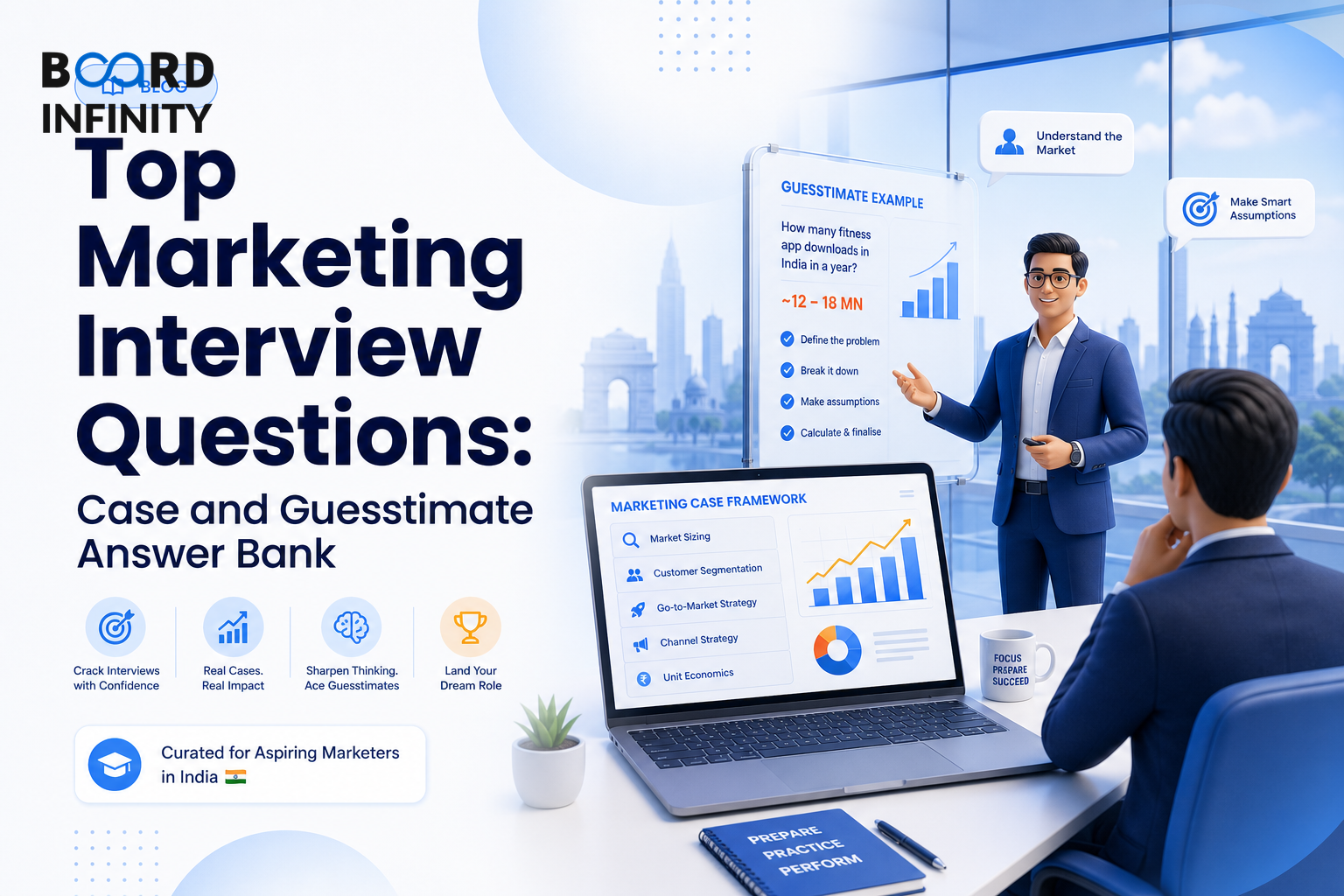
If the previous lesson, Top Marketing Interview Questions - Foundations & Frameworks, gave you the core marketing toolkit, this lesson shows you how to use that toolkit under placement pressure. Marketing interviews rarely reward memorised definitions alone; they test whether you can structure an ambiguous business problem, choose the right framework, anchor it in an Indian example, and open with confidence. Use this as a ready-to-adapt MBA placement answer bank for conceptual, case, guesstimate, and behavioural marketing questions.
- Start every answer with a sharp hook, then move into a framework, example, implication, and closing insight.
- Conceptual questions test whether you know frameworks like STP, 4Ps, CBBE, PLC, BCG Matrix, AIDA, and Porter's Five Forces.
- Case questions test diagnosis before solution - identify whether the issue is distribution, pricing, positioning, communication, or retention.
- Guesstimates test structure more than the final number; show assumptions, calculations, sanity checks, and business interpretation.
- Indian examples such as Dove, Maggi, Parle-G, Jio, Amul, HUL, Surf Excel, Nykaa, and Royal Enfield make answers credible in MBA placements.
- A strong answer avoids panic moves such as reflexive price matching, national launch without pilot testing, or deleting a viral crisis post.
- The best candidates sound like marketers: they connect consumer insight, channel economics, brand equity, and measurable outcomes.
How to Use This Answer Bank
This reference guide groups the most frequently asked marketing and sales interview questions across top MBA placements in India into four buckets: conceptual questions, situational cases, guesstimates, and behavioural questions. The goal is not to memorise every sentence, but to internalise the structure so that your answer sounds natural, commercial, and specific.
Think of each answer as a mini-case. Define the business term, pick the right framework, apply it to a named example from the Indian market where available, and end with the strategic implication.
The big picture is simple: interviewers are checking whether you can move from marketing vocabulary to business judgement.
Use this reusable structure: opening hook - define the problem - apply the framework - use a named example - state the metric or implication - close with a judgement.
Conceptual Questions: Frameworks and Hooks
Conceptual questions look simple, but they are often used to separate textbook recall from actual marketing thinking. Define every acronym clearly: STP means Segmentation, Targeting, and Positioning; CBBE means Customer-Based Brand Equity; PLC means Product Life Cycle; CLV or LTV means Customer Lifetime Value; CAC means Customer Acquisition Cost.
Your answer should show that frameworks are connected. For example, STP drives the 4Ps, brand equity affects price premium, and PLC stage changes the right marketing mix.
For [target], [brand] is the [category] that [benefit] because [reason to believe]. Use this after STP to show how positioning drives the 4Ps.
Case and Situational Questions: Diagnose Before Solving
Case questions test whether you jump to tactics or first understand the problem. In many marketing cases, the right diagnosis is more valuable than a long list of ideas. Terms to know here include FMCG, which means Fast-Moving Consumer Goods; SKU, which means Stock Keeping Unit or a sellable product variant; D2C, which means Direct-to-Consumer; GTM, which means Go-To-Market; CRM, which means Customer Relationship Management; and UGC, which means User-Generated Content.
Worked Example: Packaged Drinking Water Market Size in India
This is a complete guesstimate answer because it shows situation, problem, framework, decision, outcome, and learning. The interviewer is not only checking the number; they are checking whether you can make assumptions transparently and sanity-check the result.
The decision in this answer is to move from a broad theoretical number to a defensible final range after adjustment. That is what makes the response interview-ready rather than just arithmetic.
Guesstimate and Market Sizing Questions
Guesstimates test your ability to structure ambiguity. Use a top-down approach when starting from population or market size, and a bottom-up approach when starting from store capacity, customer visits, or usage frequency. Always include a sanity check if the source gives one.
Behavioural Marketing Questions
Even in case-heavy marketing interviews, behavioural questions matter because brand roles require persuasion, curiosity, and consumer empathy. PAR means Passion, Aptitude, and Rationale; STAR means Situation, Task, Action, and Result. Use these structures to avoid sounding vague.
Conclusion
The strongest marketing interview answers combine structure, market context, and judgement. If you can open confidently, apply the right framework, use a relevant Indian example, and end with the business implication, you will sound less like a student recalling notes and more like a marketer solving a real problem.
The most frequent error is listing frameworks without applying them to the situation. Interviewers give more credit to a simple, well-applied answer using Dove, Maggi, Parle-G, HUL, Surf Excel, Nykaa, or Royal Enfield than to a long answer full of disconnected theory. In guesstimates, the equivalent mistake is hiding assumptions or chasing precision instead of showing transparent logic!