
Aviation & Logistics Interview Questions With Model Answers
Most candidates think aviation and logistics interviews are about knowing aircraft names, airport codes or courier brands. The real test is sharper: can you explain how a time-sensitive network makes money while fighting fuel costs, capacity limits, weather, regulation and service promises?
- Do not answer like a passenger. Answer like an operator: network, capacity, cost, service, regulation and risk.
- Aviation economics depends on load factor, yield, aircraft utilization, turnaround time and cost per available unit.
- Logistics economics depends on shipment density, first-attempt delivery, route productivity, hub efficiency and exception handling.
- The best answer structure: define the business model, identify demand, map the network, explain unit economics, then discuss risks and trade-offs.
- Interviewers love trade-offs: speed versus cost, direct versus hub-and-spoke, owned assets versus partners, service level versus utilization.
- Use one metric per claim. If you say efficiency improved, name the metric - load factor, turnaround time, cost per shipment or on-time performance.
- Common trap: saying “logistics is about delivery” without explaining the operating system behind delivery.
Big Picture: The Business Is a Network, Not a Vehicle
Aviation and logistics are network businesses. Aircraft, warehouses, riders, trucks and airport slots matter, but the real advantage comes from how demand is pooled, capacity is scheduled, exceptions are handled and assets are kept productive.
Core Explanation: The 5-Lens Framework for Any Answer
When you get a sector, company or case question in aviation and logistics, use five lenses. This prevents vague answers and makes you sound commercially grounded.
The Metrics You Must Be Able to Use
Metrics are where average answers become interview-ready answers. You do not need to memorize every industry benchmark, but you must know what each measure means and what “good” looks like directionally.
If a question asks you to estimate air cargo demand, route potential or parcel volumes when no direct number is given, use a structured proxy approach such as sizing a sector when no number exists instead of guessing.
Definitions You Can Say Cleanly
- Logistics management: Based on CSCMP, it plans and controls forward and reverse flows to meet customer requirements.
- Aviation logistics: Planning and control of passenger, cargo, baggage, spares and information flows across aircraft, airports and ground networks.
- Hub-and-spoke network: A network where traffic is consolidated at hubs and redistributed to multiple destinations.
- Unit economics: Revenue, cost and asset use measured per passenger, shipment, aircraft, route or delivery unit.
Model Answers to Common Aviation and Logistics Interview Questions
Q1. How does an airline make money?
Model answer: An airline earns mainly by selling capacity on routes - passenger seats, cargo belly capacity and ancillary services. Profitability depends on matching demand with capacity, maintaining high load factor, earning good yield, controlling fuel and maintenance cost, and using aircraft efficiently. A complete answer must include trade-offs: a full aircraft is not enough if fares are weak, fuel is high or turnaround delays reduce utilization.
Q2. What is the difference between aviation and logistics?
Model answer: Aviation is the air-transport layer - aircraft, airports, routes, slots, safety and air capacity. Logistics is the end-to-end flow of goods, documents, information and returns across modes. They overlap in air cargo and express logistics, where the air leg provides speed but the customer experience depends equally on pickup, sorting, customs, tracking and last-mile delivery.
Q3. Why do logistics companies use hub-and-spoke networks?
Model answer: Hub-and-spoke networks pool shipments from many origins, sort them at a central hub, and send them to many destinations with better capacity utilization. The benefit is density - more volume per line-haul movement. The trade-off is dependency: if the hub is delayed, many downstream deliveries suffer. So the right answer is not “hub is cheaper”; it is “hub improves density but raises concentration risk.”
Q4. Why is aviation a difficult business?
Model answer: Aviation is difficult because it combines high fixed cost, volatile fuel cost, regulated safety requirements, weather disruption, airport capacity constraints and perishable inventory. A seat that flies empty cannot be stored and sold tomorrow. The best airlines therefore win through disciplined network planning, high utilization, cost control, punctual operations and a clear customer segment.
Q5. How would you improve a courier company’s profitability?
Model answer: I would first split the problem into revenue, cost and service. On revenue, improve pricing by lane, weight slab and service promise. On cost, improve route density, first-attempt delivery, hub productivity and line-haul utilization. On service, reduce damages, reattempts and address failures. I would track cost per shipment, first-attempt delivery rate, hub dwell time, on-time delivery and customer complaints.
Q6. Compare airlines and e-commerce logistics.
Model answer: Both are network businesses, but airlines optimize aircraft capacity and routes, while e-commerce logistics optimizes shipment density, fulfilment speed and last-mile productivity. Airlines face stronger safety, slot and fuel exposure; e-commerce logistics faces demand spikes, returns and delivery-address complexity. If asked to compare aviation with another sector, use the discipline of comparing two sectors on the same framework: demand, unit economics, assets, regulation and competitive advantage.
Case Study: Blue Dart - Express Logistics Built Around Air Control
Blue Dart shows how an Indian express logistics player uses controlled air capacity, ground reach and tracking to deliver time-sensitive shipments.
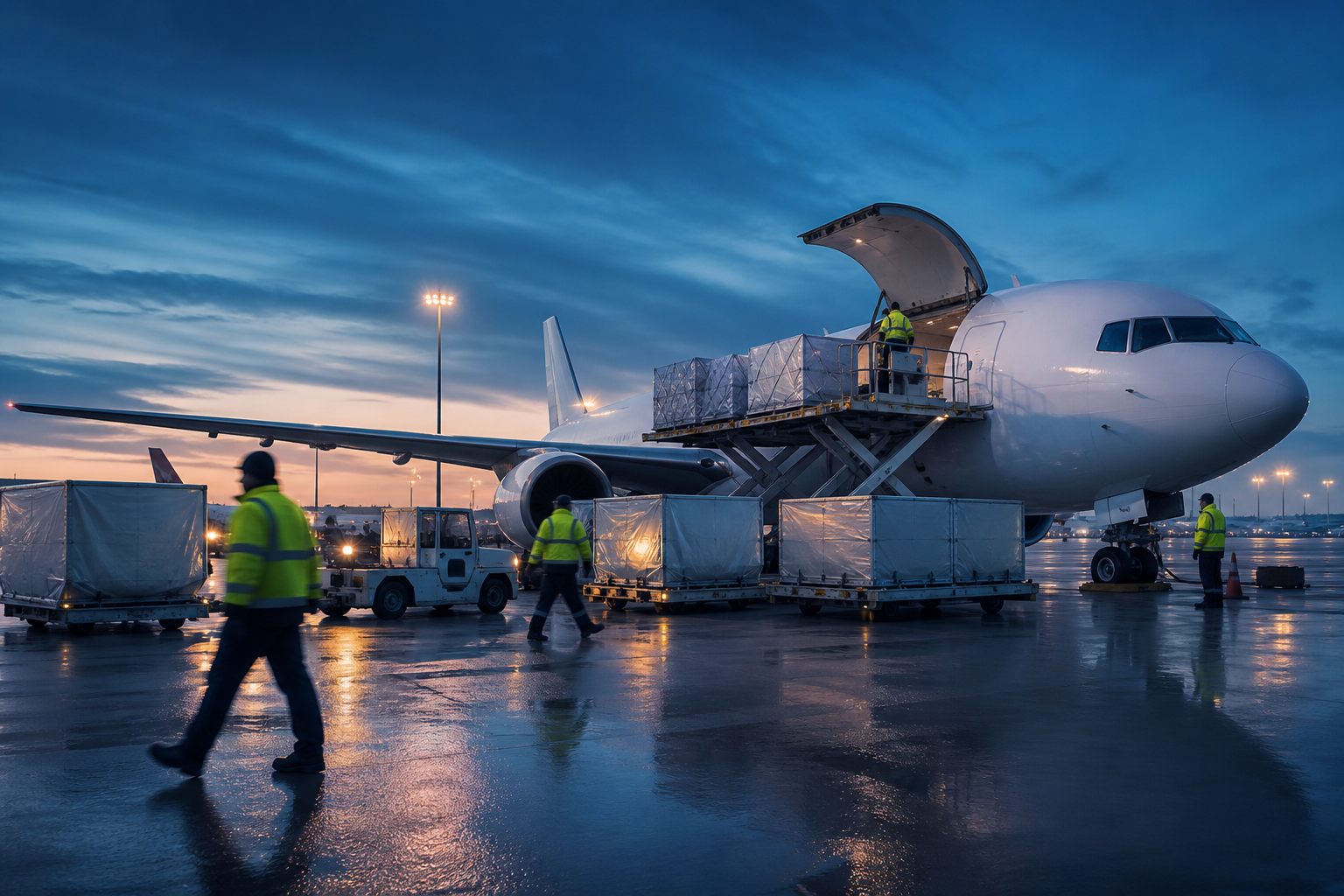
Situation: In express logistics, customers do not buy “transport”; they buy certainty. A bank document, spare part, medical shipment or premium e-commerce parcel has value only if it arrives within the promised window. India adds complexity through long distances, airport constraints, weather variation, address quality and multimodal handoffs.
The move: Blue Dart built its model around integrated express capability. Its aviation arm is positioned as a dedicated cargo airline through Blue Dart Aviation, while the wider business combines pickup, sorting, air movement, ground distribution, tracking and exception handling. The primary driver is control over time-critical air capacity. Supporting drivers include shipment consolidation, ground-network reach, technology-enabled visibility, operating discipline at hubs and access to global express know-how through its DHL relationship.
Outcome and lesson: The case is useful in interviews because it proves a core logistics idea: speed is not created by flying alone. Speed comes from synchronizing pickup cut-offs, hub sorting, aircraft departure, destination processing and last-mile execution. A weak candidate says “Blue Dart is fast because it uses air.” A strong candidate says “Blue Dart sells reliability by controlling the critical air leg and coordinating the full parcel journey around it.”
How AI Changes Aviation and Logistics
1. Demand forecasting becomes lane-level. AI models can combine bookings, seasonality, weather signals, events, price changes and historical shipment flows to forecast demand by route, lane, hub and delivery zone. This helps airlines and logistics firms plan capacity before the network is stressed.
2. Operations move from reactive to predictive. Predictive maintenance can flag aircraft or vehicle issues earlier; computer vision can monitor warehouse flow, cargo loading and ramp safety; route optimization can dynamically sequence deliveries based on traffic, promised time windows and failed-attempt risk.
3. Customer and compliance work becomes faster. GenAI can summarize shipment exceptions, draft customer updates, read tariff or customs documents, and help sales teams respond to logistics tenders. The caveat: aviation and logistics are safety-critical, so AI recommendations must remain auditable and human-supervised.
Use NotebookLM for interview prep: upload a company annual report, one sector note and your resume, then ask, “Generate 12 aviation and logistics interview questions, model answers using metrics, and two follow-up questions for each answer.”
Interview Relevance
“Pick an aviation or logistics company you follow. Explain its business model, key metrics, risks and how you would improve profitability.”
When you give a model answer, add one sentence starting with “The trade-off is…” That single line signals maturity because this sector is full of operational trade-offs.
Common Mistake
The biggest mistake is answering like a customer: “fast delivery, low fares, good service.” That costs candidates because it ignores the operating economics. Fix it in one line: every answer must connect the customer promise to the network, capacity and unit economics behind it.