
How the Aviation & Logistics Value Chain Works
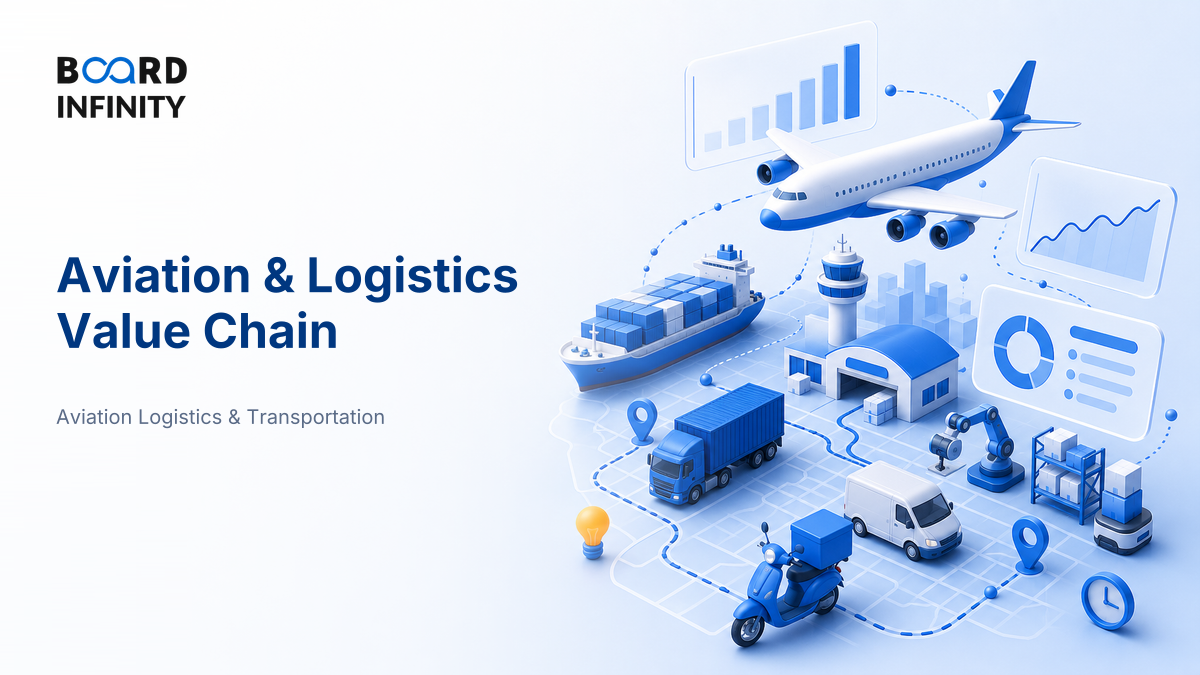
A life-saving pharma shipment may fly in the belly of a passenger aircraft at night, clear customs before sunrise, reach a city hub by road, and arrive at a hospital before the doctor starts rounds. The customer sees one delivery promise; behind it sits a chain of aircraft, airports, handlers, warehouses, trucks, data systems and regulators working in sequence.
- The aviation and logistics value chain converts capacity, infrastructure and coordination into movement of people or goods.
- Aviation is not just airlines: airports, ground handlers, MRO, fuel, air navigation, leasing, travel distribution and regulators all capture value.
- Logistics is not just transport: it includes pickup, consolidation, warehousing, line-haul, sorting, last-mile, reverse logistics and information flow.
- The core chain is: plan capacity - sell demand - move through nodes - manage exceptions - deliver and settle.
- Asset-heavy players win through utilization and network density; asset-light players win through orchestration, contracts and data visibility.
- The best interview answers separate passenger aviation, air cargo and ground logistics, then connect them through hubs.
- The common mistake is describing the chain as “planes and trucks” instead of explaining where value, cost and control actually sit.
Big Picture: One Promise, Many Hand-offs
The simplest way to understand this sector is to stop thinking in vehicles and start thinking in handoffs. Every handoff either adds value - speed, safety, visibility, reliability - or creates risk - delay, damage, idle capacity, missed connection.
Core Explanation: How the Aviation & Logistics Value Chain Works
The value chain has two linked worlds:
- Aviation value chain - moving passengers or cargo through aircraft, airports, airspace and ground services.
- Logistics value chain - planning, storing, transporting, tracking and delivering goods across modes.
They meet most clearly in air cargo: a shipment may be picked up by a courier, consolidated at a city warehouse, loaded onto an aircraft, sorted at an airport hub, moved by road and delivered to the customer. The aircraft is only one part of the promise.
The Five Operating Layers
Use these five layers to avoid a shallow answer. Each layer has different economics, assets and interview issues.
The strongest candidates explain that these layers are interdependent. A cheap flight schedule is useless if airport turnaround fails. A fast warehouse is wasted if last-mile delivery misses the customer. A high-load aircraft can still destroy service quality if it creates baggage delays or cargo backlogs.
The Aviation Side: Who Does What?
In aviation, the airline is visible, but value is split across several specialist players:
For passenger aviation, the product is a seat plus experience. For cargo aviation, the product is time-definite capacity plus handling integrity. That difference matters: passenger airlines obsess over load factor, yields and network connectivity; cargo networks obsess over cut-off times, hub sort speed, damage rates and delivery reliability.
The Logistics Side: From Pickup to Proof of Delivery
Logistics begins before a truck moves. It starts with network design: where to place warehouses, which hubs to use, which mode to select, what service level to promise and how to handle exceptions.
This is why logistics is a natural next layer after e-commerce and quick commerce. If you want to compare delivery density, dark-store networks and last-mile cost logic, revise the competitive map in e-commerce and quick commerce as an adjacent sector.
Where Companies Make Money in the Chain
Different players capture value at different points. Airlines monetize seats, cargo belly space and ancillary services. Airports monetize aeronautical charges, retail space, parking, cargo terminals and real estate. 3PLs monetize contracts, warehousing, transportation management and service reliability. Freight forwarders monetize coordination, consolidation, documentation and carrier relationships.
The matrix gives you a quick interview lens:
- Air express players need tight control over pickup, air movement, hub sort and last-mile delivery.
- Airline cargo players sell capacity, often using belly space or freighters.
- Freight forwarders may not own aircraft but create value through routing, consolidation, documentation and rate negotiation.
- Contract logistics players run warehouses, fulfilment centres and distribution operations for clients.
Key Metrics: How to Track the Value Chain
Use metrics to show commercial maturity. Do not say “efficiency improved” - say which efficiency improved.
In interviews, always pair one financial metric with one operational metric. For example: “A cargo airline may improve cost per tonne-km, but if dwell time rises at the hub, customer service may still deteriorate.”
Definitions You Should Be Able to Say in One Breath
- Value chain: Linked activities that create, deliver and capture value from inputs to the final customer.
- Aviation value chain: Activities and players that move passengers or cargo through aircraft, airports, airspace and support services.
- Logistics value chain: Planning, storage, movement, tracking and delivery of goods from origin to consumption or return.
- 3PL: A third-party logistics provider that manages transport, warehousing or fulfilment for another company.
- Freight forwarder: An intermediary that arranges shipment movement, documentation and carrier selection without necessarily owning transport assets.
- Integrator: A logistics player controlling multiple chain stages, often pickup, air or road line-haul, sorting and final delivery.
Case Study: Blue Dart - Building an Express Network Around Air and Ground
Blue Dart shows how an express logistics player creates value by integrating pickup, air movement, hubs, tracking and last-mile delivery into one time-sensitive promise.
Blue Dart is a strong Indian case because it sits at the intersection of aviation and logistics rather than only one side of the industry. The company is known for express delivery, air cargo capability, ground distribution and time-definite services for business customers, especially where reliability matters more than only the lowest transport cost.
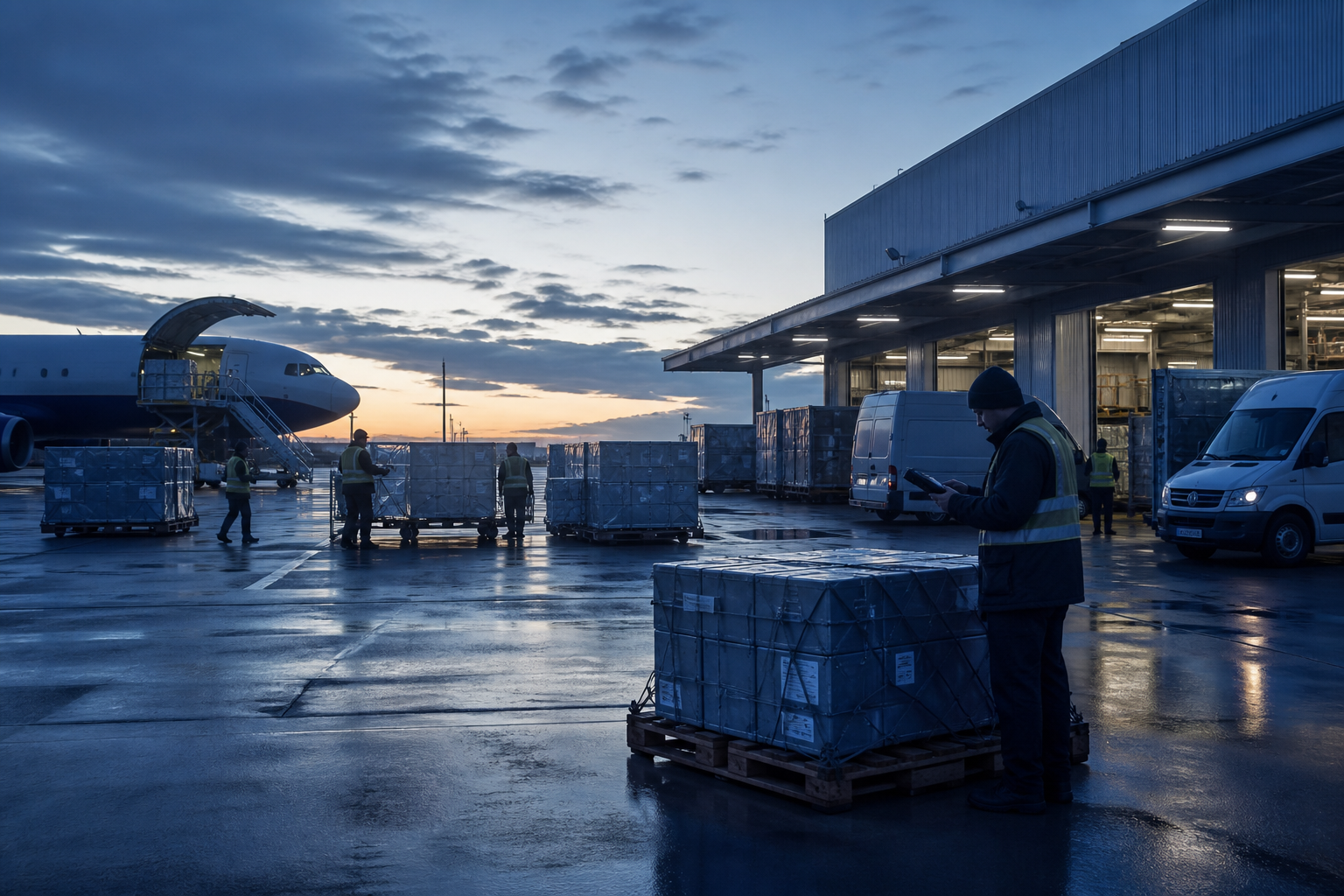
Situation: Indian businesses need delivery networks that can handle urgent documents, high-value goods, healthcare shipments and e-commerce parcels across long distances. Pure road movement can be economical, but it may not always meet time-sensitive promises across metros and distant regions.
The move: Blue Dart built its value proposition around an integrated express network: customer pickup, shipment processing, air connectivity for speed-sensitive lanes, ground distribution for reach, tracking visibility and last-mile completion. The primary driver is network control across critical handoffs. Supporting drivers include brand trust in express delivery, operational know-how in sorting and route planning, technology-enabled tracking, and the ability to combine air and ground depending on service level.
The lesson: In aviation-logistics, the winner is not simply the company with aircraft or trucks. The winner is the company that can coordinate the chain with fewer delays, fewer blind spots and better service consistency.
How AI Changes Aviation & Logistics Value Chain
AI matters here because the sector is full of prediction problems: demand, delays, routing, capacity, maintenance, no-shows, failed deliveries and exception handling.
- Smarter demand and capacity planning: Airlines and logistics firms use machine learning to forecast passenger demand, cargo volumes, route loads and peak-day capacity needs. The practical impact is better pricing, fleet deployment and warehouse staffing.
- Predictive operations: AI can flag likely aircraft maintenance issues, hub congestion, missed delivery risk or weather-linked disruption before the failure becomes visible to the customer.
- Dynamic routing and ETA accuracy: Logistics networks use traffic, address quality, delivery history, shipment priority and driver capacity to improve route sequencing and expected delivery time.
- Document and exception automation: LLMs can summarize airway bills, invoices, customer emails, claims and delay reports, helping teams resolve exceptions faster.
Use NotebookLM: upload this lesson, one aviation company annual report and one logistics company annual report. Ask: “Map both companies on the value chain, list their revenue drivers, cost drivers, KPIs and three likely interview questions.”
The caveat: AI improves decisions only when operational data is clean. Bad address data, poor scan discipline, missing exception codes or siloed airport systems will make AI outputs look confident but unreliable.
Interview Relevance
“Explain the aviation and logistics value chain. Where do airlines, airports, freight forwarders, 3PLs and last-mile players fit?”
If the interviewer asks you to compare aviation and logistics with another sector, use the same lenses - assets, demand, nodes, regulation, unit economics and customer promise. For a clean cross-sector structure, revise comparing two sectors on the same framework.
Common Mistake
The biggest mistake is giving a vehicle-based answer: “airlines use planes and logistics companies use trucks.” That misses the value chain. The fix: explain the handoffs, nodes, players, KPIs and economics from booking or pickup to final delivery.