
Bond Fundamentals: Yields, Coupons and Prices
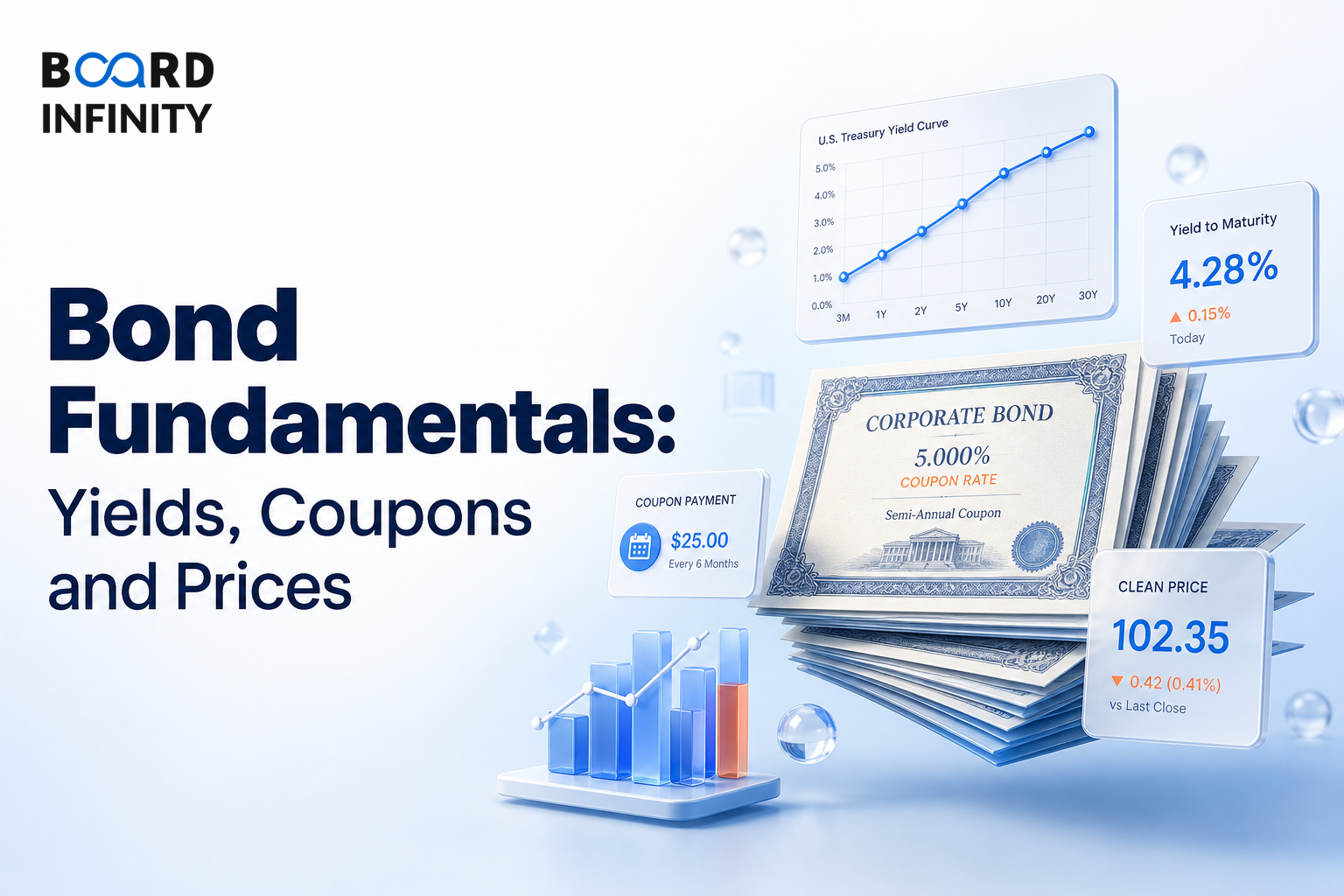
A bond is a fixed-income instrument representing a loan from the investor to a borrower, and interviewers often test whether you can connect coupon, market yield, price, duration, and convexity in one coherent answer. The practical question is simple: why does a bond trade at par, premium, or discount when market yields move? This matters in fixed-income interviews because price sensitivity, yield measures, and interest rate risk sit at the centre of bond valuation.
- A bond is a fixed-income instrument representing a loan from the investor to a borrower (government, corporation, or financial institution).
- The borrower promises to pay periodic coupon payments and return the face value (par) at maturity.
- Bond prices and yields move inversely - when interest rates rise, bond prices fall, and vice versa.
- Current Yield = Annual Coupon / Current Market Price. It is a simple measure and ignores capital gain/loss.
- Yield to Maturity (YTM) = IRR of all cash flows (coupons + face value) at current market price. It is the most complete yield measure.
- Duration tells you direction and first-order magnitude; convexity tells you that the actual price change is better than Duration predicts for large moves.
Bond Pricing Big Picture
A bond price is the present value of coupon payments plus the present value of the face value paid at maturity. The core valuation logic is the inverse price-yield relationship: when interest rates rise, bond prices fall, and vice versa.
Longer maturity bonds have greater price sensitivity to rate changes. Duration and convexity measure this interest rate risk and explain how much the price is expected to move when yield changes.
Price = Σ [C / (1+r)t] + [F / (1+r)n]. Where: C = Coupon payment, F = Face value, r = Discount rate (YTM), n = Years to maturity, t = Period.
What a Bond Represents
A bond is a fixed-income instrument representing a loan from the investor to a borrower (government, corporation, or financial institution). The borrower promises to pay periodic coupon payments and return the face value (par) at maturity.
Government Securities (G-Secs): Issued by RBI on behalf of GoI. In an interview, this definition is enough to anchor the rest of the answer: identify the cash flows, discount them at the market yield, and explain whether the price is at par, premium, or discount.
Price-Yield Relationship
Price-Yield Relationship: Inverse - when interest rates rise, bond prices fall, and vice versa. Longer maturity bonds have greater price sensitivity to rate changes.
This inverse relationship is the central interview concept. A bond paying fixed coupons becomes less attractive when the market demands a higher yield, so its price falls; when the market yield falls, the fixed cash flows are discounted at a lower rate, so the price rises.
Worked Example - Pricing a 10-Year 7% G-Sec at 7.5% YTM
Given: Face Value = ₹1,000 | Coupon = 7% per annum (semi-annual = ₹35 every 6 months) | Maturity = 10 years | YTM = 7.5% p.a. (semi-annual = 3.75%).
Bond Price Formula: P = Σ [C / (1+r)t] + [F / (1+r)n]
Duration and Convexity - Measuring Interest Rate Risk
Duration and convexity explain how a bond price responds when yield changes. Duration gives the first-order sensitivity, while convexity captures the curvature of the price-yield curve.
% ΔPrice ≈ −Modified Duration × ΔYield + ½ × Convexity × (ΔYield)². For small yield changes, Duration dominates. For large changes, convexity adjustment matters.
Structuring a Bond Fundamentals Interview Answer
"Walk me through why a 10-year 7% G-Sec at 7.5% YTM trades below par, and how duration and convexity help estimate the price impact of yield changes."
Do not stop at the formula. Connect coupon versus market YTM to the price level, then use Modified Duration and convexity to explain the price movement when yield changes.
The most frequent error is treating coupon rate and market YTM as the same thing. That costs points because the bond trades at a discount to par when the coupon rate is below the market YTM, and the price-yield relationship is inverse.
Conclusion
Bond fundamentals come down to cash flows, discounting, and interest rate sensitivity. If you can explain coupon payments, YTM, par versus discount pricing, Modified Duration, and convexity using the 10-year 7% G-Sec example, you can answer the core fixed-income interview question with clarity.