
Structured Finance & Securitisation Explained in India
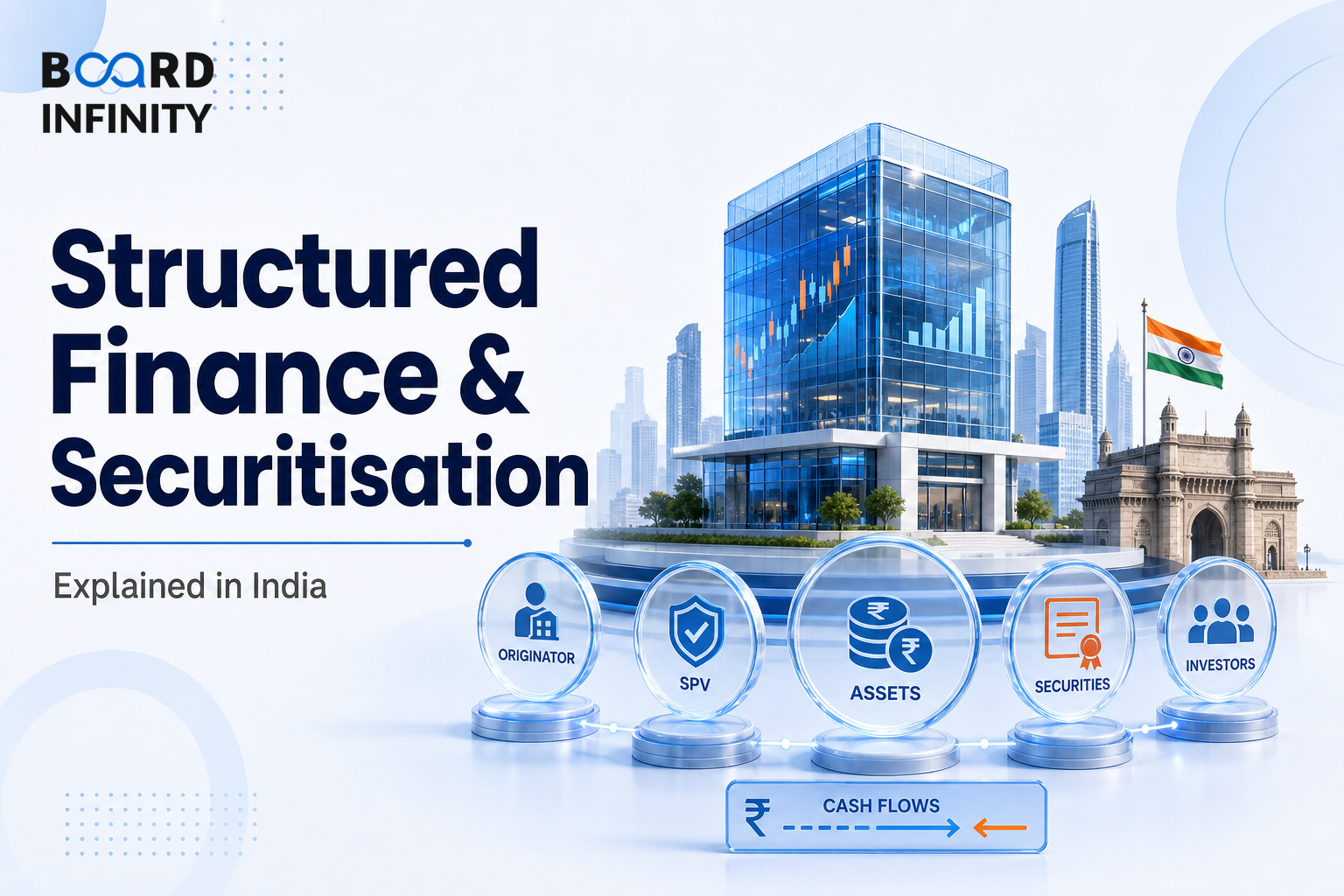
After the Indian bond market, the next question is how pools of loans and receivables can become securities for investors. Securitisation matters in interviews because it connects credit risk transfer, banks and NBFCs, and Indian structures such as ABS, MBS, PTCs, and Direct Assignment.
- Securitisation involves pooling financial assets (loans, receivables) and issuing securities backed by those pools to investors.
- This allows originators (banks, NBFCs) to transfer credit risk and free up capital for further lending.
- ABS (Asset-Backed Securities) are backed by auto loans, personal loans, credit card receivables, and microfinance loans.
- MBS (Mortgage-Backed Securities) are backed by home loans.
- Pass-Through Certificates (PTCs) are the primary Indian securitisation structure.
- Direct Assignment (DA) is a bilateral transfer of loan pools from originator to investor.
Structured Finance and Securitisation: The Big Picture
Securitisation is built around pooling financial assets and issuing securities backed by those pools to investors. The core interview lens is credit-risk transfer: originators such as banks and NBFCs use securitisation to transfer credit risk and free up capital for further lending.
In India, the major structures to compare are ABS, MBS, Pass-Through Certificates, and Direct Assignment. They differ by the underlying assets, how cash flows reach investors, and the typical use case.
Securitisation involves pooling financial assets (loans, receivables) and issuing securities backed by those pools to investors.
ABS (Asset-Backed Securities)
ABS, or Asset-Backed Securities, are backed by auto loans, personal loans, credit card receivables, and microfinance loans. They are common in India, with HDFC Bank, Bajaj Finance, and Mahindra Finance as frequent originators.
MBS (Mortgage-Backed Securities)
MBS, or Mortgage-Backed Securities, are backed by home loans. They are less common in India vs US, but growing with NHB's RMBS guidelines.
Pass-Through Certificates (PTCs)
Pass-Through Certificates, or PTCs, are the primary Indian securitisation structure. Investors receive a proportional share of the underlying loan pool's cash flows.
Direct Assignment (DA)
Direct Assignment, or DA, is a bilateral transfer of loan pools from originator to investor. In India, this typically means banks buying NBFC loan pools for priority sector lending compliance.
Structuring a Structured Finance & Securitisation Explained Interview Answer
"Explain securitisation as a credit-risk transfer mechanism and compare ABS, MBS, PTCs, and Direct Assignment in India."
Do not stop at "pooling loans". Add the credit-risk transfer point, the capital-freeing benefit for originators, and the difference between PTCs and Direct Assignment.
The most frequent error is treating all securitisation structures as the same. ABS, MBS, PTCs, and Direct Assignment differ by what backs them, how investors receive exposure, and their typical Indian use cases.
Conclusion
Securitisation pools financial assets and issues securities backed by those pools, allowing banks and NBFCs to transfer credit risk and free up capital for further lending. For interviews, the core takeaway is to compare ABS, MBS, PTCs, and Direct Assignment by underlying assets, cash-flow structure, and Indian use case.