
Credit Analysis and Credit Rating Scales Explained
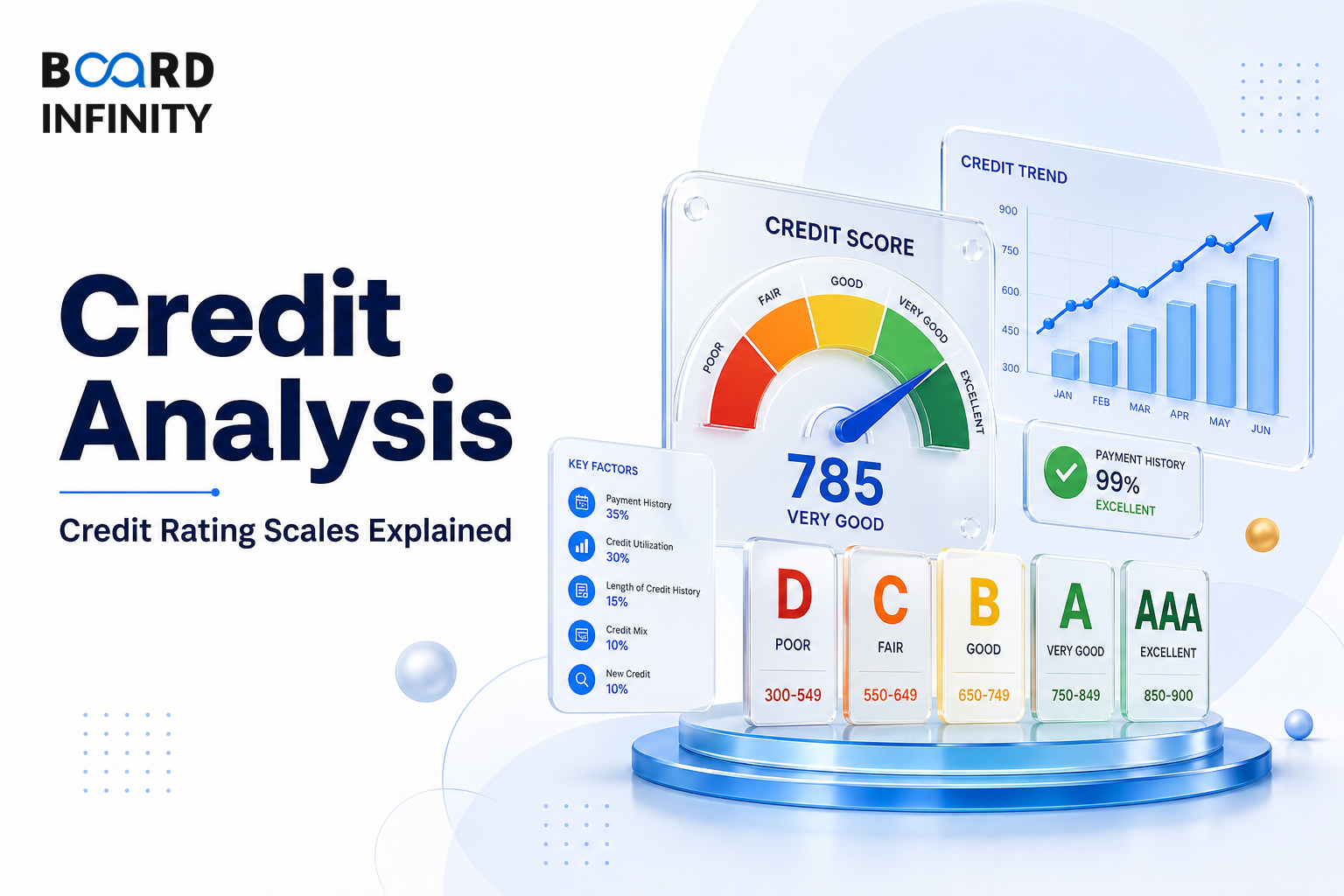
After Bond Fundamentals: Yields, Coupons & Prices, the next interview question is how investors decide whether a corporate bond deserves extra yield over a risk-free G-Sec. Credit analysis assesses the probability of default and loss given default for a borrower, and rating scales translate that risk into standardised categories used in Indian bond markets. In interviews, the important move is to connect borrower default risk, agency ratings, and observable credit spreads.
- Credit analysis assesses the probability of default and loss given default for a borrower.
- Indian credit rating agencies provide standardised rating scales widely used in bond markets, bank credit, and regulatory capital calculations.
- CRISIL, ICRA and CARE use categories from AAA for Highest Safety to D for Default.
- Credit Spreads represent the additional yield demanded by investors over the risk-free rate (G-Sec) for bearing credit risk.
- Credit spread = YTM(Corporate Bond) - YTM(G-Sec of same maturity).
- AAA-rated corporate bonds typically carry a spread of 50-80 bps over G-Sec, while BBB is 250+ bps.
- During stress, such as the IL&FS crisis 2018, AA NBFC spreads blew out to 300-400 bps.
How Credit Analysis Connects Default Risk, Ratings and Spreads
Credit analysis starts with the borrower and assesses the probability of default and loss given default. Indian credit rating agencies then provide standardised rating scales, and bond markets reflect credit risk through credit spreads over the risk-free rate (G-Sec).
The big picture is simple: weaker debt-servicing capacity generally moves a borrower down the rating scale, and investors demand a higher spread for bearing credit risk. A basis point is 0.01%, so a spread quoted in bps converts market credit risk into a measurable yield premium.
Credit Spreads represent the additional yield demanded by investors over the risk-free rate (G-Sec) for bearing credit risk. Credit spread = YTM(Corporate Bond) - YTM(G-Sec of same maturity).
During stress, such as the IL&FS crisis 2018, AA NBFC spreads blew out to 300-400 bps. The so what: credit spread is the market's observable additional yield demanded for bearing credit risk.
Credit Spread Ranges by Rating
Credit spreads turn rating categories into bond-market pricing. The additional yield over a G-Sec of the same maturity generally rises as the rating moves from highest safety toward speculative grade and default risk.
- AAA-rated corporate bonds: spread of 50-80 bps over G-Sec
- AA-rated: 80-150 bps; A-rated: 150-250 bps; BBB: 250+ bps
- During stress: AA NBFC spreads blew out to 300-400 bps in the IL&FS crisis 2018
Why the Rating Scale Matters
The rating scale is standardised across CRISIL, ICRA and CARE, which makes it widely used in bond markets, bank credit, and regulatory capital calculations. The interpretation column matters because it explains what the symbol means in credit terms: AAA indicates lowest credit risk and near-sovereign quality, while D means in default or expected to default.
For interview answers, avoid treating the symbol as the analysis itself. The stronger answer links the symbol to debt-servicing capacity, susceptibility to adverse conditions, protection under changing conditions, and the spread investors demand for bearing credit risk.
Structuring a Credit Analysis & Credit Rating Scales Explained Interview Answer
"How does credit analysis translate borrower default risk into rating scales and credit spreads in India?"
The strongest answer does not stop at naming AAA, AA or A. It connects each rating category to its interpretation and then shows how the bond market prices that credit risk through spreads over the G-Sec.
The most frequent error is treating credit ratings as fixed labels without explaining default risk, loss given default, and credit spreads. That costs points because the interviewer is testing whether you can move from borrower risk to a standardised rating scale and then to observable bond-market yield compensation.
Conclusion
Credit analysis assesses borrower default risk and loss given default, while CRISIL, ICRA and CARE ratings standardise that risk for Indian credit markets. The final takeaway is to always connect the rating symbol to its interpretation and to the credit spread investors demand over the G-Sec.