
Brand Differentiation Strategies and Brand Measurement
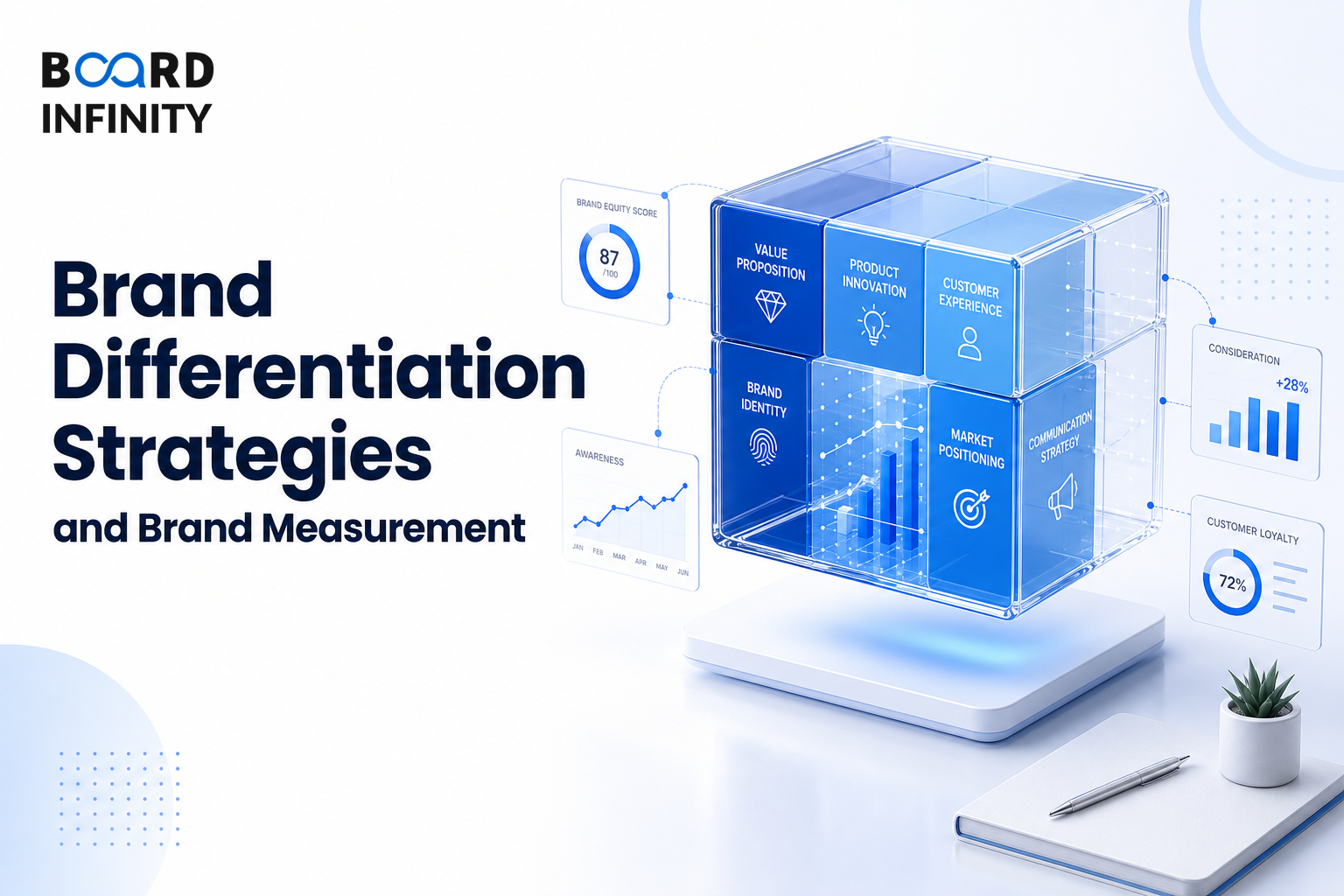
After understanding co-branding, brand extensions and brand personality, the next question is practical: what exactly makes one brand stand apart from another in the consumer's mind? Brand differentiation answers that question by choosing a clear, defensible basis such as features, quality, service, design, story, value, heritage or innovation. In interviews, this matters because candidates are often tested on whether they can move beyond vague statements like "strong brand" and explain the specific reason a consumer should remember, prefer or choose it.
- Brand differentiation is the process of creating a unique market position that makes a brand stand out from competitors in the consumer's mind.
- The main differentiation bases are product features, quality or craftsmanship, customer service, design or aesthetics, brand story or purpose, price or value, heritage or provenance, and innovation or speed.
- A strong answer connects the chosen basis to a real consumer memory, such as Dyson for bladeless fan technology, Amazon for hassle-free returns or Dove for "Real Beauty".
- Brand measurement should check whether consumers actually associate the brand with the chosen basis, not just whether the company has written a positioning line internally.
- Most brands use a primary basis and may support it with secondary cues, depending on category, business model and customer expectations.
- In case interviews, the safest structure is: define the consumer, choose the differentiation basis, prove it with examples, identify what to measure and state the strategic risk.
Big Picture: Differentiation Is a Choice of Basis
Brand differentiation is not a slogan-writing exercise. It is the strategic choice of what the brand should be known for in the consumer's mind, compared with competing options. The source framework shows that this choice can be functional, experiential, emotional, economic, historical or innovation-led.
Brand differentiation can be framed as: "For the target consumer, this brand should stand out because of one primary basis, supported by proof points that consumers can notice, remember and compare."
The table below gives the full map before we go deeper into each part.
What Brand Differentiation Means
Brand differentiation is the process of creating a unique market position that makes a brand stand out from competitors in the consumer's mind. The important phrase is "consumer's mind" because differentiation only matters when the market can recognise it, remember it and use it while making choices.
In placement and case interviews, a weak answer usually lists marketing activities. A stronger answer identifies the basis of differentiation first. For example, Dyson can be discussed through product features because the source specifically links it with bladeless fan technology and vacuum cyclone technology. That is different from Dove, which is better explained through brand story and purpose because of "Real Beauty".
This also explains why differentiation and brand measurement should be discussed together. If a company claims it is differentiated by design, service or value, the measurement question becomes: are consumers actually associating the brand with that basis?
Functional Differentiation: Features, Quality and Innovation
Functional differentiation is built around what the product does, how well it is made or how quickly it improves. It is especially useful when the consumer can observe a tangible product attribute, a technical feature or a repeated improvement cycle.
Several terms need clarity. OTA means Over-the-Air, referring to updates delivered remotely rather than through a physical service process. In the source, Tesla's OTA updates are used as an example of innovation and speed. First-to-market means reaching consumers early with a new product, feature or improvement before competitors can fully respond.
The nuance is that functional differentiation must be easy to understand. If the consumer cannot perceive the feature, quality cue or improvement, it may not create a strong position in the consumer's mind. In an interview, do not simply say "the product is better"; specify whether it is better because of technology, materials, durability, precision or speed.
Experience Differentiation: Service, Design and Aesthetics
Some brands stand out less through the core product feature and more through the experience surrounding the product. Customer service, visual design, User Experience and form factor can make the brand easier, more pleasant or more recognisable to choose.
UX means User Experience, the overall experience a person has while using a product, interface or service. In the source, design and aesthetics include visual appeal, UX, packaging and form factor. Apple is linked with minimalist product design, while Titan watches are used as a design and aesthetics example.
Amazon's hassle-free returns illustrate how service can become a brand differentiator. The product may not be the only reason the consumer remembers the brand; the ease of returning it can become part of the brand position. Similarly, Apple can be discussed not only through aluminum unibody design under quality or craftsmanship, but also through minimalist product design under design and aesthetics.
The nuance is that ownership may overlap. A brand like Apple appears in more than one basis in the source, which shows that real brands can combine cues. However, an interview answer should still identify the primary basis being argued, otherwise the response becomes a loose list of positives.
Meaning Differentiation: Story, Purpose, Heritage and Provenance
Meaning-based differentiation works when the brand is remembered for what it represents, where it comes from or the tradition it carries. This can be emotional, cultural or origin-based rather than purely functional.
Provenance means origin or source, especially when origin adds credibility or distinctiveness. GI means Geographical Indication, a tag that connects a product to a specific place or origin. In the source, Darjeeling tea's GI tag is used as a heritage or provenance example, while Royal Enfield is identified with history through "since 1901".
Dove's "Real Beauty" and Patagonia's environmental activism show how a brand can differentiate through purpose. This does not mean every brand should force a social narrative. The purpose has to be memorable and relevant enough to occupy a distinct place in the consumer's mind.
Economic Differentiation: Price and Value
Price and value differentiation is about offering the best value proposition at a given price point. It is not only about being cheap; the source frames it as the relationship between price and the value the consumer believes they receive.
Value differentiation = a clear price point plus a consumer-perceived benefit that makes the offer feel worth choosing.
IKEA's affordable, stylish furniture and Decathlon sports gear are the source examples for this basis. The word "stylish" matters in the IKEA example because it shows that value can combine affordability with design appeal. In interviews, this helps you avoid reducing the value basis to discounting alone.
The nuance is that price can attract attention, but value must defend the position. If a candidate says "lower price" without explaining why the consumer still sees the offer as valuable, the differentiation argument is incomplete.
How Brand Measurement Fits Differentiation
Brand measurement, in this lesson, means checking whether the chosen differentiation basis has actually entered the consumer's mind. Since brand differentiation is defined by the position a brand creates in the consumer's mind, measurement should focus on the link between brand and basis.
This is a practical interview structure rather than a statistical model. The key is to avoid measuring branding as a disconnected activity. If the strategic basis is customer service, then the measurement conversation should be about whether consumers associate the brand with exceptional support and experience. If the basis is heritage, the question is whether origin, history or tradition is actually part of the consumer's memory.
Worked Example: Apple as a Differentiated Brand
This example shows how to turn a brand name into a structured case answer. Instead of listing every positive thing about Apple, the answer chooses a basis, supports it with source-backed proof and defines what should be measured in the consumer's mind.
Choosing the Right Differentiation Basis
A useful interview move is to choose the basis that best matches the category and the proof available. If the proof is technological, choose product features or innovation. If the proof is emotional, choose story or purpose. If the proof is origin-based, choose heritage or provenance.
In many organisations, more than one basis may appear in the brand system. Tata Motors, for example, is linked in the source to build quality, while Apple appears under both craftsmanship and design. The interview skill is not to deny overlap, but to prioritise the basis that best explains the market position.
Structuring a Brand Differentiation Strategies & Brand Measurement Interview Answer
"How would you differentiate a brand in a crowded category and measure whether the differentiation is working?"
The best candidates do not say "differentiate through branding" as a circular answer. They name the basis, prove it with an example and then explain what consumer association they would measure.
Conclusion
Brand differentiation is the disciplined choice of what a brand should stand for in the consumer's mind, whether that is Dyson's technology, Tata Motors' build quality, Amazon's returns, Dove's purpose or Royal Enfield's heritage. The final takeaway is simple: pick a defensible basis, support it with proof and measure whether consumers actually remember the brand for that reason.
The most frequent error is treating differentiation as a list of good qualities instead of a clear basis for distinctiveness. This costs points because the interviewer cannot tell what position the brand is trying to own in the consumer's mind or how you would measure whether that position is working.