
Responsible AI in Marketing: Privacy, Transparency and Bias
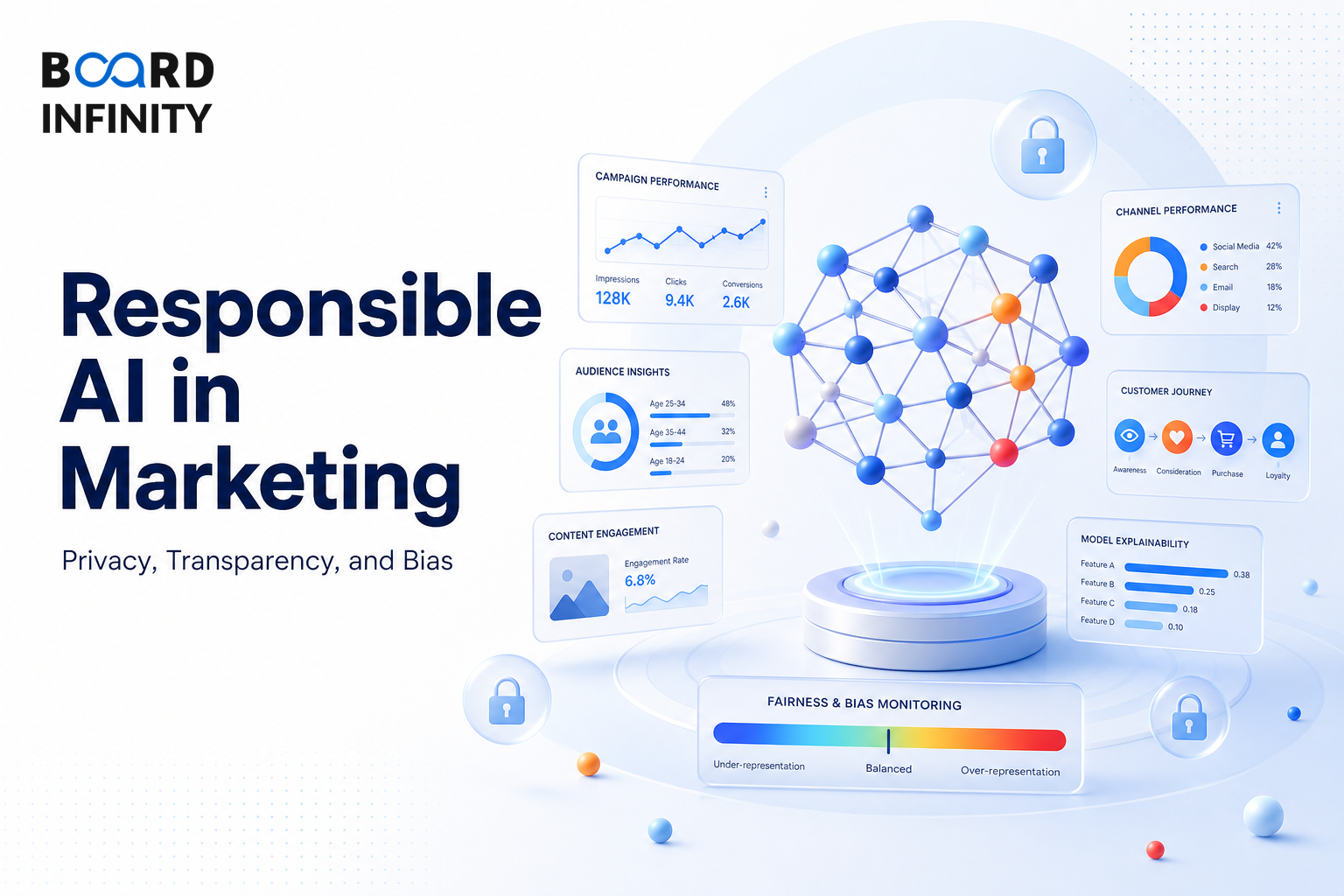
After learning Brand Differentiation Strategies & Brand Measurement, the next placement question is practical: how do you protect the brand while using artificial intelligence in day-to-day marketing? Artificial intelligence, or AI, means software systems that generate, analyse, or optimise content and decisions from data - for example, ChatGPT for campaign ideas or Meta Advantage+ for automated ad testing. This matters in interviews because progressive FMCG, D2C, and tech companies increasingly expect marketers to use AI for speed without compromising privacy, trust, or fairness.
- Responsible AI in marketing has three core duties: data privacy, transparent AI-generated content, and bias-aware targeting.
- India's Digital Personal Data Protection Act, 2023 governs how personal data is collected, stored, processed, and used for marketing.
- Consent-first marketing means personal data cannot be used for targeting unless consent is explicit, informed, and not hidden inside buried clauses.
- AI-generated content must be fact-checked because large language models can hallucinate statistics, product claims, or competitor information.
- Bias can enter ad delivery even when targeting is broad, so marketers must audit who ads actually reach versus who they intended to reach.
- Interview answers should name role-specific tools such as ChatGPT, Canva AI, Brandwatch, Meta Advantage+, Surfer SEO, GA4, and Perplexity AI, but always pair tools with governance.
The Big Picture - Responsible AI Marketing at a Glance
Responsible AI is not a separate legal checklist at the end of a campaign. It is a working discipline across data collection, content creation, media delivery, and role-specific execution.
Why Ethical AI Is a Marketer's Responsibility
AI is now central to marketing operations because it can generate campaign concepts, speed up creative iteration, analyse sentiment, identify content gaps, and build predictive audiences. But the same systems can misuse personal data, create unsupported claims, drift away from brand voice, or reinforce biased ad delivery.
For a marketer, the responsibility is professional, not just technical. A brand manager using ChatGPT still owns the final campaign brief. A performance marketer using Meta Advantage+ still owns audience fairness and compliance. A market researcher using Perplexity AI still owns whether the synthesis is accurate and fit for decision-making.
Responsible AI in marketing = consented data + verified outputs + brand-safe content + bias-aware targeting + role-relevant business use.
Data Privacy and DPDPA Compliance
DPDPA stands for Digital Personal Data Protection Act. India's DPDPA, 2023 governs how personal data is collected, stored, processed, and used for marketing purposes. The source glossary also notes a penalty of up to ₹250 Cr per violation, which is why privacy cannot be treated as a back-office legal issue.
Personal data becomes especially sensitive when AI tools are used for personalisation, targeting, customer segmentation, or marketing automation. CRM, or Customer Relationship Management, refers to technology and processes for managing customer interactions across the lifecycle. If a CRM or marketing automation tool cannot support consent, purpose control, and erasure, an AI personalisation layer built on top of it increases risk.
DPA stands for Data Processing Agreement. It is the agreement that defines how a vendor processes data on behalf of a business. In practical interview language, you should say: "Before I use an AI personalisation tool, I would check whether the data source has consent, whether the use case matches the consented purpose, and whether the vendor DPA covers the processing."
Transparency in AI-Generated Content
AI-generated content can be useful for first drafts, creative variations, product explainers, and campaign concepts. The risk is that consumers may mistake AI-generated output for human-written expert opinion, real customer experience, or a verified product claim.
LLM stands for large language model. ChatGPT is an example of an LLM-based tool used for generating text, ideas, and drafts. The source warns that large language models hallucinate, which means they can produce false but confident-sounding statistics, product claims, or competitor information.
Adobe Firefly is named in the source as a commercially licensed AI image tool. For a brand campaign, using a licensed tool such as Adobe Firefly can reduce copyright risk compared with publishing unverified AI-generated imagery. The strategic lesson is simple: creative speed is useful only when it does not create legal or brand-trust exposure.
Bias-Aware Targeting and Inclusive Creative
AI targeting algorithms optimise for the objective you give them. That can improve efficiency, but it can also embed discriminatory patterns if the historical data or optimisation signals are skewed.
Demographic bias can occur when algorithms trained on historical purchase data systematically exclude lower-income or rural audiences from ad targeting. Gender and age bias can also appear in delivery. The source specifically notes that Meta's ad delivery system has been documented showing job ads disproportionately to men for engineering roles and women for nursing roles, even when targeting was set to broad audiences.
Performance Max and Advantage+ abstract away audience targeting, which means marketers do not always directly control or see every targeting decision. That makes auditing more important, not less important. A responsible marketer compares who the campaign was intended to reach with who the platform actually delivered impressions to.
Meta's ad delivery system has been documented showing job ads disproportionately to men for engineering roles and women for nursing roles, even when targeting was set to broad audiences. For marketers, the so what is that broad targeting is not automatically neutral. Delivery breakdowns still need to be reviewed against the intended audience.
Role-Specific AI Applications for Marketing Interviews
The best interview answers do not say, "I will use AI for marketing." They connect a specific role to specific tools, then add the responsibility layer. This shows both business understanding and professional judgment.
GA4 means Google Analytics 4, an analytics platform that can support predictive audiences. SEO means Search Engine Optimisation, the practice of improving organic search visibility through content quality, technical signals, and authority. In an interview, define the term once, then explain the business use.
Worked Example - Building an AI-Enabled Performance Marketing Plan Responsibly
This is a complete answer structure because it does not stop at tool names. It starts with the business task, identifies the risk, applies a responsible framework, makes a decision, and explains the learning.
Practical Checklist Before Using AI in a Marketing Campaign
Use this checklist before deploying AI for personalisation, targeting, content generation, or research synthesis. It is especially useful in case interviews because it turns a broad ethical concern into clear operating steps.
Structuring a The 12 Pricing Strategies Every Marketer Must Know Interview Answer
"How would you use AI in this marketing role while ensuring privacy, transparency, and fair targeting?"
The strongest candidates do not list AI tools like a software catalogue. They explain what the tool improves, what risk it creates, and what control they would put in place before launch.
Conclusion
Responsible AI in marketing is the discipline of using automation without losing accountability. If you can connect DPDPA compliance, transparent content, bias-aware targeting, and role-specific AI tools into one answer, you signal that you are ready for modern marketing roles.
The most frequent error is treating AI as a productivity shortcut and ignoring governance. This costs points because interviewers want marketers who can protect consumer trust, brand credibility, and compliance while still using AI effectively.