
Pricing in the Indian Context - Jio, D2C and Tier-2 Markets
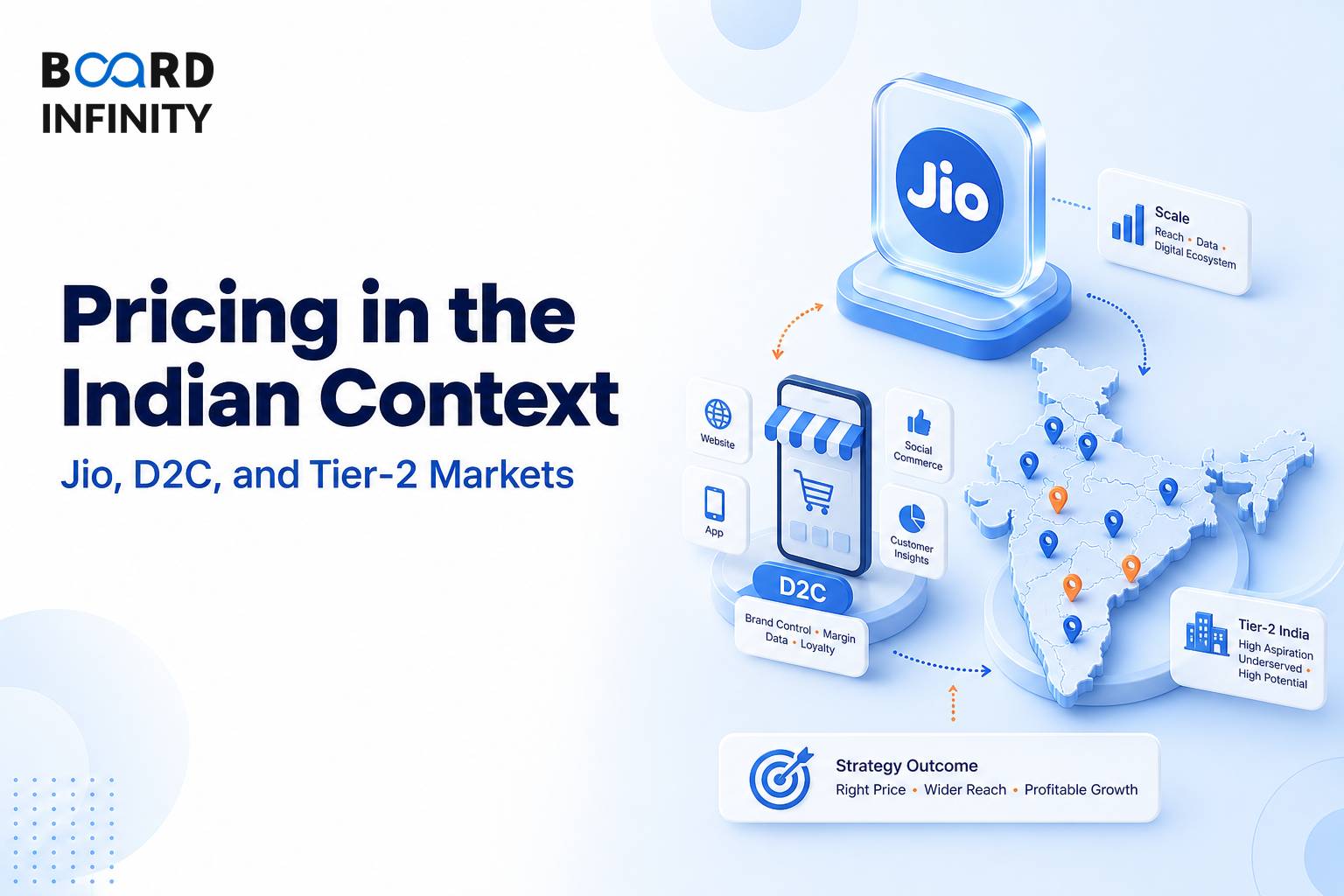
After understanding Price Elasticity of Demand - how demand changes when price changes - the next interview question is sharper: why does the same pricing logic behave differently in India? Indian pricing is not only about willingness to pay; it is shaped by ₹1-2 differences, sachet packs, Goods and Services Tax slabs, Maximum Retail Price rules, distributor margins, rural affordability, festival demand and direct-to-consumer economics. In case interviews, this matters because a pricing recommendation that ignores Indian market structure can look elegant on paper but fail at the shelf.
- India has extreme mass-market price sensitivity, where even a ₹1-2 difference can matter for trial, repeat and household adoption.
- The sachet strategy makes products affordable through small packs at ₹1, ₹5 and ₹10 price points, reducing trial barriers and matching daily-wage income patterns.
- GST, or Goods and Services Tax, affects the final consumer price through 5%, 12%, 18% and 28% slabs, so category placement can change competitive pricing.
- MRP, or Maximum Retail Price, is mandated on packaging under the Legal Metrology Act and must factor in all channel margins upfront.
- Traditional distribution can require a 40-50% margin stack across distributor, wholesaler and retailer, while D2C brands can create a 20-30% price advantage or reinvest in quality.
- Rural India represents 65% of the population and often needs lower price points and smaller packs, while Diwali, Navratri and Eid can bring a 30-40% surge in consumer spending.
Big Picture - How Indian Pricing Actually Works
In many Western textbook models, price is often framed as a function of cost, competition and willingness to pay. In India, those still matter, but the final price is also constrained by packaging size, taxation, legal MRP, channel economics and affordability at the point of purchase. The big picture is to treat pricing as a market system, not a single number.
Netflix and Hotstar adopted India-first mobile-only over-the-top subscription pricing at ₹49-99 per month. OTT means over-the-top media, or video content delivered through the internet rather than traditional television distribution. The strategic so what is simple: in India, access and trial often improve when the product is resized around the consumer price point instead of forcing a standard global pack or plan.
For an Indian pricing case, frame the final price as: consumer price point plus pack size plus GST slab plus MRP constraint plus channel margin stack plus rural or urban affordability plus seasonal demand plus D2C versus traditional distribution economics.
Why Indian Pricing Is Different from Textbook Pricing
Price elasticity of demand means the degree to which demand changes when price changes. In India, the mass market can be extremely price-sensitive, with even a ₹1-2 difference affecting consumer response. That makes price architecture - the set of pack sizes, price points and channel margins - more important than a single premium or discount decision.
This does not mean Indian consumers only buy the cheapest product. It means the product must be accessible at the right entry point. For many categories, the first battle is to reduce the trial barrier so that a household can test the product without committing to a large pack or monthly expense.
That is why sachets, mobile-only subscriptions and small data packs matter so much in Indian pricing. They convert a high absolute spend into a manageable daily, weekly or trial-sized decision. For interviews, this is the distinction between saying "reduce price" and saying "change the unit of purchase."
The Sachet Strategy - India’s Core Pricing Innovation
The sachet strategy means selling a product in very small units so that the entry price becomes affordable. India pioneered this model through micro-packaging, making premium or aspirational products accessible to consumers who could not afford standard-sized products. It was instrumental in the growth of FMCG, or fast-moving consumer goods, which are frequently purchased packaged products such as shampoo and detergent.
The key insight is that sachets work because they reduce the trial barrier, accommodate daily-wage income patterns and help brands reach 800M+ consumers who cannot afford standard-sized products. The pack may be small, but the strategic role is large: it opens up consumption by changing the affordability equation.
The nuance is that sachet pricing is not just a cheaper product. It is a different consumption design. A brand can preserve aspiration and category value while changing the pack size, payment moment and trial risk for the consumer.
GST, MRP and Channel Margins - The Hidden Price Architecture
GST stands for Goods and Services Tax. In the source context, 5%, 12%, 18% and 28% slabs affect the final consumer price, and category placement in a GST slab affects competitive pricing. This means the same base product economics can look different to the shopper once tax is included.
MRP stands for Maximum Retail Price. Under the Legal Metrology Act, MRP must be printed on packaging, and it must factor in all channel margins upfront. This is particularly important in Indian distribution because products often move through multiple intermediaries before reaching the consumer.
For an interview, this is where many candidates lose points. They recommend a consumer price without checking whether that price can support distributor, wholesaler and retailer economics. In India, the price that wins the consumer but breaks the channel may not scale through traditional distribution.
Rural Affordability, Tier-2 Markets and Festival Demand
The source highlights that rural India is 65% of the population and has different price expectations from urban India. For pricing cases that include tier-2 or smaller markets, the same affordability lens is useful: lower price points and smaller pack sizes often become central to distribution and adoption. The goal is not only to be cheap; it is to create a purchase unit that fits the consumer’s cash flow and shopping behavior.
Festival pricing adds another layer. Diwali, Navratri and Eid see a 30-40% surge in consumer spending, which makes aggressive promotional pricing useful for volume growth. This is not necessarily the same as permanent discounting; it is a seasonal pricing lever tied to a known demand spike.
The nuance is that festival promotions can drive volumes, but they should be understood as a timing lever rather than a substitute for a sustainable price architecture. If the everyday price point is wrong, a seasonal discount can create a temporary spike without solving adoption.
D2C Pricing - Cutting Margins or Reinvesting in Quality
D2C means direct-to-consumer, where a brand sells directly to consumers instead of relying entirely on traditional distributor, wholesaler and retailer layers. The source states that D2C brands can cut channel margins and create a 20-30% price advantage versus traditional distribution. Alternatively, they can reinvest that advantage in quality.
The important interview nuance is that D2C does not automatically mean "sell cheaper." The source gives two options: a 20-30% price advantage versus traditional distribution, or reinvestment in quality. Depending on the brand’s positioning, either can be strategically valid.
Worked Example - Detergent Sachets for Rural Reach
Consider a detergent brand trying to expand beyond consumers who can afford a standard-sized pack. The problem is not only willingness to pay; it is the absolute cash outlay required for trial and repeat purchase. The Indian pricing framework pushes the brand to redesign the purchase unit, not just reduce the headline price.
This example is useful because it shows a complete pricing decision. The brand does not merely ask "what price should we charge?" It asks what pack size, entry point and channel structure can make the product affordable while still practical to distribute.
How to Use This in Case Interviews
When an interviewer gives an Indian pricing case, start with the consumer but do not stop there. A strong answer separates consumer affordability from channel feasibility. It also recognizes when the correct move is a ₹1, ₹5 or ₹10 pack, a festival promotion, or a D2C route rather than a simple across-the-board price cut.
Structuring a Pricing in the Indian Context Interview Answer
"Reliance Jio is evaluating a low-priced data offer for smaller Indian markets. How would you think about pricing it?"
The strongest answers do not say "India is price-sensitive" and stop. They translate price sensitivity into a specific mechanism: sachet pack, mobile-only plan, GST-aware final price, MRP-backed margin stack, rural affordability or D2C margin saving.
Conclusion
Pricing in India is a market-specific discipline where the right answer often comes from redesigning access, not merely lowering price. If you can connect sachets, GST, MRP, channel margins, rural affordability, festivals and D2C economics into one pricing architecture, your interview answer will sound practical rather than textbook.
The most frequent error is applying a Western-style cost-plus or premium-discount model without adapting it to Indian realities. This costs points because it ignores the ₹1-2 sensitivity of the mass market, the 40-50% channel margin stack, MRP constraints and the strategic role of sachets in reaching 800M+ consumers.