
Brand Positioning: POPs, PODs and Perceptual Mapping
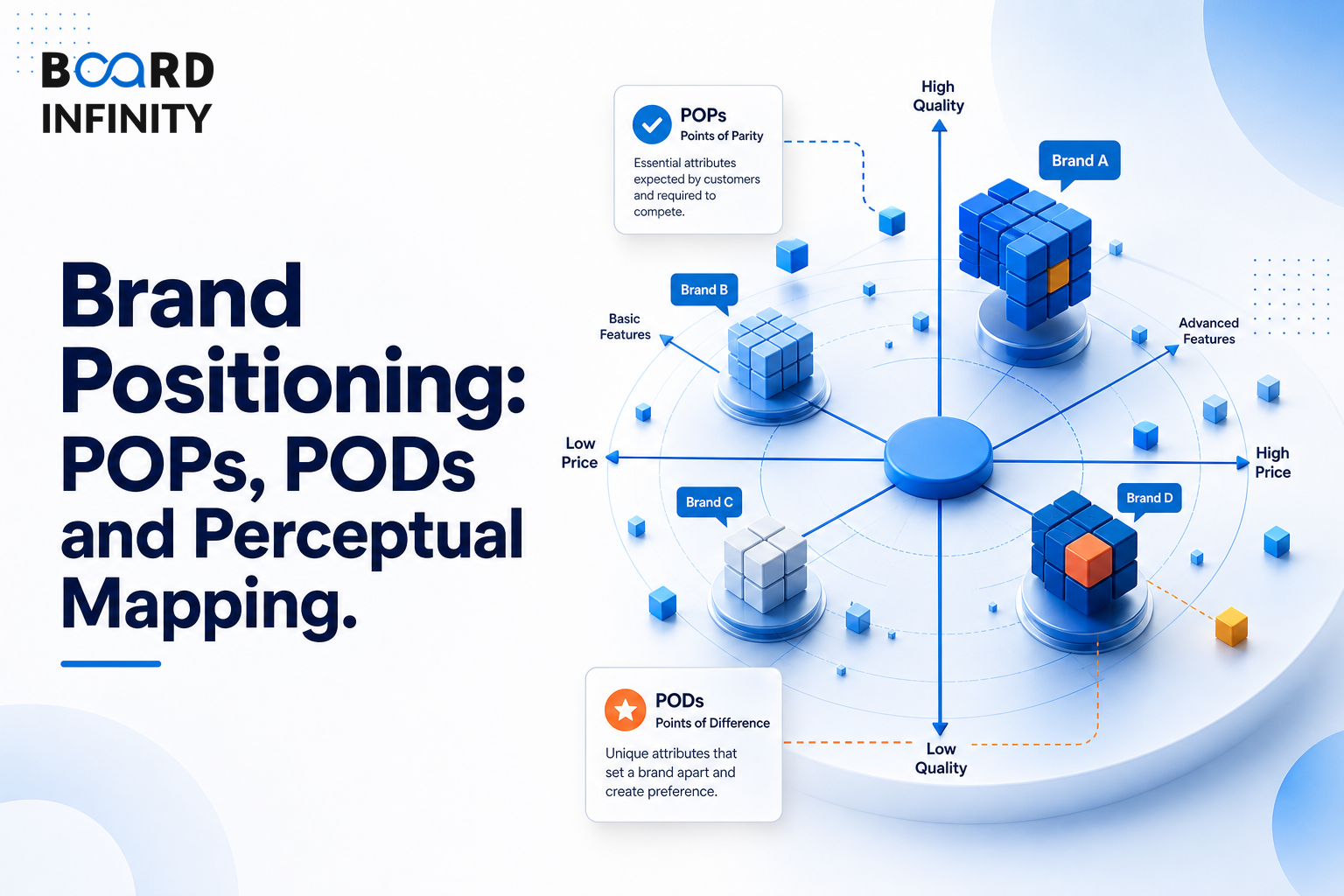
Kapferer's Brand Identity Prism helps you describe what a brand is from multiple identity angles. Brand positioning answers the next interview-critical question: where should that brand sit in the consumer's mind, and why should the consumer believe it? In case interviews at companies such as HUL and P&G, this matters because a weak positioning answer becomes a list of slogans, while a strong answer connects target consumer, need state, points of parity, points of difference and reasons to believe into one coherent bullseye.
- Brand positioning is the disciplined choice of who the brand is for, what need it serves, how it is meaningfully different and why that promise is credible.
- The Brand Positioning Bullseye moves from external consumer understanding inward to the brand's core essence.
- Points of parity are category must-haves that make the brand legitimate, such as comfortable, durable and stylish in athletic wear.
- Points of difference are the distinctive associations that make the brand preferred, such as Nike's inspiration, innovation and premium performance gear.
- RTB means Reasons to Believe - proof points that make the promise credible, such as world-class athlete endorsements and technologies like Air Max, Flyknit and ZoomX.
- A brand mantra is the heart and soul of the brand in 3-5 words, such as Nike's "Authentic Athletic Performance".
- Perceptual mapping is useful in interviews as a way to make POPs and PODs visible: show where the brand must match the category and where it should stand apart.
The Big Picture: The Brand Positioning Bullseye
The bullseye is a concentric framework: it starts with the consumer on the outside and moves inward to the brand's core mantra. This prevents a common interview error - jumping straight to a tagline without proving who the brand is for, what need it addresses, and why the promise is believable.
Why Brand Positioning Matters
Brand positioning matters because it forces a brand to make choices. A brand cannot be meaningful to everyone in the same way, so the framework begins by defining the consumer target, the insight behind that target and the specific need state being served.
In interviews, this helps you move from vague language like "build a premium brand" to a structured answer. You can say who the consumer is, what tension exists in that consumer's life, which category expectations the brand must meet, which distinctive associations it should own and what proof makes the claim credible.
POPs, PODs and RTBs: The Strategic Core
Three ideas usually carry the most weight in a positioning discussion: Points of Parity, Points of Difference and Reasons to Believe. Together, they separate a defensible positioning from a cosmetic one.
For a specific consumer target, in a defined need state, the brand promises a meaningful point of difference, while meeting category points of parity, because its reasons to believe make the promise credible.
How Perceptual Mapping Fits In
Perceptual mapping is best used after you have clarified POPs and PODs. In an interview, you can use it as a simple visual logic: one side of the map captures the category expectations the brand must meet, while the other highlights the distinctive associations the brand wants to own.
For Nike, the source gives both sides of that logic. As athletic wear, it must still be comfortable, durable and stylish. But its stronger positioning comes from inspiration, innovation and premium performance gear, supported by world-class athlete endorsements and technologies such as Air Max, Flyknit and ZoomX.
Nike: The Full Framework in One Business
Nike demonstrates the full bullseye because the source gives each major part of the positioning system: target, insight, POP, POD, RTB and mantra. That makes it useful as a complete worked example rather than a one-line brand slogan.
The takeaway is that a shallow answer says "Nike is about performance." A complete answer explains who the brand serves, what consumer tension it addresses, what it must deliver as table stakes, what makes it different, what proves the promise and how all of that collapses into a 3-5 word mantra.
The Bullseye as an Interview Framework
When you are asked to position or reposition a brand, work from the outside inward. This keeps the answer consumer-led rather than execution-led. Visual identity, colours, imagery, fonts and sound matter, but in the bullseye they sit inside a larger positioning logic rather than replacing it.
Key Nuance: Difference Is Not Enough
Candidates often over-focus on differentiation because it sounds strategic. But the source makes clear that points of parity are also part of the inner ring: a brand must meet category must-haves to be seen as legitimate.
For Nike, innovation and premium performance gear are powerful PODs, but comfort, durability and style still matter as POPs. In many interview answers, the highest-scoring move is to show both: "Here is what we must match, and here is where we should stand apart."
Structuring a Brand Positioning Interview Answer
"How would you define the positioning for an athletic performance brand like Nike using POPs, PODs and reasons to believe?"
The strongest answers do not treat POP, POD and RTB as separate bullet points. They link them into one story: the brand is credible because it meets category basics, preferred because it owns a difference and believable because the proof supports the promise.
The most frequent error is confusing a point of difference with a reason to believe. "Innovation" is a POD for Nike, while Air Max, Flyknit and ZoomX are RTBs that make the innovation claim credible. Mixing these up costs points because the interviewer cannot see whether your positioning is merely asserted or actually substantiated.
Conclusion
Brand positioning is strongest when it moves from consumer understanding to brand essence through a clear bullseye. Use POPs to establish legitimacy, PODs to create preference, RTBs to prove the promise and a short brand mantra to make the positioning memorable.