
Caste, Language, Region & Class in the Indian Workplace - Interview-Ready DEI Framework
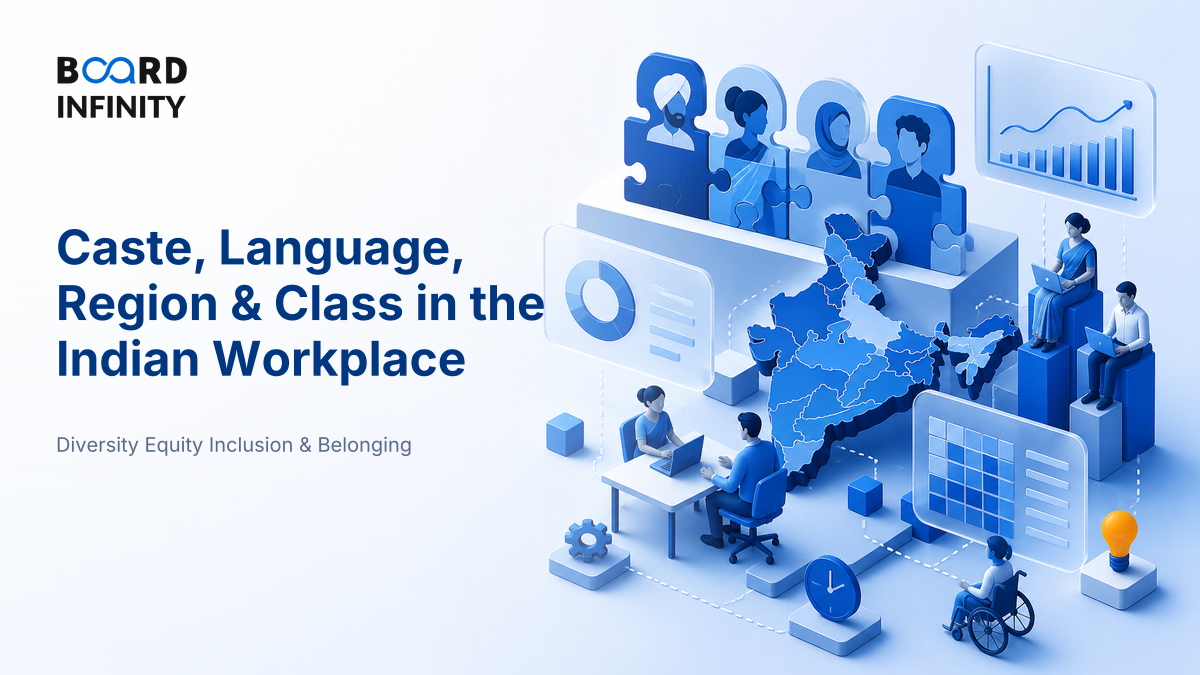
The biggest misconception is that caste, language, region and class disappear once people enter a modern office with ID cards, laptops and English meetings. They often do not disappear - they become quieter signals: a surname on a resume, an accent in a client call, a hometown joke, a college brand, a lunch-table network.
- Caste, language, region and class are workplace variables because they affect access to jobs, networks, credibility, voice and mobility.
- The core idea is not “identity politics”; it is fair opportunity design - making decisions less dependent on inherited social capital.
- Bias may be direct, like casteist remarks, or indirect, like treating fluent metro English as a proxy for intelligence.
- Intersectionality matters: a first-generation woman from a non-metro, non-English-medium background may face a very different barrier than a metro male from the same caste group.
- Good inclusion work changes systems: hiring criteria, referral controls, language norms, manager training, grievance channels and promotion reviews.
- Measure outcomes with parity indices, selection-rate ratios, promotion parity, pay-equity gaps, inclusion pulse gaps and grievance closure quality.
- The strongest interview answer separates legal compliance, business performance and human dignity - then gives practical workplace interventions.
Big Picture: The Hidden Loop Behind Workplace Inequality
In the Indian workplace, caste, language, region and class often operate through a loop. Identity cues create assumptions; assumptions shape access; access affects outcomes; outcomes then reinforce the belief that some groups are naturally more “polished”, “stable” or “leadership-ready”.
Core Explanation: What Each Identity Changes at Work
Think of this topic as a practical DEI lens for India. The question is simple: does a person’s social background change how they are hired, heard, evaluated, promoted or protected? If yes, the workplace has an inclusion problem even if the company never uses openly discriminatory language.
Caste: The Most Sensitive and Often Most Denied Layer
Caste can enter the workplace through surnames, hometowns, informal networks, housing patterns, food practices, marriage talk, college peer groups and social comfort. The risk is not only open discrimination; it is also network exclusion - who gets referrals, mentors, visibility and trust.
In Indian workplaces, caste conversations require care because caste identity data is sensitive, discrimination can be legally serious, and employees may not feel safe self-identifying. A mature company does not force disclosure. It creates anonymous reporting, strong conduct norms, fair hiring systems and consequences for casteist behaviour.
Language: The Accent-Equals-Ability Trap
Language matters because English fluency, accent and presentation style often get confused with capability. For client-facing roles, communication is important; but the error is using one kind of English polish as a blanket proxy for intelligence, leadership or cultural fit.
A better system separates role-critical communication from status signalling. For example, a sales role in Tamil Nadu may require Tamil fluency more than corporate English, while an analyst role may require structured thinking more than a metro accent.
Region: Where You Come From Can Shape Where You Can Go
Regional identity affects workplace experience through relocation norms, language comfort, food, festivals, stereotypes and informal group formation. A North-East Indian employee may face “foreignness” assumptions; a Hindi-speaking employee in a southern plant may face language barriers; a non-metro employee may be perceived as less cosmopolitan before they have even performed.
Class: The Invisible Advantage Called “Polish”
Class shows up as English-medium schooling, parental education, unpaid internship affordability, laptop access, interview grooming, confidence with authority and familiarity with corporate codes. Two candidates may have the same degree, but not the same social preparation for the workplace.
This is why “merit” must be examined carefully. Merit is real, but performance signals are often mixed with inherited access. The job of HR and managers is to identify actual capability while reducing irrelevant social filters.
The Indian Workplace Lens: Four Identities, One Experience
These identities rarely act alone. A candidate may be from a marginalised caste but elite English-medium schooling; another may be from a dominant caste but first-generation, rural and non-English-medium. The practical skill is to avoid lazy assumptions and look at how identities combine in actual workplace systems.
How to Design Inclusion Without Tokenism
A good inclusion strategy does not stop at awareness sessions. It redesigns the moments where opportunity is allocated: hiring, onboarding, performance reviews, promotion, grievance handling and leadership visibility.
Practical Interventions That Actually Work
What to Measure: Six Metrics That Make Inclusion Real
Do not collect caste or sensitive identity data casually. Use voluntary self-identification, clear purpose, privacy safeguards, minimum reporting thresholds and legal review. Where identity data is not safe or appropriate, use proxy-free process audits and anonymous employee listening.
Definitions You Can Say in One Breath
- Social identity: Tajfel described it as the part of self-concept derived from membership in a social group.
- Intersectionality: Crenshaw introduced it to explain how overlapping identities create distinct forms of disadvantage.
- Inclusion: SHRM defines it as fair treatment, equal access to opportunities and full contribution to organisational success.
- Workplace discrimination: unfair distinction or exclusion that impairs equality of opportunity or treatment in employment.
Case Study: Zoho and the Small-Town Talent Bet
Zoho challenged the metro-and-elite-degree talent model by building pathways for non-metro and non-traditional technology talent.
Situation: Indian technology hiring has often concentrated opportunity in metros, elite colleges and English-comfortable networks. This can unintentionally favour class privilege and regional access, even when the company believes it is hiring purely for merit.
The move: Zoho became known for building a wider talent pipeline through small-town presence, non-traditional hiring routes and its Zoho Schools model, where students can be trained for technology roles without the conventional elite-degree filter. The primary driver was a different definition of talent: demonstrated skill and learning ability over pedigree. Supporting drivers included long-term training investment, local employment creation, product work outside the usual metro hubs and leadership conviction behind the model.

Outcome and lesson: Zoho’s approach shows that inclusion can be a business design choice. It expands access for candidates affected by class, region and language barriers while also helping the company build loyal, trained talent pools beyond saturated metro markets. The lesson is not “hire anyone from anywhere”; it is change the signal of merit from social polish to job-relevant capability.
So what: A strong DEI answer should connect inclusion to talent supply, retention, innovation and fairness. Zoho is useful because it proves that reducing class and regional barriers can be part of core talent strategy, not a side CSR activity.
How AI Changes Caste, Language, Region & Class in the Indian Workplace
First, AI can reduce some barriers if designed carefully. AI translation, writing assistants and speech-to-text tools can help employees from different language backgrounds participate better in meetings, documentation and customer support. This is useful only if companies do not then punish people for using support tools.
Second, AI can silently reproduce class and language bias. Resume-screening models may overvalue elite colleges, metro internships, English keywords or familiar career paths. Video-interview tools can misread accent, lighting, bandwidth and presentation style as confidence or competence. For India, this is a serious risk because class, region and language often appear as data proxies.
Third, AI can improve skills intelligence. Instead of relying only on degree brand or manager perception, companies can use skills taxonomies, work samples and internal talent marketplaces to identify who can do the job. The caution: employees must know what data is used, how it affects decisions and how to appeal errors.
Use NotebookLM to upload a company annual report, DEI policy and careers page. Ask: “Where could caste, language, region or class bias enter this company’s hiring, onboarding, promotion and grievance systems? Give me five interview questions and model answers.”
Interview Relevance
“In an Indian workplace, how would you address caste, language, region and class issues without making the organisation divisive?”
Use one Indian example, such as Zoho’s non-metro talent model, to show you understand the topic beyond textbook diversity language.
Common Mistake
The biggest mistake is reducing this topic to food, festivals and “people should be respectful.” That sounds harmless but shallow because it ignores hiring, networks, promotion and power. One-line fix: always move from culture talk to system design - criteria, access, measurement and accountability.
What to Revise Next
Once this framework is clear, revise the two tools that convert inclusion intent into workplace reality: employee voice structures and inclusive policies.