
Measuring Representation, Equity & Inclusion for Interview-Ready HR Answers
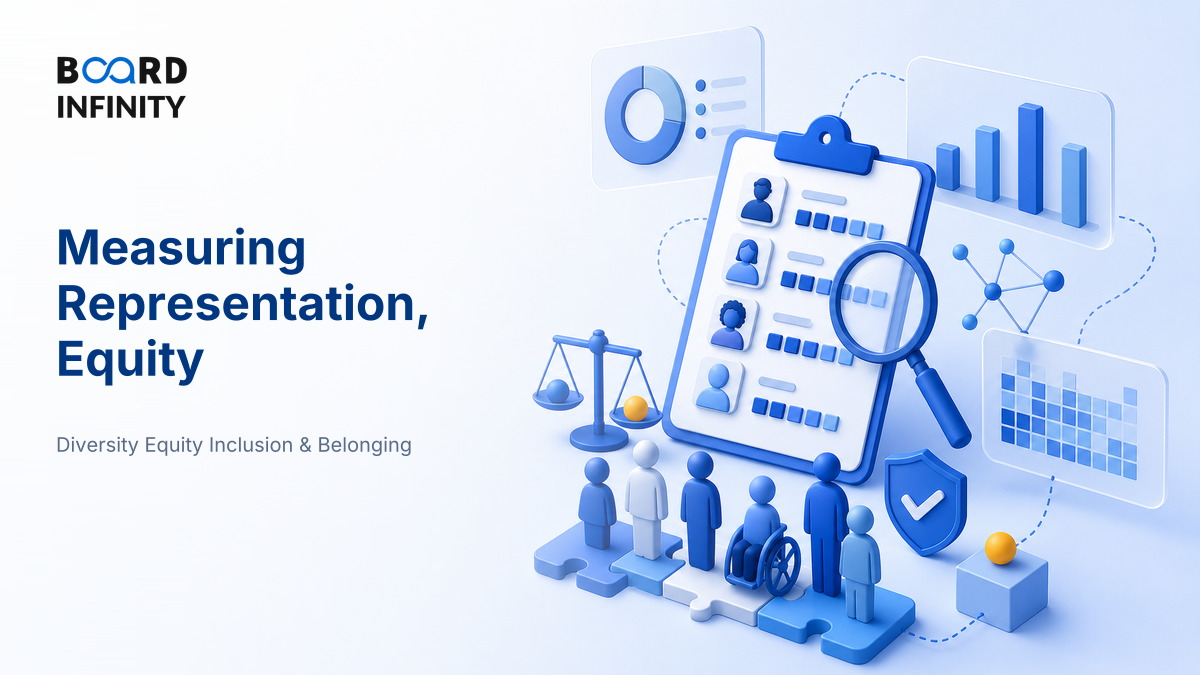
A leadership team can celebrate “40% women employees” on a glossy slide - and still have almost no women in profit-and-loss roles, senior promotions, or high-influence meetings. That is the tension at the heart of measuring representation, equity and inclusion: the headline number may look good while the employee journey is quietly leaking fairness.
- Representation asks: who is present, at which level, compared with the relevant talent pool?
- Equity asks: do different groups get fair access to hiring, pay, promotion, learning and retention outcomes?
- Inclusion asks: do people feel respected, heard, safe and able to influence work without identity penalty?
- Measure DEI across the talent funnel - applicants, shortlists, hires, promotions, leadership and exits.
- Use ratios and gaps: representation parity, selection-rate ratio, promotion parity, attrition gap, adjusted pay gap and inclusion-score gap.
- A good DEI dashboard protects privacy, uses minimum viable demographic data, and turns gaps into accountable actions.
- The biggest trap is reporting only overall diversity percentages; strong answers show where the system is fair or unfair.
Big Picture: Measure the Ladder, Not Just the Door
DEI measurement is not a headcount exercise. It is a ladder check: who enters, who moves up, who gets rewarded, who stays, and who feels able to contribute fully.
Use these six measures as your minimum dashboard. The “good value” is a working benchmark, not a blind target - the right interpretation depends on role, level, location, sample size and local law.
Core Explanation: From Counting People to Finding Barriers
Start with the big idea: representation tells you what the workforce looks like; equity tells you whether the system is fair; inclusion tells you whether people can thrive inside that system. A mature organisation measures all three, cuts the data by employee journey stage, and acts on the largest gaps.
The cleanest way to think about it is the talent funnel. If an organisation hires diverse entry-level talent but loses them before middle management, the problem is not “diverse hiring”; it may be manager allocation, mentoring, promotion criteria, safety, flexibility, or bias in performance ratings.
A strong DEI measurement system has three layers:
A Tiny Worked Example: Selection-Rate Ratio
Suppose a company interviews two groups for a management trainee role.
The selection-rate ratio for Group B is 15% ÷ 30% = 0.50. Since 0.50 is below the commonly used 0.80 screening threshold, the company should investigate the process - sourcing mix, screening criteria, interview panel consistency, assessment design and documentation. This number is not proof of discrimination; it is a signal that the process needs examination.
Salesforce is a widely cited example of a company that made pay equity measurement a recurring process rather than a one-time audit. The primary driver was systematic compensation analysis, supported by leadership sponsorship, budget for pay adjustments and repeat reviews after acquisitions and organisational changes. The strategic lesson: equity measurement has to be operational, because pay gaps can reappear when roles, managers and business units change.
Definitions
- Representation: the presence of a group in a workforce, level, role or funnel stage relative to a relevant comparison population.
- Equity: fair access to opportunities, resources and outcomes after removing avoidable, group-linked barriers.
- Inclusion: employees’ felt ability to participate, be respected and influence decisions without identity-related penalty.
- Four-fifths rule: under the US Uniform Guidelines, a selection rate below 80% of the highest group’s rate is an adverse-impact screen.
In Indian HR discussions, be careful with demographic data. Collect only what is necessary, explain the purpose, protect confidentiality, and align with applicable privacy obligations such as India’s Digital Personal Data Protection framework.
Axis Bank: Measuring Inclusion Beyond the Employee Headcount
Axis Bank’s “Come As You Are” work shows how inclusion measurement must cover policies, products, employee experience and customer access - not just workforce representation.

Situation: In financial services, inclusion is not only an internal HR issue. Banking products, account-opening forms, customer titles, partner recognition and employee benefits can quietly exclude LGBTQIA+ customers and employees even when the organisation’s public language sounds inclusive.
The move: Axis Bank launched its “Come As You Are” charter, publicly extending inclusion into both workplace and customer-facing practices. The company’s approach included changes such as recognition of diverse gender identities and partner structures in relevant contexts, more inclusive employee policies, and customer propositions designed to reduce friction for LGBTQIA+ individuals.
Outcome and lesson: The important lesson is not that one policy creates inclusion. The primary driver was a broader design of inclusive access across HR and banking touchpoints, supported by leadership signalling, policy changes, process redesign and front-line implementation. For measurement, Axis Bank is a useful case because it shows that inclusion should be tracked across policy availability, uptake, employee sentiment, customer access and complaint or friction data.
The shallow answer is “Axis Bank launched an inclusion initiative.” The stronger answer is “Axis Bank shows that DEI measurement must move from demographic counting to friction measurement across the employee and customer journey.”
How AI Changes Measuring Representation, Equity & Inclusion
AI changes DEI measurement in 2026 in practical, high-stakes ways:
- Bias detection in hiring funnels: AI analytics can scan applicant tracking data to find where selection-rate ratios drop by group, campus, source, interviewer or assessment stage. The risk is false confidence - the model can reflect biased historical data unless audited.
- Skills intelligence for equity: AI can map skills, learning access and internal mobility patterns to see whether underrepresented groups are being channelled into lower-growth roles. This matters because equity is often hidden in opportunity allocation, not only pay.
- Inclusion listening at scale: NLP tools can summarise open-text survey comments and employee-listening themes. The safeguard is essential: anonymise data, suppress small-group cuts, and never use inclusion analytics for individual surveillance.
Load a company’s annual report, sustainability report and careers-page DEI policy into NotebookLM. Ask it to create a table with “representation metrics mentioned, equity metrics mentioned, inclusion metrics mentioned, missing measures, and likely interview questions.” Then verify every fact from the original source before using it.
Interview Relevance
“If you were the HR manager of a growing Indian company, how would you measure whether its diversity and inclusion efforts are actually working?”
Use the phrase “cut the data by level and funnel stage.” It instantly signals that you understand DEI measurement is diagnostic, not cosmetic.
Common Mistake
The common mistake is treating DEI as a single diversity percentage - for example, “we have 35% women employees” - and ignoring where those employees sit, how they are paid, promoted and heard. It costs candidates because it sounds like PR, not HR analytics. One-line fix: always measure representation, equity and inclusion across the full talent funnel.
What to Revise Next
Next, move from measurement to intervention. Revise how organisations design hiring processes and reduce bias in everyday decisions.