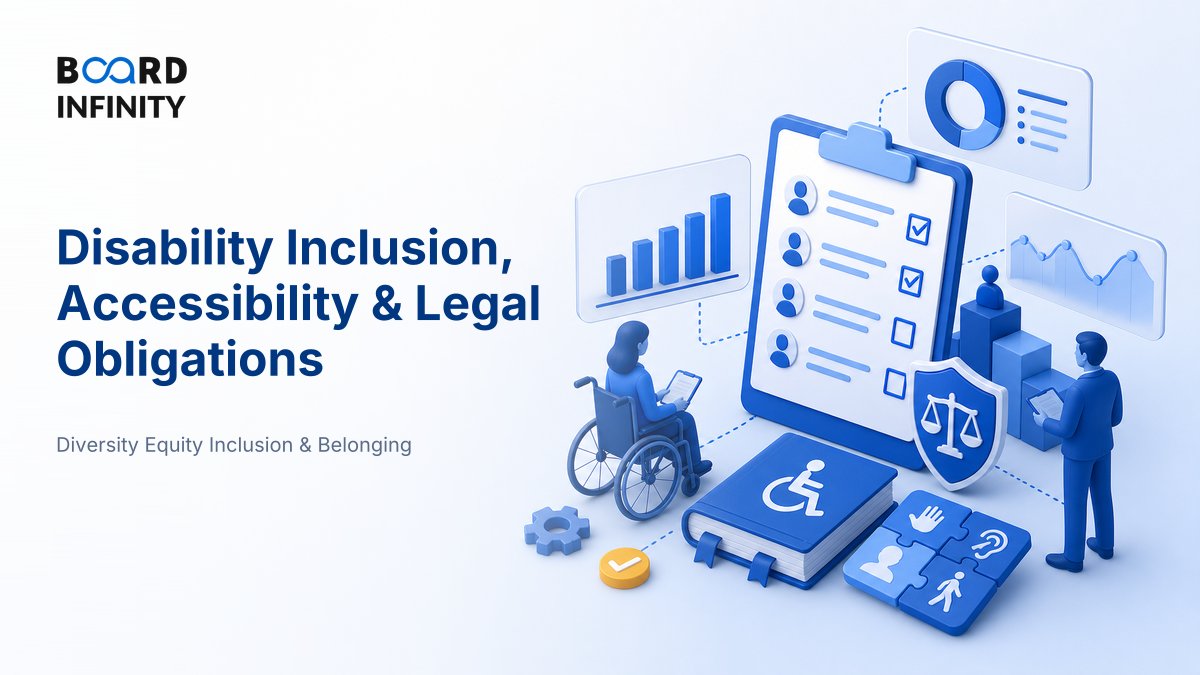
A hotel check-in desk lowers one section of its counter, a meeting room starts with live captions already on, and a candidate receives the case prompt in an accessible format before the interview begins. Nothing dramatic has happened - which is exactly the point of disability inclusion done well: the workplace quietly removes the barriers that would otherwise decide who gets to participate.
Disability inclusion means designing work so people with disabilities can enter, perform, grow and lead - not merely be hired.
Accessibility is barrier-free design of physical spaces, digital systems, communication and processes.
Reasonable accommodation is an individual adjustment that enables equal participation without imposing disproportionate burden.
India's core law is the Rights of Persons with Disabilities Act, 2016, which recognises 21 specified disabilities and mandates non-discrimination, accessibility and equal opportunity.
Do not reduce disability inclusion to ramps. Think built environment + digital access + job design + manager behaviour + career systems.
Strong answers separate legal compliance from real inclusion: compliance prevents exclusion; inclusion creates belonging and progression.
The best interview structure is: define disability inclusion, map barriers, cite legal duties, propose accommodations, measure outcomes.
Big Picture: Inclusion Is a Participation Funnel
Disability inclusion is not a one-time hiring initiative. It is a funnel: every stage either keeps a person in the system or silently pushes them out. The job of HR is to remove leakage from attraction to advancement.
Disability inclusion fails when candidates are hired but the later stages of work remain inaccessible.]
<h2>Core Explanation: From Compliance to Real Inclusion</h2>
<p>The big idea is simple: <strong>disability is not only a medical condition; it is also a mismatch between a person's abilities and an environment's barriers</strong>. A wheelchair is not the problem at the office entrance; the staircase-only entrance is the problem.</p>
<p>That shift matters because it changes the HR response. Instead of asking, “What can this person not do?”, a good HR manager asks, “Which barrier is preventing performance, and how do we remove it fairly?”</p>
<h2>The Four Layers of Disability Inclusion</h2>
<p>A complete disability inclusion answer should cover four layers. If you cover only one - usually infrastructure - your answer will sound shallow.</p>
[[FIGURE: {"layout":"pyramid","items":[{"label":"Culture","note":"Respect and safety"},{"label":"Managers","note":"Daily support"},{"label":"Systems","note":"Policies and processes"},{"label":"Access","note":"Physical and digital"}]} | caption: Accessibility is the base, but inclusion becomes real only when systems, managers and culture support it.]
<p><strong>1. Physical accessibility:</strong> entrances, elevators, washrooms, emergency exits, workstations, signage, lighting, seating and transport access. This helps people with mobility, visual, hearing and other disabilities navigate the workplace safely.</p>
<p><strong>2. Digital accessibility:</strong> websites, HR portals, learning platforms, documents, apps and collaboration tools that work with screen readers, captions, keyboard navigation and accessible document formats.</p>
<p><strong>3. Process accessibility:</strong> job descriptions, interviews, assessments, onboarding, training, appraisal and promotion processes that do not create unnecessary barriers. Example: a timed online test may disadvantage a candidate who needs assistive technology unless reasonable accommodation is provided.</p>
<p><strong>4. Social and managerial inclusion:</strong> respectful language, confidentiality, flexible work design, psychologically safe disclosure, and managers trained to distinguish performance standards from avoidable barriers.</p>
<h2>Key Definitions You Must Say Clearly</h2>
<tip-box data-type="info" data-title="Precise Definitions" data-icon="📘">
<ul>
<li><strong>Disability inclusion:</strong> Workplace design that enables people with disabilities to participate, perform, belong and progress equitably.</li>
<li><strong>Accessibility:</strong> Barrier-free design of spaces, technology, communication and processes so people can use them independently.</li>
<li><strong>Reasonable accommodation:</strong> A necessary adjustment enabling equal participation, unless it causes disproportionate or undue burden.</li>
<li><strong>Benchmark disability under India's RPwD Act:</strong> At least 40% of a specified disability, as certified by the appropriate authority.</li>
</ul>
</tip-box>
<p>Under the <strong>Rights of Persons with Disabilities Act, 2016</strong>, India moved from a welfare view of disability toward a rights-based view. For MBA interviews, remember three legal anchors: non-discrimination, reasonable accommodation and accessibility.</p>
<h2>Legal Obligations in India: What HR Must Know</h2>
<p>You do not need to sound like a lawyer. You do need to know the practical HR implications of the law.</p>
<data-table
data-headers='["Area", "What it means for HR", "Interview-ready point"]'
data-rows='[
["Non-discrimination", "Employers should not discriminate on the ground of disability and should enable equal opportunity.", "Selection, deployment and promotion must be based on role requirements, not assumptions."],
["Reasonable accommodation", "Modify work arrangements, tools, timing or processes where needed, unless the burden is disproportionate.", "Accommodation is not a favour; it is an equality mechanism."],
["Equal opportunity policy", "Establishments are expected to publish an equal opportunity policy and maintain relevant records under the RPwD framework.", "A policy without implementation, ownership and grievance channels is weak compliance."],
["Accessibility", "Workplaces and digital systems should progressively remove barriers in infrastructure, communication and services.", "Accessibility must cover both buildings and software."],
["Government reservation", "Government establishments have reservation obligations for persons with benchmark disabilities.", "Private employers may not have the same quota duty, but still have non-discrimination and accessibility expectations."],
["Grievance handling", "Employees need a route to raise disability-related barriers, denial of accommodation or harassment.", "A named owner and time-bound resolution make the policy real."]
]'>
</data-table>
<p>For multinational companies, also be aware that disability law may vary by country - for example, the Americans with Disabilities Act in the US and the Equality Act in the UK. In an Indian interview, however, the RPwD Act is the core reference.</p>
<h2>The Barrier-to-Accommodation Framework</h2>
<p>When you are asked what HR should do, do not jump straight to “hire more persons with disabilities.” First diagnose the barrier. Then design the accommodation.</p>
[[FIGURE: {"layout":"flow","items":[{"label":"Identify barrier","note":"Where exclusion happens"},{"label":"Check role need","note":"Essential vs optional"},{"label":"Design adjustment","note":"Tool or process"},{"label":"Implement safely","note":"With consent"},{"label":"Review outcome","note":"Works or revise"}]} | caption: Reasonable accommodation is a structured decision, not an ad hoc favour.]
<p><strong>Example:</strong> If a role requires client calls, the essential requirement may be clear client communication - not necessarily voice-only communication. Depending on the disability and role, accommodations could include captions, relay services, written communication protocols, adjusted meeting formats or assistive devices.</p>
<tip-box data-type="info" data-title="Example - Microsoft's Xbox Adaptive Controller" data-icon="📌">
<p>Microsoft's Xbox Adaptive Controller is a well-known accessibility example because it redesigned the gaming interface for players with limited mobility. The primary driver was inclusive product design; supporting drivers included partnerships with accessibility communities, modular hardware compatibility and a broader company push on accessibility. The strategic lesson: accessibility can expand participation without lowering the core experience.</p>
</tip-box>
<h2>Types of Workplace Barriers</h2>
<p>Use this classification when diagnosing a company's disability inclusion maturity.</p>
<data-table
data-headers='["Barrier Type", "What it looks like", "How HR can respond"]'
data-rows='[
["Physical", "Stairs without alternatives, inaccessible washrooms, poor signage, unsafe evacuation routes.", "Access audits, barrier-free design, accessible transport and emergency planning."],
["Digital", "HR portals not screen-reader friendly, videos without captions, inaccessible PDFs.", "WCAG-aligned design, captions, alt text, keyboard navigation and accessible documents."],
["Attitudinal", "Assuming low capability, overprotecting employees, stigma around disclosure.", "Manager training, disability etiquette, visible leadership support and accountability."],
["Process", "Rigid interview formats, timed tests, one-size-fits-all onboarding.", "Accommodation request process, flexible assessments, accessible learning and fair appraisal."],
["Career", "Hiring at entry level but no promotion, mentoring or leadership pipeline.", "Career tracking, sponsorship, ERGs with mandate and inclusive talent reviews."]
]'>
</data-table>
<h2>How to Measure Disability Inclusion</h2>
<p>Good intent is not a metric. Track both access and outcomes. Use numbers carefully because disability disclosure is sensitive and must respect privacy.</p>
<data-table
data-headers='["Metric", "Formula / Definition", "What good looks like"]'
data-rows='[
["Representation rate", "Employees self-identifying as persons with disabilities ÷ total employees × 100.", "Range is 0-100%; strong means improvement toward a role-relevant target and no concentration only in low-growth jobs."],
["Accommodation closure time", "Average days from approved request to implemented accommodation.", "Range varies by accommodation; strong means time-bound closure and no long-pending critical requests."],
["Digital accessibility conformance", "Share of critical digital assets meeting the chosen accessibility standard, such as WCAG 2.2 AA.", "Range is 0-100%; strong is near-complete coverage for hiring, HR and learning systems."],
["Hiring funnel parity", "Selection rate of candidates with disclosed disabilities ÷ selection rate of comparable candidates.", "A parity ratio close to 1 suggests fewer process barriers; major gaps need audit."],
["Retention parity", "Retention rate of employees with disabilities ÷ retention rate of overall workforce.", "A ratio close to 1 is healthier; persistent gaps indicate experience or accommodation issues."],
["Promotion parity", "Promotion rate of employees with disabilities ÷ promotion rate of comparable employees.", "A ratio close to 1 shows inclusion beyond hiring; low parity signals career blockage."]
]'>
</data-table>
<p>Never force disclosure to improve a metric. The ethical route is to build trust, ensure confidentiality and let employees self-identify voluntarily.</p>
<h2>Lemon Tree Hotels: Disability Inclusion in a Service Business</h2>
<tip-box data-type="info" data-title="Case Study - Lemon Tree Hotels" data-icon="🏆">
<p>Lemon Tree Hotels built disability inclusion into hotel operations, showing that inclusion can work even in high-contact service roles when jobs, training and teams are designed well.</p>
</tip-box>
[[GOLD-IMAGE: A warm hotel lobby with lemon-yellow accents, a front desk at two heights, a staff member using sign language with a guest, and soft morning light, with no logos or readable text | caption: The best disability inclusion is visible in everyday service moments, not just policy documents.
Situation: Hotels run on consistency, speed and guest comfort. Many employers assume disability inclusion is difficult in such settings because guest-facing work involves communication, mobility, coordination and service pressure.
The move: Lemon Tree Hotels challenged that assumption by employing people with disabilities in operational roles and adapting work through training, job matching, team sensitisation and workplace process design. The company's approach has included employees with speech and hearing disabilities and other disability groups, supported by role-specific training and co-worker readiness.
Why it worked: The primary driver was not charity; it was job-role redesign linked to operating discipline. Supporting drivers included leadership commitment, structured training, sensitised teams, visible service standards and a culture that treated inclusion as part of the operating model rather than a CSR side project.
[[FIGURE: {"layout":"hub","centre":{"label":"Inclusive service"},"items":[{"label":"Role fit","note":"Tasks designed well"},{"label":"Training","note":"Skills and routines"},{"label":"Managers","note":"Daily support"},{"label":"Culture","note":"Respectful teams"}]} | caption: Lemon Tree's lesson is that inclusion works when operational design and human support reinforce each other.]
Outcome or lesson: The case is memorable because it breaks the stereotype that disability inclusion belongs only in desk jobs. In a service environment, inclusion succeeds when primary job design is supported by training, manager capability and team culture.
How AI Changes Disability Inclusion, Accessibility & Legal Obligations
AI is making disability inclusion more powerful - and more risky. HR managers must use it as an accessibility accelerator, not as an invisible gatekeeper.
AI can improve accessibility at work: live captions, speech-to-text, text simplification, image descriptions, meeting summaries and translation tools can reduce barriers for employees with hearing, visual, cognitive or communication-related disabilities.
AI hiring tools can create disability discrimination: automated video interviews, keystroke-based tests or resume screeners may penalise speech patterns, assistive technology use, employment gaps or non-linear education paths. HR must audit these tools for adverse impact and provide alternate formats.
AI can support accommodation design: managers can use AI to generate accessible document formats, draft accommodation options, redesign tasks and create inclusive meeting norms - while keeping medical data confidential and human-reviewed.
Use NotebookLM: upload the RPwD Act summary, a target company's careers page and one job description. Ask: “Identify possible accessibility barriers in this hiring process and suggest legally safer, role-relevant accommodations.” Then refine the answer in your own words for interviews.
Interview Relevance
“Our company wants to become more disability-inclusive. As an HR manager, what would you do beyond hiring a few persons with disabilities?”
Use the phrase “same performance standard, different access route”. It shows you understand that accommodation enables fairness without diluting job expectations.
Common Mistake
The mistake: Treating disability inclusion as ramps plus charity hiring. Why it costs you: it ignores digital barriers, reasonable accommodation, career progression and legal risk. One-line fix: answer through the full system - access, process, managers, culture and measurable outcomes.
What to Revise Next
Once you understand disability inclusion, move to other forms of workplace identity and exclusion. Revise these next as a connected DEI journey: