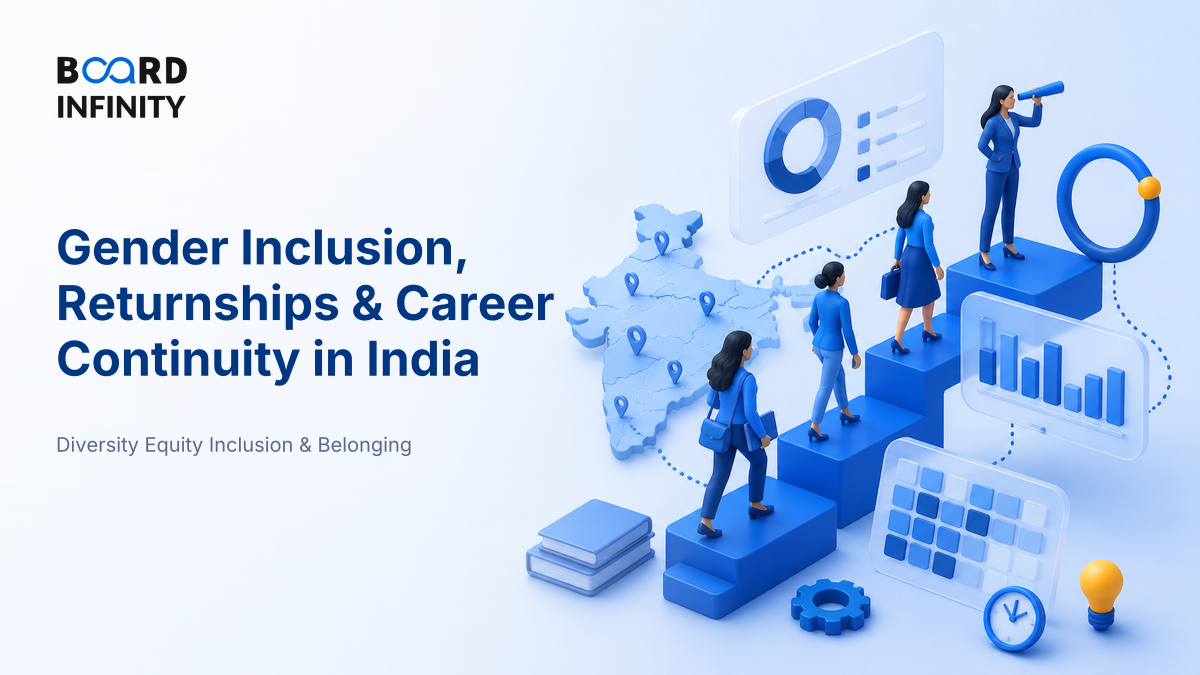
If a high-performing woman pauses work for caregiving, did her capability disappear - or did the organisation design its hiring system to forget her? Gender inclusion becomes real at exactly this point: not in a poster, but in whether careers can bend without breaking.
Gender inclusion means systems that give all genders fair access, safety, voice, growth and rewards - not just better female headcount.
Career continuity is the ability to sustain employability through life events such as maternity, caregiving, relocation, health breaks or spouse transfers.
Returnships are structured, paid re-entry programs for professionals returning after a career break, usually combining training, mentoring and project work.
The best answer separates representation, equity, safety, flexibility and advancement; weak answers stop at hiring more women.
In India, connect the topic to the POSH Act, Maternity Benefit Act, Code on Wages and the reality of unpaid care work.
Track outcomes with parity metrics: representation parity, selection rate ratio, promotion gap, adjusted pay ratio, returnship conversion and post-return retention.
The strongest returnships are not charity programs; they are talent supply solutions for skilled roles where capability exists but access is broken.
Big Picture - Inclusion Is a Career System, Not an HR Event
Gender inclusion works when an organisation redesigns the full career system: how people enter, pause, return, grow, stay safe and get rewarded. Returnships are one important bridge inside that system, especially in India where many skilled women face non-linear career paths because of caregiving expectations and social mobility constraints.
Gender inclusion becomes practical when barriers are diagnosed, continuity is designed and outcomes are measured.]
<h2>Core Explanation - What Gender Inclusion Actually Requires</h2>
<p>The big idea is simple: <strong>gender inclusion is not a women-only initiative</strong>. It is an organisational capability to prevent gender from unfairly shaping opportunity, safety, pay, visibility or career speed.</p>
<p>For MBA interviews, understand the three connected ideas:</p>
<ul>
<li><strong>Gender inclusion:</strong> removing systemic barriers so all genders can participate, influence decisions and progress fairly.</li>
<li><strong>Career continuity:</strong> keeping people employable and promotable through life events instead of punishing career breaks.</li>
<li><strong>Returnship:</strong> a structured pathway for experienced professionals to re-enter work after a break through training, mentoring and live projects.</li>
</ul>
<p>In India, this matters because the talent problem is not just pipeline. Many organisations can hire women at entry level but lose them at middle management due to caregiving load, unsafe commute concerns, inflexible work design, relocation expectations, biased promotion criteria and lack of sponsorship.</p>
<h2>The 2x2 - Which Career Continuity Intervention Fits?</h2>
<p>Not every career break needs a returnship. A short break may need onboarding support; a longer break in a fast-changing role may need reskilling. Use this 2x2 to avoid giving a generic answer.</p>
[[FIGURE: {"layout":"matrix","xAxis":"Role change required","yAxis":"Break length","items":[{"label":"Refresher Onboarding","note":"Short break, same role"},{"label":"Role Transition","note":"Short break, new role"},{"label":"Returnship","note":"Long break, same domain"},{"label":"Reskilling Academy","note":"Long break, new domain"}]} | caption: The right intervention depends on both break length and how much the target role has changed.]
<p>The matrix helps you sound practical. For example, a finance manager returning after one year may need a refresher and manager support. A software developer returning after five years may need a returnship with coding refreshers, cloud tools, agile project exposure and mentoring.</p>
<h2>What a Strong Gender Inclusion Program Includes</h2>
<p>A credible inclusion program has six design elements. Missing even one can make the initiative look good on paper but fail in employee experience.</p>
<check-list
data-items='[
"Leadership accountability: senior leaders own inclusion goals, not only HR.",
"Inclusive hiring: job descriptions, sourcing, interviews and selection ratios are audited for gender bias.",
"Safe workplace: POSH compliance, trusted reporting channels and anti-retaliation norms are active.",
"Flexibility by design: hybrid work, part-time pathways, caregiver flexibility and predictable schedules are available where role-feasible.",
"Career growth: women get stretch roles, sponsorship, promotion access and leadership visibility.",
"Return pathways: paid returnships, re-entry onboarding and skill refreshers reduce the penalty of career breaks."
]'>
</check-list>
<h2>Returnship Design - The Re-entry Bridge</h2>
<p>A returnship should be treated like a business talent program, not a CSR gesture. The participant already has experience; the organisation must rebuild confidence, update skills, provide context and evaluate fairly.</p>
[[FIGURE: {"layout":"cycle","items":[{"label":"Source Returners","note":"Experienced break talent"},{"label":"Refresh Skills","note":"Tools and domain"},{"label":"Live Projects","note":"Real business work"},{"label":"Mentor Support","note":"Confidence and context"},{"label":"Convert Roles","note":"Fair job pathway"}]} | caption: A returnship works as a loop from sourcing to conversion, with learning and business evaluation built in.]
<p>The strongest returnships have four features: they are <strong>paid</strong>, linked to real business roles, supported by managers and measured by conversion plus retention. If it is only a workshop with no job pathway, it is awareness - not career continuity.</p>
<h2>Metrics - How to Measure Whether Inclusion Is Working</h2>
<p>Use metrics carefully. Gender inclusion cannot be reduced to one dashboard number, but without measurement it becomes storytelling. Because benchmarks vary by sector and role, the best practice is to use <strong>parity targets</strong> and compare similar cohorts.</p>
<data-table
data-headers='["Metric", "Formula or definition", "What good looks like"]'
data-rows='[
["Representation parity ratio", "Women share in a level or function divided by women share in the relevant talent pool.", "Close to 1.0 indicates parity; below 0.8 needs diagnosis."],
["Selection rate ratio", "Women selection rate divided by men selection rate for the same hiring funnel.", "At least 0.8 is a common adverse-impact screen; closer to 1.0 is stronger."],
["Promotion rate gap", "Women promotion rate minus men promotion rate within comparable level, tenure and performance cohorts.", "Target is no persistent negative gap after cohort controls."],
["Adjusted pay ratio", "Average women pay divided by average men pay after controlling for role, level, location and tenure.", "Close to 1.0; unexplained gaps require correction."],
["Returnship conversion rate", "Returners moved into regular roles divided by returners completing the program.", "Strong when conversion is planned, role-linked and not merely symbolic."],
["Post-return retention", "Returners retained after 12 months divided by returners converted into roles.", "Strong when comparable to similar lateral-hire retention."]
]'>
</data-table>
<tip-box data-type="info" data-title="Indian Context - The Legal Minimum Is Not the Inclusion Standard" data-icon="📌">
<p>In India, organisations must consider the POSH Act, 2013 for prevention of sexual harassment, the Maternity Benefit framework for maternity-related rights and the Code on Wages, 2019 provisions against gender discrimination in wages and recruitment. But compliance is the floor; inclusion requires everyday systems that make careers sustainable.</p>
</tip-box>
<h2>Definitions - Say These Clearly</h2>
<tip-box data-type="info" data-title="Precise Definitions" data-icon="📘">
<ul>
<li><strong>UN Women:</strong> Gender equality means equal rights, responsibilities and opportunities of women and men and girls and boys.</li>
<li><strong>Gender inclusion:</strong> Workplace systems that ensure all genders can participate, feel safe, influence decisions and progress fairly.</li>
<li><strong>Career continuity:</strong> Sustained employability and growth despite life events, breaks, caregiving, relocation or health-related interruptions.</li>
<li><strong>Returnship:</strong> A structured, usually paid re-entry program for experienced professionals returning after a career break.</li>
</ul>
</tip-box>
<h2>Thoughtworks India Vapasi: Returnship as a Talent Bridge</h2>
<tip-box data-type="info" data-title="Case Study - Thoughtworks India" data-icon="🏆">
<p>Thoughtworks India's Vapasi program helps women technologists return to software careers after a break, showing how returnships can solve a real talent access problem.</p>
</tip-box>
[[GOLD-IMAGE: A woman developer in a Bengaluru coworking space, laptop open with a dark coding interface and warm orange accents, coffee cup beside her, no logos or readable text | caption: Returnships work when skilled professionals are given a credible bridge back to real work.
Situation: India has a large pool of experienced women in technology who step away from work because of caregiving, relocation, maternity or family responsibilities. When they try to return, hiring systems often screen them out because of a resume gap, even when their core problem-solving ability remains strong.
The move: Thoughtworks India built Vapasi as a re-entry route for women developers. The program focuses on refreshing technical skills, rebuilding confidence, exposing participants to current software practices and creating a pathway back into technology roles.
Primary driver: The main driver is a skills-first bridge: the program addresses the actual re-entry gap in tools, practice and confidence instead of treating a career break as lack of ambition.
Supporting drivers: Mentoring, peer learning, live technical exposure and an employer brand associated with inclusive engineering culture support the model. This combination matters because returners need both updated capability and a fair evaluation environment.
[[FIGURE: {"layout":"flow","items":[{"label":"Career Break","note":"Talent leaves market"},{"label":"Vapasi Bridge","note":"Refresh and rebuild"},{"label":"Project Readiness","note":"Current tech practice"},{"label":"Role Pathway","note":"Return to work"}]} | caption: The case shows how a returnship converts hidden experience into employable, role-ready talent.]
Outcome or lesson: The lesson is not that every company should copy the same program name. The strategic lesson is that returnships work when they are connected to real skill gaps, manager readiness and actual job pathways. Otherwise, they become well-intentioned but low-impact events.
How AI Changes Gender Inclusion, Returnships & Career Continuity in India
AI is changing this topic in practical ways, especially in hiring, internal mobility and returnship design.
Bias-aware hiring audits: AI tools can scan job descriptions for gender-coded language, compare funnel conversion by gender and flag stages where women disproportionately drop out. The risk is that an AI model trained on biased past hiring data may reproduce bias unless audited.
Skills intelligence for returners: AI can map a returner's past experience to current role requirements and create a personalized learning path - for example, identifying gaps in cloud platforms, analytics tools or product workflows.
Career continuity prediction: HR analytics can identify teams with high post-maternity attrition, low promotion parity or manager-level bottlenecks. The ethical challenge is privacy: sensitive employee data must be handled transparently and lawfully, especially under India's DPDP Act framework.
Use NotebookLM: upload the company's careers page, DEI report, annual report people section and two recent job descriptions. Ask: “Find evidence of gender inclusion, returnship support, flexibility, safety mechanisms and measurable outcomes. Then create five HR interview questions with model answers.”
Interview Relevance
“Our company wants to improve gender diversity at middle management level in India. What would you recommend beyond hiring more women?”
Use the phrase “career continuity infrastructure.” It signals that you understand inclusion as a system of policies, manager behavior, safety, flexibility and measurement - not as a single diversity campaign.
Common Mistake
The most common mistake is equating gender inclusion with “hire more women.” That answer fails because it ignores retention, safety, promotion, pay equity and career breaks. One-line fix: say, “Hiring improves representation at the entry point; inclusion is proven only when women can stay, return, grow and be rewarded fairly.”
What to Revise Next
Now move from gender inclusion to other forms of workplace equity. Revise Disability Inclusion, Accessibility & Legal Obligations next to understand reasonable accommodation and inclusive design, then study Caste, Language, Region & Class in the Indian Workplace to build a sharper India-specific DEI lens.
Mark Lesson Complete (Gender Inclusion, Returnships & Career Continuity in India - Interview-Ready Framework)