
Cost, Service & the Core Operations Trade-off
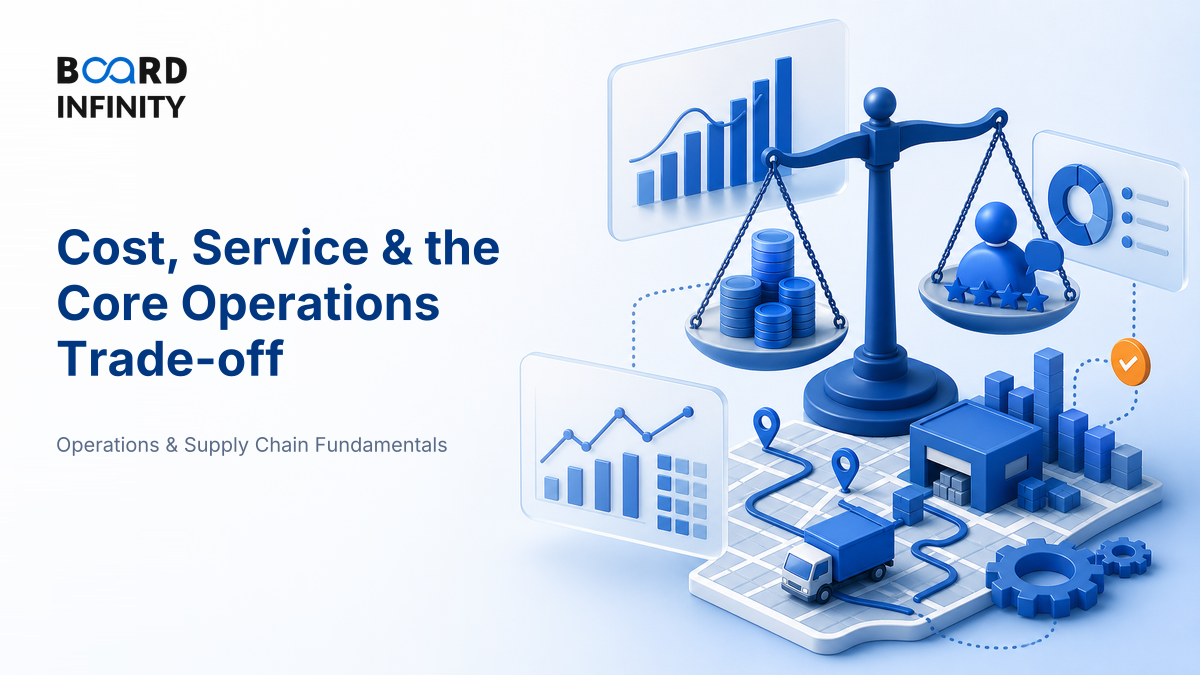
The biggest misconception in operations is that better service always means “spend more.” Walk into a quick-commerce dark store at peak hour and you see the truth: every extra minute saved may need more riders, more inventory, tighter picking, and higher error control. Service is not a mood - it is a costed operating promise.
- The core operations trade-off: higher speed, reliability, quality or flexibility usually consumes more capacity, inventory, labour or control cost.
- The right question is not “How do we maximize service?” It is “Which service level will our target customer pay for, and can we deliver it profitably?”
- Great operators shift the trade-off curve - they improve service without proportional cost increases through process design, automation, standardization and better planning.
- Track the trade-off using unit cost, OTIF, fill rate, cycle time, capacity utilization and cost of poor quality.
- A low-cost model is not a weak-service model. It may offer fewer service dimensions but execute the chosen ones brilliantly.
- The common interview trap is saying “reduce cost and improve service” without naming the constraint, customer promise or metric.
The Big Picture: Operations Is a Promise-Cost Loop
Operations converts a market promise into a physical system. If sales promises “same-day delivery,” operations must decide the warehouse network, inventory buffers, staffing, technology and exception handling required to keep that promise. If any part is under-designed, service breaks. If everything is over-designed, cost explodes.
Core Explanation: What the Trade-off Really Means
The cost-service trade-off says that service improvements are rarely free. Faster delivery may need local inventory. Higher product variety may need more complex planning. Better reliability may require redundant capacity. More customization may slow down throughput.
But this does not mean managers must choose either low cost or high service forever. The smarter view is:
- Short term: there is usually a trade-off because capacity, labour, time and cash are limited.
- Long term: better process design can shift the operating frontier, giving better service at the same cost or lower cost for the same service.
Think of a food delivery platform. A 60-minute promise can work with fewer riders and wider batching. A 20-minute promise needs denser restaurant coverage, sharper dispatching and lower slack. A 10-minute promise needs a fundamentally different operating model. The promise is a product decision, but the feasibility is an operations decision.
If you need to revise how process speed is read mathematically, connect this topic with cycle time, takt time and lead time. If you want the larger functional map, revisit what operations management actually does.
The Four Positions on the Cost-Service Map
A business model becomes clearer when you place it on two questions: How strong is the service promise? How expensive is the system required to deliver it?
The strongest companies are not always in the top-left box immediately. Many deliberately choose a premium model or a discount model. The danger is the bottom-right box: high internal cost with poor customer experience. That usually signals bad forecasting, weak layout, poor quality control, unclear ownership or excessive complexity.
The Six Metrics That Reveal the Trade-off
Do not discuss cost and service as feelings. Use measures. There is no universal “good” number across industries because a hospital, airline, kirana distributor and D2C brand have different promises. A strong number is one that beats the firm's SLA, improves versus baseline and supports the chosen business model.
A Quick Worked Example: When Faster Service Raises Cost
Use this as a simple interview-style calculation. Suppose an online grocery hub serves 1,000 weekly orders.
The faster model increases demand, but unit cost rises from ₹80 to ₹100. The decision is not automatically good or bad. It depends on whether the same-day promise increases order frequency, basket size, retention or willingness to pay enough to cover the extra ₹20 per order. That is the real trade-off conversation.
Definitions You Can Say in One Breath
- Cost to serve: the total resources consumed to deliver one customer order, visit, unit or transaction.
- Service level: the promised and delivered performance on speed, availability, reliability, quality and flexibility.
- Operations trade-off: the choice between competing performance goals when capacity, time, inventory, labour or cash is limited.
- Operating frontier: the best achievable cost-service combinations possible with the current process design.
- Service promise: the explicit or implicit expectation a customer has about availability, speed, quality and support.
Case Study: DMart and the Discipline of “Good Enough” Service
DMart shows that a company can win by choosing a focused service promise - everyday value and dependable availability - instead of trying to offer every convenience.

DMart, operated by Avenue Supermarts, is a useful Indian example because its operating model is not built around luxury service, endless assortment or instant home delivery. Its strength is a tighter promise: value pricing, everyday essentials, dependable in-store availability and disciplined store execution. Avenue Supermarts publishes its business disclosures through its DMart investor relations page.
Situation: Indian grocery retail is operationally hard. Demand is frequent, margins are thin, stores carry many fast-moving categories, and customers are price-sensitive. If a retailer tries to offer premium ambience, unlimited variety, deep discounts and high convenience simultaneously, the cost base can become heavy very quickly.
The move: DMart's primary driver is a deliberately focused low-cost operating model. It supports this with disciplined assortment, efficient store operations, strong vendor management, high attention to working capital and a no-frills shopping experience. The model does not mean “bad service.” It means the service dimensions are chosen carefully: availability, value and store reliability matter more than expensive frills.
Outcome and lesson: The strategic lesson is not “low cost always wins.” It is sharper: a business wins when its operations system fits the customer promise. DMart does not need to maximize every service dimension. It needs to execute the selected ones better than alternatives at a cost structure that supports value pricing.
How AI Changes Cost, Service & the Core Operations Trade-off
AI does not remove the trade-off. It changes the shape of the frontier by making operations more predictive, adaptive and granular.
- Dynamic service promises: AI can estimate delivery dates, queue times or fulfilment feasibility in real time, so firms stop over-promising when capacity is tight.
- Smarter cost-to-serve decisions: ML models can identify which customers, SKUs, routes or locations are expensive to serve and suggest pricing, batching or network changes.
- Predictive quality and maintenance: AI can detect equipment failure, defect patterns or process drift earlier, reducing both service failures and recovery cost.
Student workflow: Before an operations interview, load a company annual report, this lesson and recent business news into NotebookLM. Ask: “Map this company's cost-service trade-off, list its main service promises, identify 5 operating metrics, and draft 3 interview questions with model answers.” For the broader role impact, connect this to how AI is reshaping operations work and roles.
Interview Relevance
“A company wants to improve customer service while reducing operating cost. How would you think through the trade-off?”
In interviews, always say: “Some improvements remove waste and improve both cost and service, but beyond that point we must choose the service level the customer values enough to fund.” That sentence signals maturity.
Common Mistake
The mistake: saying “we should minimize cost and maximize service” as if both can always be optimized together. Why it costs candidates: it ignores constraints, customer segments and operating design. One-line fix: define the target service promise first, then design the lowest-cost system that can reliably deliver it.