
The Evolution of Supply Chains in India
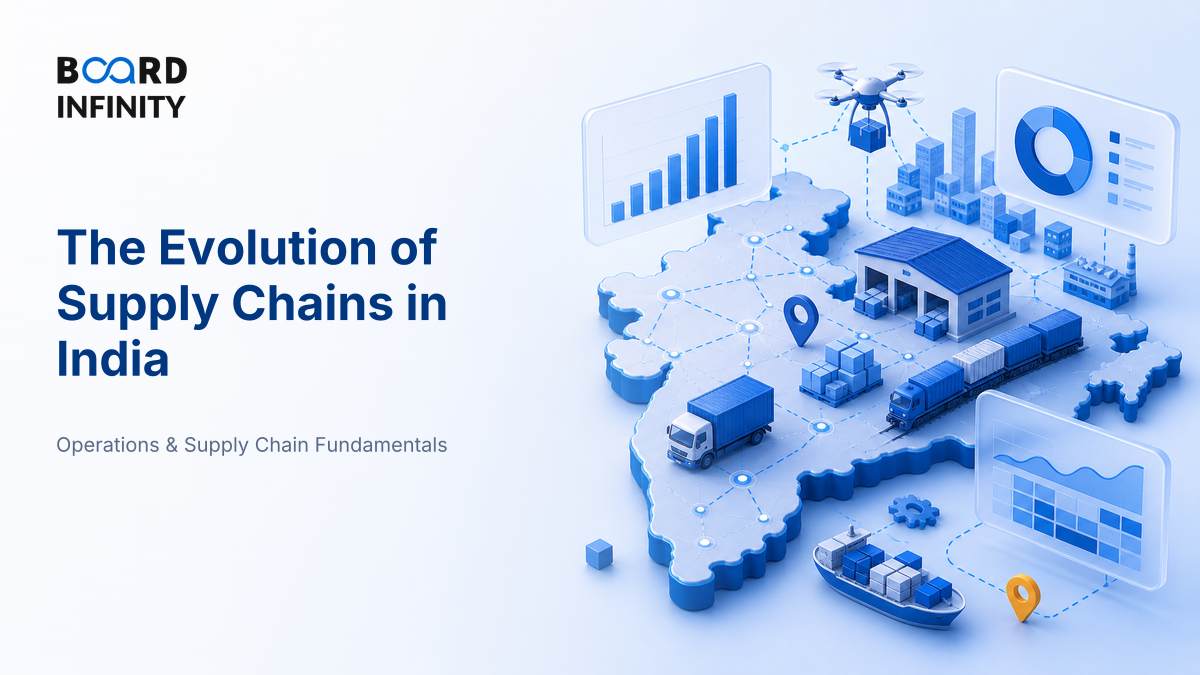
A truck that once lost hours at state borders now moves through a network planned around speed, service and data rather than tax check-posts. A kirana order that once depended on a distributor's weekly visit can now be replenished through app-based ordering, micro-fulfilment and real-time inventory signals.
That before-after contrast is the story of Indian supply chains: not just better transport, but a deep shift in how goods, money and information flow through the economy.
- India's supply chains evolved from fragmented, inventory-heavy, tax-led networks to integrated, digital, service-led networks.
- The biggest structural shifts were GST-led network redesign, highway and logistics infrastructure, e-commerce fulfilment, platform digitisation and resilience after global disruptions.
- Old supply chains optimised for availability and local tax rules; modern chains optimise for cost, speed, visibility, resilience and working capital.
- Interview answers should separate the evolution into five waves: fragmentation, scale, GST integration, platform commerce and AI-resilient networks.
- Key metrics to track: OTIF, fill rate, inventory turns, logistics cost as percentage of sales, forecast accuracy and cash-to-cash cycle.
- The best Indian example is not only e-commerce - sectors like food, fashion, pharma, auto and building materials all show supply-chain reinvention.
- Common mistake: saying “technology changed everything” without explaining the operating model changes behind the technology.
Big Picture: India Moved from Stocking Goods to Orchestrating Flows
Earlier Indian supply chains were built to survive uncertainty: poor visibility, state-level tax complexity, fragmented trucking, limited cold chain and distributor dependence. Modern supply chains are built to sense demand, move faster and coordinate partners across the chain. If you need the base concept first, revise the supply chain as a flow of goods, money and information.
The Five-Wave Evolution of Supply Chains in India
The cleanest way to explain India's supply-chain evolution is as a sequence of waves. Each wave did not replace the previous one completely; it added a new capability layer.
Old vs New Indian Supply Chains: The Interview Comparison
The answer becomes powerful when you compare dimensions, not just periods. Use this table when asked, “How have supply chains changed in India?”
This also connects naturally to what supply chain management covers end to end - planning, sourcing, making, delivering and returning are now connected decisions, not isolated departments.
The Core Operating Model Shift
The real evolution is not “offline to online.” It is a shift from a push-heavy, buffer-led operating model to a segmented, responsive operating model.
In stable categories like staples, firms can still use efficient planning and bulk replenishment. In volatile categories like fashion, fresh food or quick commerce, the chain must sense demand faster and replenish in shorter cycles. This is why modern supply-chain leaders mix push, pull and hybrid models instead of choosing one blindly; revise push, pull and hybrid supply chain strategies if you want the next layer.
What to Measure: Six Metrics That Prove the Evolution
If a supply-chain answer has no metrics, it sounds like a newspaper summary. Use these measures to show managerial depth. Benchmarks vary by sector, so treat the “good” range as an interview-safe directional benchmark, not a universal law.
Definitions You Can Say in One Breath
Supply chain management: “Supply chain management encompasses the planning and management of all activities involved in sourcing and procurement, conversion, and all logistics management activities” - Council of Supply Chain Management Professionals.
- Supply chain evolution in India: The shift from fragmented, inventory-led networks to integrated, digital and service-led flow systems.
- Supply-chain visibility: The ability to track inventory, orders, shipments and exceptions across partners in near real time.
- Resilient supply chain: A chain designed to absorb disruption through flexibility, buffers, alternate suppliers and fast decision-making.
Real Example: Zara Shows Why Speed Became Strategy
Zara is a classic example of supply chain as competitive strategy. Its primary driver is a responsive operating model that links store feedback, design decisions and replenishment faster than traditional seasonal fashion chains. Supporting drivers include disciplined assortment choices, supplier coordination and frequent replenishment - the lesson is that speed is not a transport trick; it is a full system design.
For India, the same logic now appears in value fashion, fresh food, beauty, electronics and quick commerce. The winning question is no longer “Can we manufacture cheaply?” It is “Can we sense demand, allocate inventory and fulfil reliably at the promised cost-to-serve?”
Case Study: Licious and the Reinvention of Fresh Meat Supply Chains in India
Licious built a consumer brand in a category where the supply chain itself - freshness, hygiene, cold chain and trust - is central to the product promise.
Situation: India's meat and seafood market has traditionally been fragmented, with trust, hygiene, standardisation and cold-chain reliability varying sharply across local markets. For a branded player, the challenge was not only demand generation; it was building confidence in a perishable category.
The move: Licious positioned itself as a fresh meat and seafood brand selling through a consumer-facing digital platform (Licious). The strategic move was to control more of the value chain: procurement standards, processing, cold-chain handling, packaging, demand forecasting and last-mile delivery experience.
Outcome or lesson: The primary driver was controlled quality across the cold chain. Supporting drivers were app-based demand visibility, category-specific processing capability, inventory discipline for perishables and a branded customer experience. The lesson for interviews: in categories with high trust risk, supply-chain design becomes brand strategy.
How AI Changes the Evolution of Supply Chains in India
AI is making the next phase of Indian supply chains less reactive and more predictive. The change is specific, not generic.
Student workflow: Load this lesson, a company's annual report and one recent logistics article into NotebookLM. Ask it to generate: “What are the likely supply-chain risks, metrics and AI use cases for this company?” Then turn the output into a 90-second interview answer. For the broader role impact, revise how AI is reshaping operations work and roles.
Interview Relevance
Question: “How have supply chains in India evolved over the last decade, and what does it mean for companies today?”
If the interviewer asks for “recent changes,” do not only say e-commerce. Add GST-era network redesign, visibility, resilience, sustainability pressure and AI-led planning.
Common Mistake
Mistake: Saying “Indian supply chains improved because of technology.” That answer is too shallow because technology works only when network design, partner capability, inventory policy and metrics change with it. Fix: say “technology enabled visibility, but the real change was operating-model redesign.”