
What Has Changed in Supply Chains Recently
A tiny semiconductor can stop a car plant. A missing API update can delay a shipment. A sudden spike in online demand can empty a dark store faster than a truck can arrive.
That is the big recent shift in supply chains: the problem is no longer just moving goods cheaply. It is designing a network that can sense shocks early, respond fast, protect service, and still control cost.
- Old supply chains optimized mainly for cost and efficiency. New supply chains optimize for cost, resilience, speed, visibility, sustainability and risk.
- Just-in-time has not died. It has become more selective: lean for predictable items, buffers and backup sources for critical items.
- Visibility is now strategic. Firms need live data on suppliers, inventory, production, shipments and customer demand.
- Supply chains are moving from linear planning to sense-and-respond. Teams use demand signals, control towers and exception management.
- India-specific change: e-commerce, quick commerce, manufacturing localisation and digital compliance have made fulfilment speed and network design central.
- AI is changing planning work. Forecasting, supplier-risk sensing, route optimization and warehouse decisioning are becoming AI-assisted.
- Interview answer: explain the shift, segment the supply chain, pick design moves, and measure with service, cost, inventory, cash and risk metrics.
Big Picture: From Efficient Chain to Adaptive Network
For years, the dominant question was: “How do we reduce cost?” Recently, the better question is: “How do we deliver reliably when demand, supply, regulation and customer expectations keep changing?” If you need the foundation first, revise the supply chain as a flow of goods, money and information.
The word “chain” is now slightly misleading. Modern supply chains behave more like networks: multiple suppliers, manufacturing nodes, warehouses, data systems, logistics partners and customer channels connected in real time.
The Six Recent Shifts You Must Know
Do not answer this topic as a list of disruptions. Answer it as a change in operating logic.
The New Supply Chain Decision Rule
The best recent supply chain teams do not say, “Let us add inventory.” They ask two questions: How critical is this item? and How volatile is its supply or demand? The answer decides the design.
This matrix is a clean interview move. It shows maturity because you are not recommending the same solution for every SKU, supplier or market.
The Control Tower Mental Model
A modern supply chain “control tower” is not just a dashboard. It is a decision loop: sense what is happening, diagnose the exception, decide the action, execute through partners, and learn for the next cycle.
This is why recent supply chain roles increasingly overlap with analytics, product, finance and customer experience. Operations no longer sits at the back office; it shapes the customer promise.
Metrics: How to Track the New Supply Chain
When an interviewer asks “What has changed?”, add metrics. It proves you can manage the change, not just describe it.
Worked example: Suppose a company had 1,000 orders in a week. 900 reached on time, 920 were complete, but only 850 were both on time and complete. OTIF = 850 / 1,000 = 85%. The important lesson: you do not add on-time percentage and fill-rate separately; the customer experiences both together.
Definitions You Can Say in One Breath
- Supply chain: “The global network used to deliver products and services from raw materials to end customers through an engineered flow of information, physical distribution, and cash” (ASCM Supply Chain Dictionary).
- Supply chain management: Managing plan, source, make, deliver and return decisions across firms to balance cost, service, risk and cash.
- Supply chain resilience: The ability to absorb disruption, recover service and adapt the network without losing strategic control.
- Supply chain visibility: The ability to see material, inventory, order and shipment status across nodes in time to act.
- Control tower: A cross-functional system that monitors supply chain exceptions and coordinates decisions across partners.
Case Study: Tata Motors EVs and the New Supply Chain Reality
Tata Motors shows how a supply chain shift can become a business-model shift: EVs require new suppliers, new components, new service capabilities and tighter ecosystem coordination.
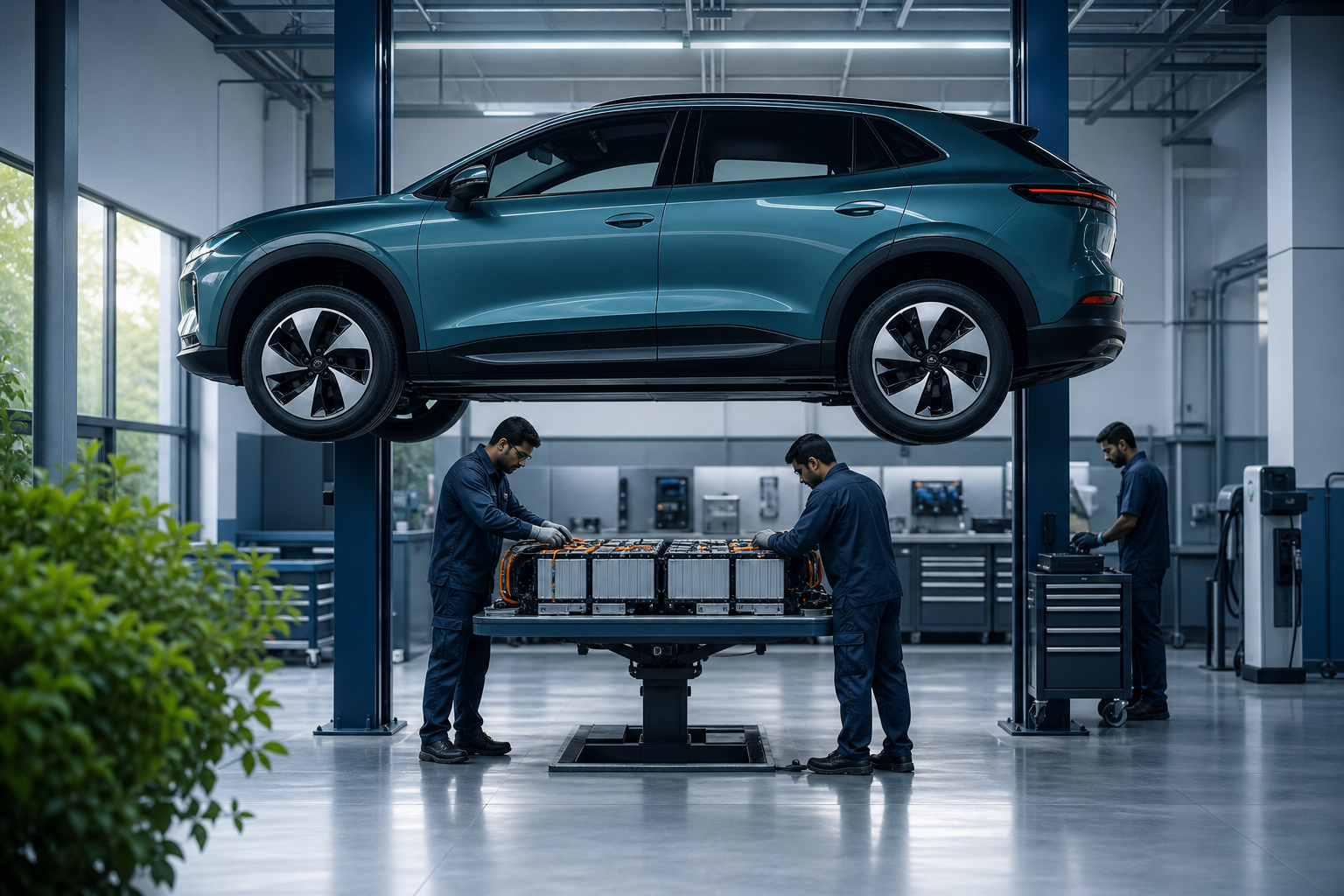
Situation. In internal-combustion vehicles, the supply chain was built around engines, transmissions, fuel systems, mechanical assemblies and a mature supplier base. EVs changed the bottleneck. Batteries, cells, power electronics, software, semiconductors, charging compatibility and high-voltage service capability became central to delivery and customer trust.
The move. Tata Motors built its EV business around a dedicated electric portfolio visible on its official EV platform (Tata Motors EV). The supply chain challenge was not simply “buy batteries cheaper.” It was to coordinate product architecture, suppliers, localisation choices, safety requirements, software readiness, service training and customer charging expectations.
Primary driver. The main driver was architectural change: EVs shift value from traditional mechanical systems to battery, electronics, software and energy ecosystem coordination.
Supporting drivers. Tata Motors also benefited from brand trust in passenger vehicles, portfolio breadth across EV models, learning from operating EVs in Indian road and charging conditions, and the wider Tata ecosystem’s presence in auto components, power and digital capabilities. The lesson is not that one company wins because of one supplier. The lesson is that the supply chain became part of the strategy itself.
Outcome or lesson. Recent supply chain advantage comes from ecosystem orchestration. The winner is not always the firm with the lowest unit cost; it is often the firm that can align design, sourcing, production, data, service and partners faster than competitors.
How AI Changes Recent Supply Chain Shifts
AI matters here because recent supply chains generate more data than manual planners can absorb. The role of the manager shifts from preparing every report to designing the decision logic and challenging AI recommendations.
- Demand sensing becomes more granular. AI models can combine sales orders, marketplace signals, promotions, weather, local events and stockouts to improve short-term replenishment decisions.
- Supplier risk sensing becomes earlier. Teams can monitor shipment delays, quality issues, financial stress signals and geopolitical alerts, then prioritize suppliers for mitigation.
- Warehousing and transport become more dynamic. AI can support slotting, labour planning, route sequencing, ETA prediction and exception alerts.
Use NotebookLM or ChatGPT like a supply chain analyst: upload a company annual report, a job description and this lesson, then ask: “List five recent supply chain risks for this company, map each to a metric, and suggest one practical mitigation.” Then check every claim against the company source before using it in an interview.
Interview Relevance
“Supply chains were earlier designed for efficiency. What has changed recently, and how would you redesign a company’s supply chain for the new environment?”
If you want to sound sharper, connect the answer to the operating model. For example: “This redesign will also require S&OP cadence, supplier scorecards, exception governance and clear ownership across procurement, planning, manufacturing and logistics.” To structure that end-to-end view, revise the standard reference model for supply chain processes.
Common Mistake
The mistake: saying “companies now keep more inventory” as the full answer. That sounds shallow because it ignores visibility, sourcing, network design, AI, sustainability and cash. One-line fix: say “firms now buffer selectively, based on criticality and volatility, while improving visibility and response speed.”
Start with How AI Is Reshaping Operations Work and Roles.