
How the Defence, Aerospace & Space Value Chain Works
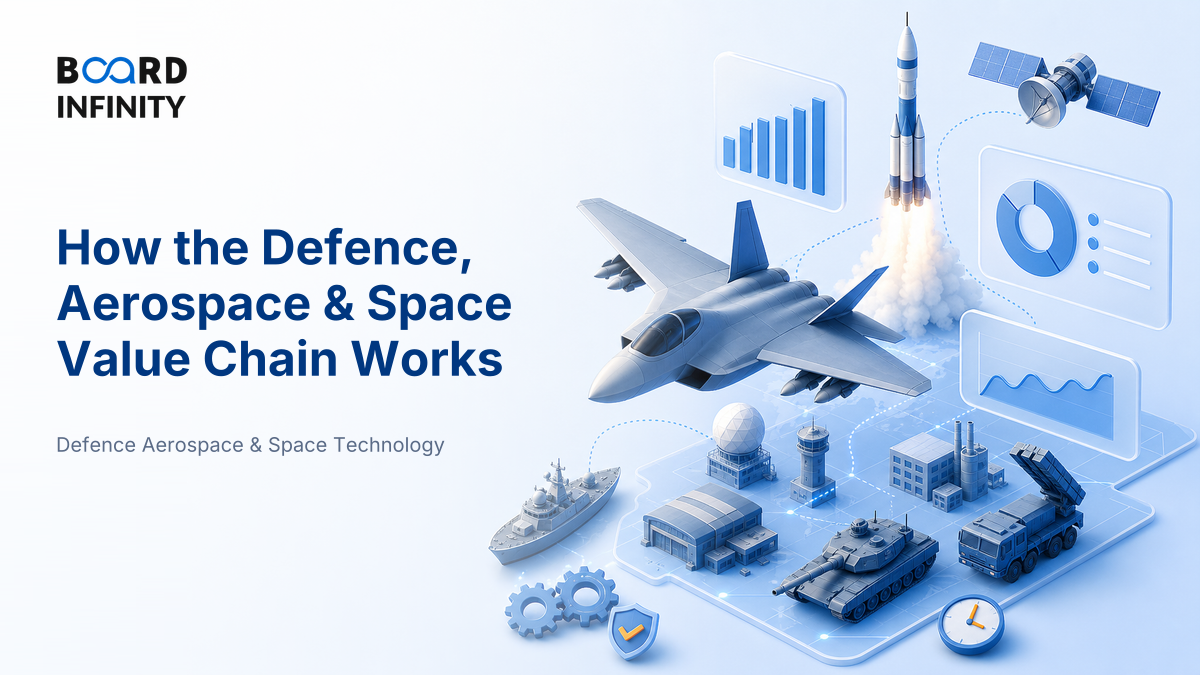
A missile battery, an aircraft engine and a satellite launch all fail in the same unforgiving way: one weak supplier, one uncertified component, one delayed test can hold back the entire mission. That is why this sector is not just a manufacturing chain - it is a trust chain, where technology, regulation, capital and national security move together.
- The defence, aerospace and space value chain converts a mission need into certified platforms, delivered systems and long-term sustainment.
- The chain has five big layers: materials and components, subsystems, platforms, integration and testing, then operations and lifecycle support.
- Prime contractors own system integration and customer accountability; Tier-1 and Tier-2 suppliers provide critical subsystems and components.
- Unlike consumer industries, demand is shaped by government budgets, procurement rules, export controls, certification and long development cycles.
- Money is made not only at sale, but across spares, maintenance, upgrades, software, training, payload data and mission services.
- The biggest interview trap is describing the sector as “manufacturing aircraft or weapons” and missing the engineering, certification and sustainment economics.
Big Picture: Think of It as a Mission-to-Sustainment Chain
The simplest way to understand this sector is to start with the buyer’s problem: defend airspace, move troops, launch payloads, gather intelligence, connect remote regions, or monitor Earth. The value chain then works backward from that mission into technology, suppliers, systems integration, testing, delivery and decades of support.
Core Explanation: The Five Layers of the Value Chain
The defence, aerospace and space value chain is layered because no single company normally makes everything. A fighter aircraft, drone, satellite or launcher is a system of systems - electronics, propulsion, structures, software, sensors, communications, materials and control systems must work together under extreme reliability requirements.
Here is the chain in interview language:
Who Does What in the Chain?
The sector becomes much easier once you separate ownership of the customer relationship from ownership of technical capability. A prime contractor may face the customer, but a small specialist supplier may own the most mission-critical sensor, actuator, chip or software module.
This is why a defence or space company’s moat is rarely just “factory capacity.” It is usually a combination of engineering IP, qualification record, regulatory approvals, integration capability, supplier depth, working-capital strength and trust with sovereign customers.
India’s defence and space ecosystems are gradually opening to private firms through mechanisms such as innovation programs, procurement reforms and the Innovations for Defence Excellence initiative. The strategic point is not simply “more startups”; it is that specialised private suppliers can now enter electronics, drones, propulsion, space applications, simulation and components instead of waiting for fully integrated platform opportunities.
The Defence-Aerospace-Space Chain Is Different from a Normal Industrial Chain
In most industries, the buyer asks: “Is it cheaper, faster and good enough?” In defence, aerospace and space, the buyer also asks: “Will it work under stress, can it be trusted, who controls the IP, can it be supported for decades, and is it geopolitically acceptable?”
If you already know civilian aviation and logistics, compare this with how the aviation and logistics value chain works: defence and space add secrecy, sovereign control, mission assurance and procurement complexity on top of the movement-of-assets logic.
Definitions You Should Be Able to Say Cleanly
Michael Porter describes a value chain as activities performed “to design, produce, market, deliver, and support its product” in Competitive Advantage.
How to Evaluate the Value Chain: Six Metrics That Matter
Interviewers like candidates who move from “this sector is complex” to “here is how I would measure performance.” In this industry, good measurement combines cost, time, reliability, localisation and lifecycle economics.
Use these metrics carefully: there is no universal “good number” across missiles, aircraft, satellites, drones and engines. A strong answer says the benchmark must be set against program type, mission criticality, maturity of technology and contract terms.
Case Study: ideaForge and the Drone Value Chain in India
ideaForge shows how an Indian aerospace player can create value by combining hardware, embedded software, manufacturing, customer-specific use cases and after-sales support.
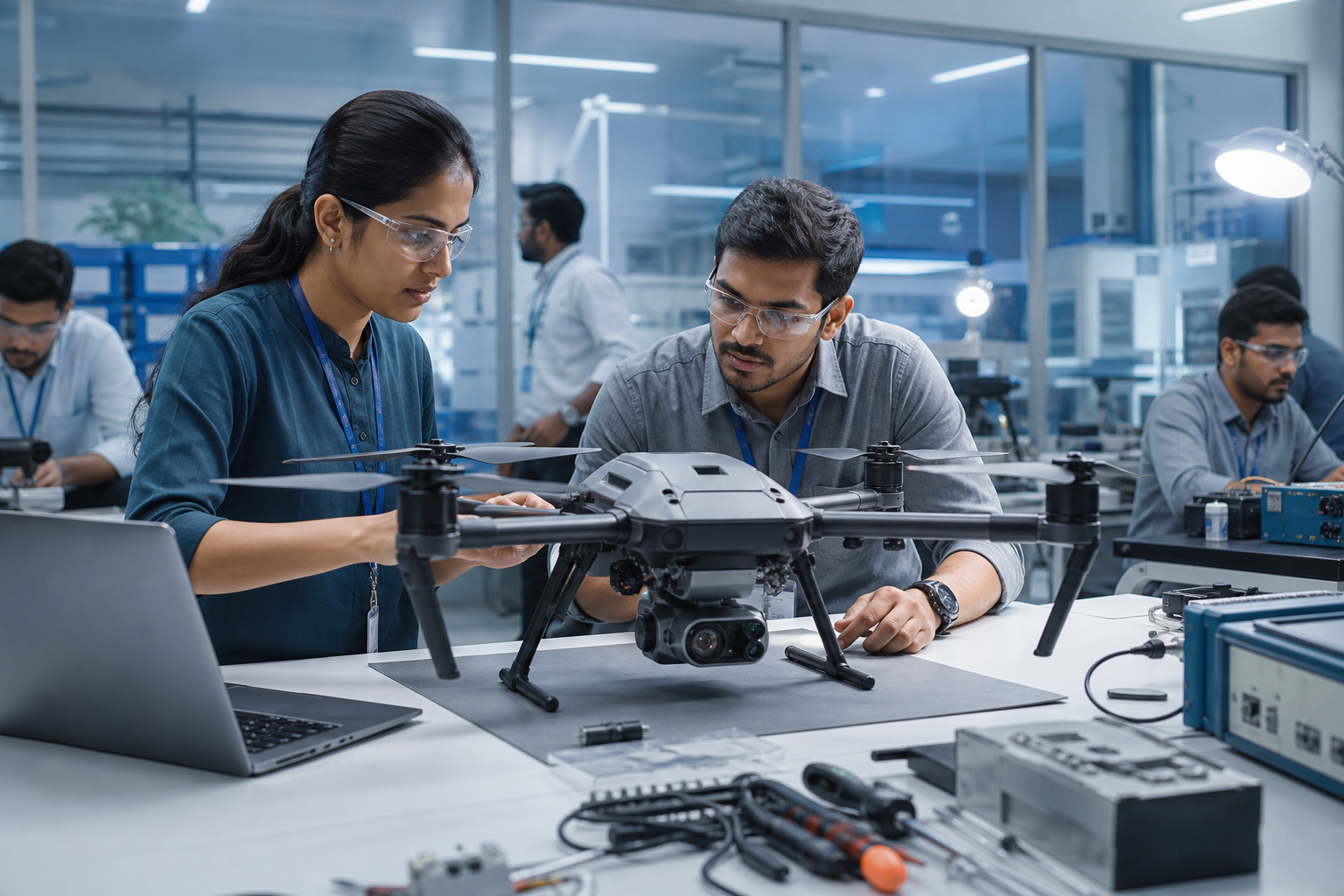
The situation: drones are not just flying gadgets. For defence, homeland security, mapping or inspection customers, the real requirement is reliable aerial intelligence under field conditions. That means airframe design, autopilot software, sensors, batteries, communications, operator training and maintenance all matter together.
The strategic move: ideaForge built itself around an integrated drone stack rather than acting only as a component trader. Its public-facing business describes unmanned aerial systems for applications such as surveillance, mapping and security on the ideaForge company website. The important value-chain lesson is that the company participates across multiple layers: product design, embedded systems, manufacturing, customer deployment and support.
The outcome or lesson: the primary driver is not “India needs drones” alone. The stronger explanation is that demand for drones meets supporting drivers: local operating conditions, procurement preference for trusted suppliers, field-service capability, software integration and the ability to adapt platforms for specific missions. In interviews, this is the difference between a shallow market answer and a value-chain answer.
How AI Changes Defence, Aerospace & Space Value Chains
AI is reshaping this value chain less through flashy robots and more through better prediction, simulation, inspection and mission decision support. Three changes matter for 2026:
The risk is equally important: AI outputs must be explainable, tested and governed because false positives, hallucinated analysis or biased data can create operational and safety risks.
Use NotebookLM or ChatGPT to prepare company-specific answers: load this lesson, the company’s annual report or investor presentation, and one government policy page such as the Indian Space Policy 2023, then ask: “Map this company across the value chain, identify its revenue pools, suppliers, customers, risks and likely interview questions.”
Interview Relevance
“Explain the defence, aerospace and space value chain. Where would an Indian private company create value, and what risks should it watch?”
A strong answer sounds like a consultant’s map: “Here is the chain, here are the players, here is where value accrues, and here are the bottlenecks.” If you want to sharpen adjacent industrial thinking, revise an applied industrial value-chain teardown next.
Common Mistake
The common mistake is treating the sector as “manufacturing big hardware.” That misses software, testing, certification, procurement, spares, upgrades and lifecycle support - exactly where many strategic profit pools sit. One-line fix: always answer from mission need to sustainment, not from factory to finished product.