
Regulation and the Bodies That Govern Defence, Aerospace & Space
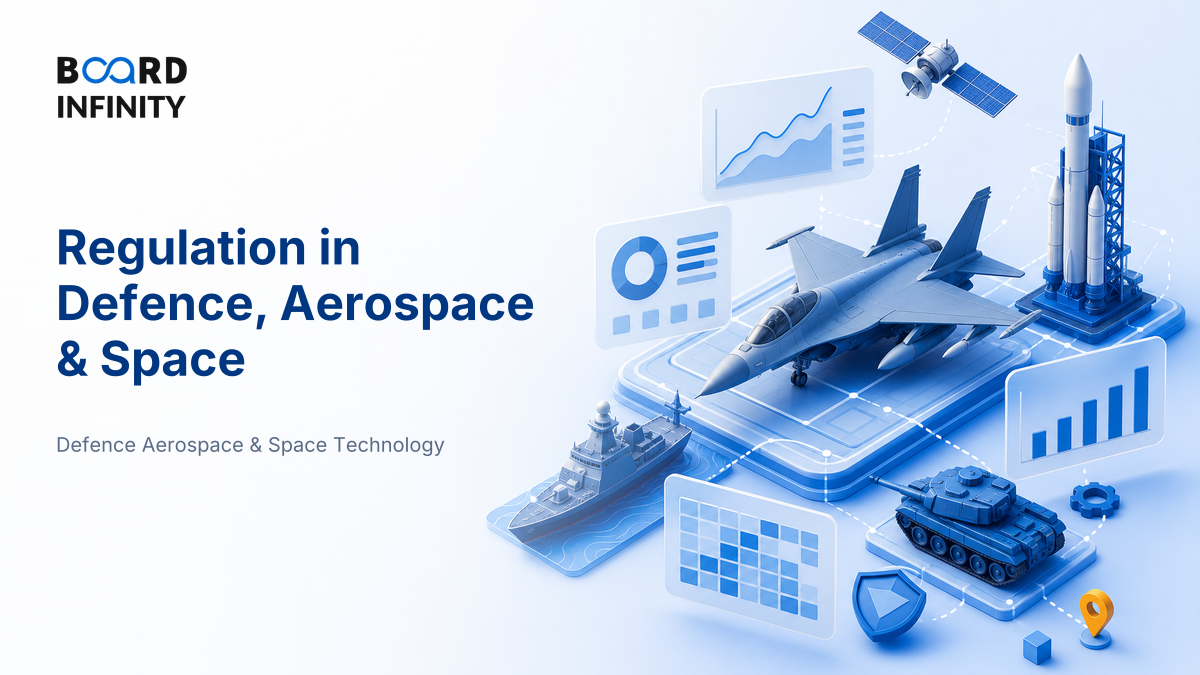
A rocket startup may have brilliant propulsion, a drone maker may have a strong order book, and an aircraft supplier may have world-class engineering - but none of them can move without permission. In defence, aerospace and space, regulation is not a background formality; it is the market gatekeeper, risk filter and competitive moat.
- Defence is governed by sovereignty logic: capability, security, procurement integrity, indigenisation and export control matter as much as price.
- Aerospace is governed by safety logic: airworthiness, certification, airport regulation, security and operating permissions shape the business model.
- Space is moving from state-led to state-enabled: the Department of Space, ISRO, IN-SPACe and NSIL split policy, technical, authorisation and commercial roles.
- The regulatory funnel is simple: licence or authorisation - certification - procurement or market access - compliance - export or operational clearance.
- The key interview move: name the right regulator for the right activity. Do not say “government approval” generically.
- Most candidates miss dual-use risk: the same sensor, software, drone or satellite component can be commercial in one use case and controlled in another.
Big Picture: Regulation Is the Entry Gate, Not the Last Step
In consumer businesses, regulation often comes after product-market fit. In defence, aerospace and space, it comes before revenue. A company must prove not only that the product works, but that it is safe, secure, authorised, traceable and aligned with national interest.
Core Explanation: The Three Regulatory Logics
Do not memorise regulators as a list. Understand the logic each domain is protecting.
The major shift in India is that private participation has expanded, but permission has not disappeared. Instead, the state is moving from being only the operator to also being the market architect.
The Regulatory Map: Who Governs What
For interviews, use a map. It prevents the classic error of mixing up a ministry, a regulator, a buyer and a technical certifier.
Defence: The Governance Stack
Defence regulation begins with the Ministry of Defence, which sets the overall policy direction for India’s defence establishment. Within it, the Department of Defence Production focuses on defence manufacturing, indigenisation and industry interface.
For capital acquisition, India uses the Defence Acquisition Procedure, commonly referred to as DAP. The Defence Acquisition Procedure shapes categories such as domestic procurement, indigenous design and development, trials, technical evaluation and contract award.
The Defence Research and Development Organisation is central to defence technology development and industry collaboration. But it is not the same as the buyer, and that distinction matters in interviews.
For exports and dual-use items, the Directorate General of Foreign Trade matters because strategic goods, software and technologies may fall under export-control rules. A defence company can win a domestic order and still face separate restrictions when exporting a component or transferring technical know-how abroad.
Aerospace: Certification, Safety and Operations
Civil aerospace sits at the intersection of manufacturing, airlines, airports, safety and security. If you need the industry value-chain context first, revise how the aviation and logistics value chain works before going deeper into regulation.
The Ministry of Civil Aviation sets the policy environment, while the Directorate General of Civil Aviation is the key technical safety regulator for civil aviation. The Bureau of Civil Aviation Security handles aviation security, while AERA regulates aeronautical tariffs for major airports.
Space: From ISRO-Led Execution to Private Authorisation
India’s space governance is changing because private firms now build satellites, launch vehicles, payloads, data platforms and downstream applications. The key is to separate four roles.
The Department of Space is the policy anchor. ISRO remains India’s principal space agency and technical backbone. IN-SPACe acts as the interface and authorisation body for private space activities. NewSpace India Limited is the commercial arm that helps monetise and transfer space capabilities.
Defence procurement: the structured acquisition of military capability by the state through approved procedures, trials, evaluation and contracting.
Airworthiness: the approved condition that an aircraft or system is safe for its intended operation.
Export control: rules restricting transfer of military or dual-use goods, software, technology or know-how across borders.
Space authorisation: permission for a private entity to conduct specified space activity under the national space governance framework.
The Most Useful Interview Framework: Activity First, Regulator Second
When a company says “we operate in defence, aerospace and space,” your first question should be: what activity exactly? The regulator changes with the activity.
Regulatory Due Diligence Scorecard
If you are analysing a company in this sector, do not stop at revenue and order book. Add a compliance lens.
Mini Case Study: Pixxel and the New Private Space Rulebook
Pixxel shows why Indian space startups need both deep technology and regulatory navigation to turn satellite capability into a scalable business.

Pixxel is an Indian space-tech company building hyperspectral Earth-imaging capability and a downstream data platform. The technology story is attractive: better imagery can serve agriculture, climate monitoring, mining, energy, environmental tracking and government use cases.
But the strategic lesson is regulatory. A company like Pixxel does not scale like a normal SaaS startup. It must navigate satellite authorisation, launch coordination, spectrum-related dependencies, data-use sensitivity, customer trust and cross-border commercial constraints. The primary driver is not just superior imagery; it is the ability to convert regulated space infrastructure into usable, compliant data products. Supporting drivers include technical credibility, partnerships, customer education and the shift in India’s space policy architecture toward private participation under the Indian Space Policy 2023.
Lesson: in space-tech, regulation is not a brake alone. Handled well, it becomes a trust signal that helps customers, investors and government partners take the company seriously.
How AI Changes Regulation in Defence, Aerospace & Space
AI is not just another software layer in these sectors. It changes what must be tested, explained, secured and approved.
- AI-enabled autonomy increases certification complexity. Drones, unmanned systems, aircraft maintenance tools and satellite operations using AI must be assessed not only for performance, but also for reliability, failure modes and human override.
- AI changes export-control risk. A model, simulation tool or targeting-related software can be dual-use even if it is sold as analytics. This makes technical classification and end-use clarity more important.
- AI helps compliance teams prepare faster. Firms can use LLMs to summarise tender clauses, compare approval requirements and create audit checklists, but final interpretation must stay with legal, regulatory and technical experts.
Use NotebookLM: upload a company annual report, a relevant policy note and a defence or aviation tender document. Ask it to produce “top 10 regulatory risks, mapped to regulator, approval stage and business impact.” Then verify every point against the original document.
Interview Relevance
“A private Indian company wants to build and sell a dual-use drone for border surveillance, industrial inspection and export markets. Which regulatory bodies and approvals would you think about?”
Use the phrase “same platform, different regulatory treatment by end use”. It signals mature thinking and prevents a generic answer.
Common Mistake
The mistake: saying “the government regulates it” without naming the exact body or approval stage. Why it costs candidates: it shows you have not understood how business actually moves in regulated strategic sectors. One-line fix: always answer as activity - regulator - approval - business implication.