
Emerging Trends Reshaping Defence, Aerospace & Space
A decade ago, this sector looked like a slow, state-led world of fighter jets, satellites and decade-long procurement files. Now the same battlefield and orbit are being reshaped by drones, AI, private launch startups, software-defined platforms and supply chains that governments no longer want to leave exposed.
The big shift is simple: defence, aerospace and space are moving from closed, hardware-heavy national programs to networked, software-rich, dual-use ecosystems. That changes who wins, how money is made, and what an MBA candidate must notice.
- The core trend: the sector is shifting from pure government hardware programs to dual-use, software-led, commercially accelerated ecosystems.
- Five forces to track: geopolitics, private capital, AI and autonomy, supply-chain sovereignty, and low-cost access to space.
- Defence is becoming more networked: sensors, drones, command systems and cyber layers matter as much as platforms.
- Aerospace is being pulled by efficiency: MRO, engine reliability, composites, sustainable aviation and digital operations are major themes.
- Space is commercialising: launch, earth observation, satcom, navigation and downstream analytics are becoming business models, not only national missions.
- India angle: IN-SPACe, iDEX, Make in India and private space startups are turning policy into market opportunity.
- Interview answer rule: never list buzzwords. Tie each trend to buyer need, capability gap, regulation, economics and risk.
Big Picture: The Sector Is Moving From Arsenal Logic to Ecosystem Logic
The old model was dominated by sovereign programs, prime contractors, long qualification cycles and bespoke hardware. The emerging model still has governments at the centre, but it adds startups, AI firms, telecom networks, private capital, reusable infrastructure, commercial satellite data and dual-use suppliers.
Think of the industry as three connected arenas: defence protects national security, aerospace moves people and assets through air, and space provides launch, satellite and data infrastructure. The same trend can hit all three differently - AI may power target recognition in defence, predictive maintenance in aerospace, and satellite image analytics in space.
Core Explanation: The Six Trends Reshaping the Sector
Use this as your master map. In an interview, you do not need to name every company in the world. You need to show that you understand why the structure of the industry is changing.
1. Geopolitics Is Pulling Demand Toward Sovereign Capability
Countries are trying to reduce dependence on fragile external supply chains for critical systems. This creates demand for local manufacturing, domestic design authority, trusted electronics, indigenous propulsion, secure communication and local maintenance ecosystems.
For India, this connects directly with policy-led market formation. iDEX positions startups and innovators around defence problem statements, while IN-SPACe acts as India's single-window agency for enabling private participation in space activities.
2. Dual-Use Technology Is Collapsing the Civil-Military Boundary
Many technologies now serve both civilian and defence markets: drones, satellite imagery, secure communications, AI vision, robotics, cybersecurity, simulation and advanced materials. This matters because startups can often enter through commercial use cases and later adapt for defence-grade needs.
For example, earth observation data can help agriculture, insurance and disaster response, but the same capability can support strategic monitoring. Satellite communication also overlaps with the broader telecom and digital infrastructure market structure, especially as connectivity moves beyond towers and fibre into orbit.
3. Defence Is Becoming Network-Centric and Software-Defined
The winning capability is no longer just a superior aircraft, tank or missile. It is the network that connects sensors, shooters, commanders, satellites, cyber systems and autonomous assets. Software upgrades, data fusion and interoperability increasingly determine battlefield effectiveness.
This changes the profit pool. Value shifts toward secure operating systems, mission software, electronic warfare, AI-enabled decision support, cloud-edge architecture and lifecycle upgrades.
4. Aerospace Is Moving From Asset Sales to Lifecycle Economics
Aerospace companies increasingly compete on reliability, uptime, fuel efficiency, maintenance cost and fleet availability. For airlines and operators, the aircraft is not just a product; it is a high-value asset whose economics depend on engines, spares, MRO, predictive maintenance, leasing and turnaround time.
If you want to understand this operational logic better, revise the aviation and logistics value chain, because many aerospace business models ultimately depend on fleet utilisation and service reliability.
5. Space Is Commercialising From Mission to Market
Space is no longer only about national prestige. It is becoming an infrastructure layer for communication, navigation, climate monitoring, defence surveillance, agriculture intelligence, disaster management and financial risk modelling.
India's Chandrayaan-3 mission demonstrated a successful lunar soft landing near the Moon's south polar region, a milestone documented by the ISRO Chandrayaan-3 mission page. The business implication is not that every firm should build moon landers. The lesson is that space capability creates national credibility, talent depth and downstream commercial confidence.
6. Cost Curves Are Falling, but Certification Barriers Remain High
Reusable launch systems, additive manufacturing, commercial electronics, cloud simulation and modular design can reduce development time and cost. But this sector still has unusually high barriers: testing, qualification, security clearance, export controls, safety certification and procurement approval.
That is why the best companies combine speed with compliance. They move like startups in prototyping, but like mission-critical enterprises in reliability.
Trend Metrics: How to Track Whether the Shift Is Real
In interviews, strong candidates avoid vague lines like “space is booming” or “AI is transforming defence.” They name the indicators that prove a trend is becoming a market.
Quick worked example: if a defence electronics firm wins ₹1,200 crore of new orders and books ₹1,000 crore of revenue in the same year, its book-to-bill ratio is 1.2. That indicates the order pipeline is being replenished faster than delivery, though you would still check margins, execution risk and customer concentration.
Definitions You Should Be Able to Say Cleanly
- Emerging trend: a durable shift in technology, policy, economics or demand that changes industry advantage.
- Dual-use technology: goods, software and technology usable for both civil and military purposes, as described by the European Commission dual-use guidance.
- Technology readiness level: a 1-9 scale indicating how close a technology is to proven operational use.
- Sovereign capability: domestic control over critical design, production or operation when external dependence is strategically risky.
- Downstream space economy: services built from space infrastructure, such as imagery analytics, satcom, navigation and weather intelligence.
Case Study: Skyroot Aerospace and India's Private Space Shift
Skyroot Aerospace shows how India's space sector is moving from institution-only missions to a startup-plus-state ecosystem around launch capability.
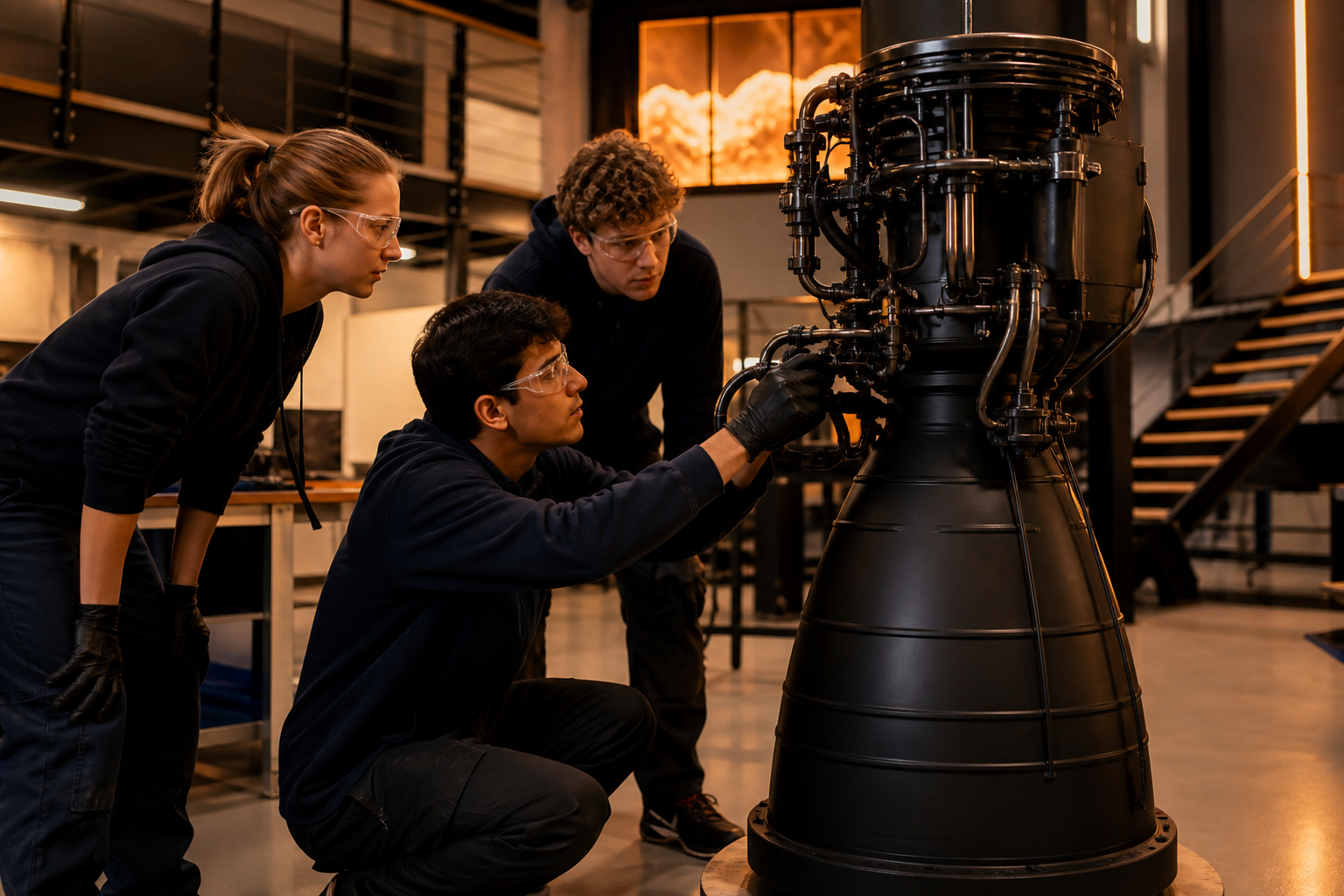
Situation: For decades, India's space capability was built primarily through ISRO-led national missions and a supplier ecosystem around it. That created deep engineering credibility, but private companies had limited room to own end-to-end space products.
The move: Skyroot Aerospace entered as a private launch company building the Vikram family of launch vehicles, as described on Skyroot Aerospace's official site. The strategic move was not merely “make a rocket.” It was to build a modular, privately led launch business around speed, specialised engineering, supplier partnerships and the policy opening created by India's private space reforms through IN-SPACe.
Outcome and lesson: The important lesson for an MBA student is market structure. Private launch companies can create new roles in the value chain - mission design, launch services, propulsion, testing, payload integration and customer acquisition - while still depending on national infrastructure, regulation and trust. The primary driver is policy-enabled private participation; supporting drivers include India's engineering talent base, supplier capability, lower-cost development environment and demand for small-satellite launch options.
How AI Changes Emerging Trends Reshaping Defence, Aerospace & Space
AI is not a separate trend sitting beside the sector. It is becoming the intelligence layer across design, operations, missions and decision-making.
The caution: AI adoption in this sector is constrained by explainability, cyber risk, safety certification, adversarial manipulation and classified data handling. A model that works in a demo is not automatically acceptable in a cockpit, command centre or satellite-control environment.
Use Perplexity or NotebookLM to compare one company's annual report with IN-SPACe or iDEX policy pages. Ask: “List the company's exposure to autonomy, private space, indigenous content, lifecycle services and export risk, with likely interview questions.” Then verify every factual claim from the original source before using it.
Interview Relevance
“What are the most important emerging trends in defence, aerospace and space, and how would they affect a company's strategy in this sector?”
Use the phrase “speed with trust.” It captures the sector perfectly: companies must prototype fast, but win only when they prove reliability, security and compliance.
Common Mistake
The biggest mistake is giving a buzzword list: “AI, drones, space, Make in India, cybersecurity.” That sounds shallow because it does not show business understanding. The fix: for every trend, add one buyer need, one capability implication, one economic impact and one risk.