
E-Commerce Fulfilment During a Peak Sale Event
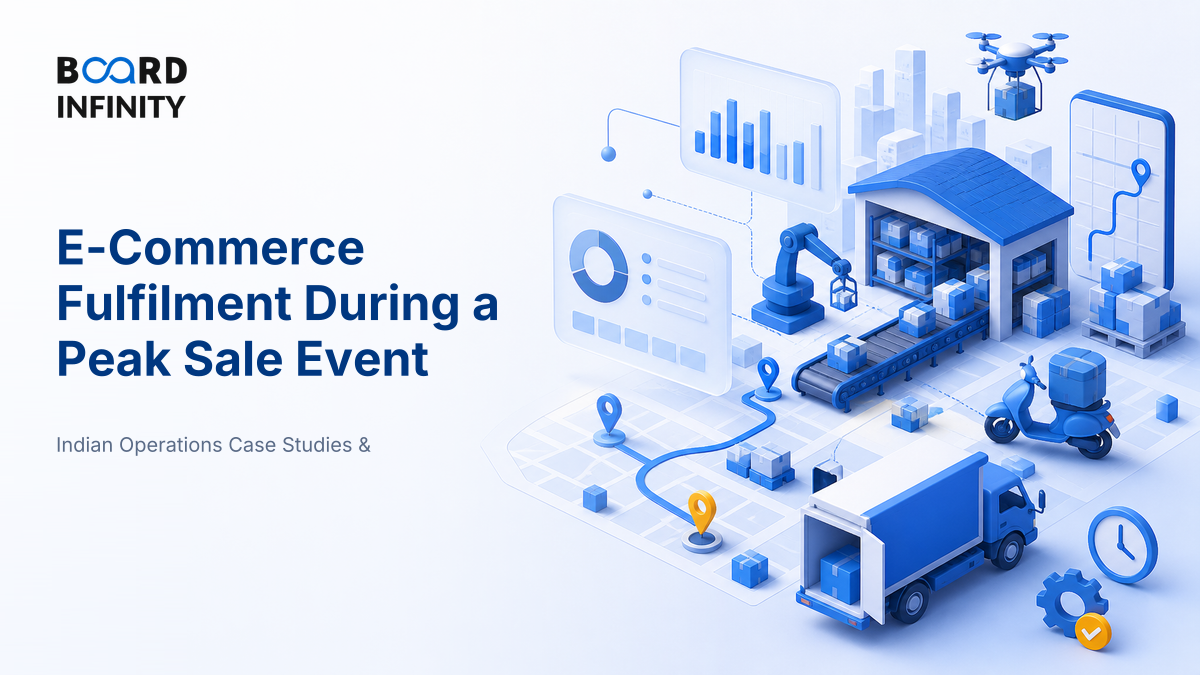
The biggest myth about a peak e-commerce sale is that it is a website traffic problem. The real battle starts after the customer clicks “Buy Now” - when thousands of promised delivery dates, warehouse picks, payment confirmations, seller handoffs and courier capacity decisions collide at once.
- Peak sale fulfilment is the end-to-end execution of unusually high order volumes while protecting delivery promise, cost and customer experience.
- The core loop is: forecast demand - position inventory - control promises - execute warehouse flow - dispatch - learn from exceptions.
- The biggest operational risk is not demand itself; it is demand arriving in the wrong city, SKU, size, seller node or courier lane.
- Good operators build capacity before the sale, throttle promises during the sale and manage exceptions after the sale.
- Track perfect order rate, on-time dispatch, fill rate, pick productivity, backlog age and cost per order - not just gross orders.
- In interviews, answer using a control-tower lens: demand, inventory, warehouse, transport, customer promise and exception recovery.
- The common mistake is saying “add more warehouse workers”; the better answer is to redesign the system constraints before volume hits.
The Big Picture: Peak Fulfilment Is a Control Loop, Not a Rush Job
A peak sale event compresses a month of operational pressure into a few days. The winning system is not the one that reacts fastest; it is the one that keeps learning and rebalancing every few hours across inventory, labour, courier capacity and customer promises.
Core Explanation: What Actually Happens Behind a Peak Sale
In normal fulfilment, the operation has slack. In a peak event, slack disappears. Small errors - wrong demand forecast, stock mismatch, poor slotting, late courier pickup - multiply quickly because every node is already near capacity.
Think of e-commerce fulfilment as six connected decisions:
If you want a broader teardown template for any operations setup, revise how to read an operations setup before applying this topic to a company.
The Peak Sale Fulfilment Funnel
Every order looks like one sale on the app, but operationally it must survive a funnel. Losses can happen at every stage: stock not found, payment pending, item damaged, packing delayed, pickup missed, customer unavailable or return initiated.
The Operating Levers: Where Managers Actually Intervene
During a peak event, managers do not simply “work harder.” They pull specific levers. Each lever protects either speed, reliability or cost.
The same logic becomes more compressed in instant delivery, where node size, assortment and rider availability dominate economics. That is the natural bridge to Quick Commerce Dark Store Economics, Broken Down.
Metrics That Matter in Peak Fulfilment
Never judge a peak sale only by order volume. A weak answer celebrates sales; a strong answer asks whether the system delivered those sales profitably and reliably.
For inventory-policy depth, especially reorder points and safety stock, revise setting inventory policy for a multi-product business.
Definitions You Should Be Able to Say Cleanly
- Fulfilment: The activities that receive, process, pick, pack, ship and deliver a customer order.
- Peak sale event: A short promotional period where order volume, SKU mix and delivery pressure rise sharply above normal baseline.
- Available-to-promise: Inventory that can be confidently committed to a customer after considering stock, reservations and capacity constraints.
- Perfect order: An order delivered complete, accurate, damage-free and on time.
- Control tower: A central operating view that tracks fulfilment exceptions and coordinates corrective action across teams.
Case Study: Nykaa and Beauty Fulfilment During a Peak Sale
Nykaa’s large beauty sale events show why peak fulfilment is a promise-control problem as much as a warehouse problem.

Beauty e-commerce is operationally tricky. Many items are small, high-SKU, shade-specific, fragile, leak-prone or expiry-sensitive. A lipstick shade mismatch, a damaged bottle or a delayed premium skincare order can hurt trust more than a simple late commodity shipment.
During a major sale property such as Nykaa’s Pink Friday-style events, the primary operational driver is promise discipline: the platform must show realistic availability and delivery dates rather than over-promising to capture demand. Supporting drivers include pre-positioning fast-moving beauty SKUs, packaging standards for liquids and fragile items, seller and warehouse coordination, and fast exception handling for delayed or damaged orders.
The lesson is powerful for interviews: Nykaa’s fulfilment challenge is not “ship more boxes.” It is to protect customer trust in a category where selection accuracy, packaging quality and delivery reliability all matter. The win comes chiefly from disciplined promise management, supported by inventory placement, category-aware packaging and control-tower execution.
Worked Example: Why One Bad Capacity Assumption Creates Backlog
Suppose a fulfilment centre expects 50,000 orders on a sale day. It plans two shifts with combined capacity for 45,000 orders. The team assumes the remaining 5,000 can be cleared the next morning.
The danger is that backlog is not just a number; it ages. Older orders start missing customer promises, occupy staging logic, trigger support tickets and consume management attention. A strong answer would recommend pre-sale capacity buffers, dynamic promise throttling and priority rules for ageing orders.
How AI Changes E-Commerce Fulfilment During a Peak Sale Event
AI does not remove operational constraints, but it helps teams see them earlier and react more precisely.
- Demand sensing at SKU-location level: Machine learning can combine past sales, campaign calendars, price drops, wishlists, search trends and regional patterns to predict which SKUs will spike in which city clusters.
- Dynamic promise and allocation: AI models can recommend whether to show faster delivery, slower delivery, substitute fulfilment nodes or stop taking orders for constrained SKUs in specific pin codes.
- Exception prediction: Models can flag orders likely to miss SLA because of stock mismatch, courier lane stress, address risk, seller delay or warehouse backlog.
Load this lesson, a company’s latest annual report and any public sale-event communication into NotebookLM. Ask: “Create a peak-sale fulfilment control tower for this company with risks, metrics, likely bottlenecks and interview questions.” Then convert the output into a 90-second answer.
If you want to go deeper into replenishment models, the next practical layer is using AI for inventory optimisation and replenishment.
Interview Relevance
“An e-commerce company is running a five-day festive sale. Orders are expected to spike sharply. How would you design the fulfilment plan and what metrics would you monitor?”
Use the phrase “booked orders are not the same as fulfilled orders.” It signals that you understand the difference between marketplace excitement and operational performance.
Common Mistake
The mistake is treating peak fulfilment as a manpower problem: “hire more pickers, add more delivery partners.” That answer misses inventory accuracy, promise logic, warehouse flow, carrier-lane capacity and exception recovery. One-line fix: identify the binding constraint first, then add capacity only where that constraint actually sits.