
Key Players and the Competitive Map in Electronics & Semiconductors
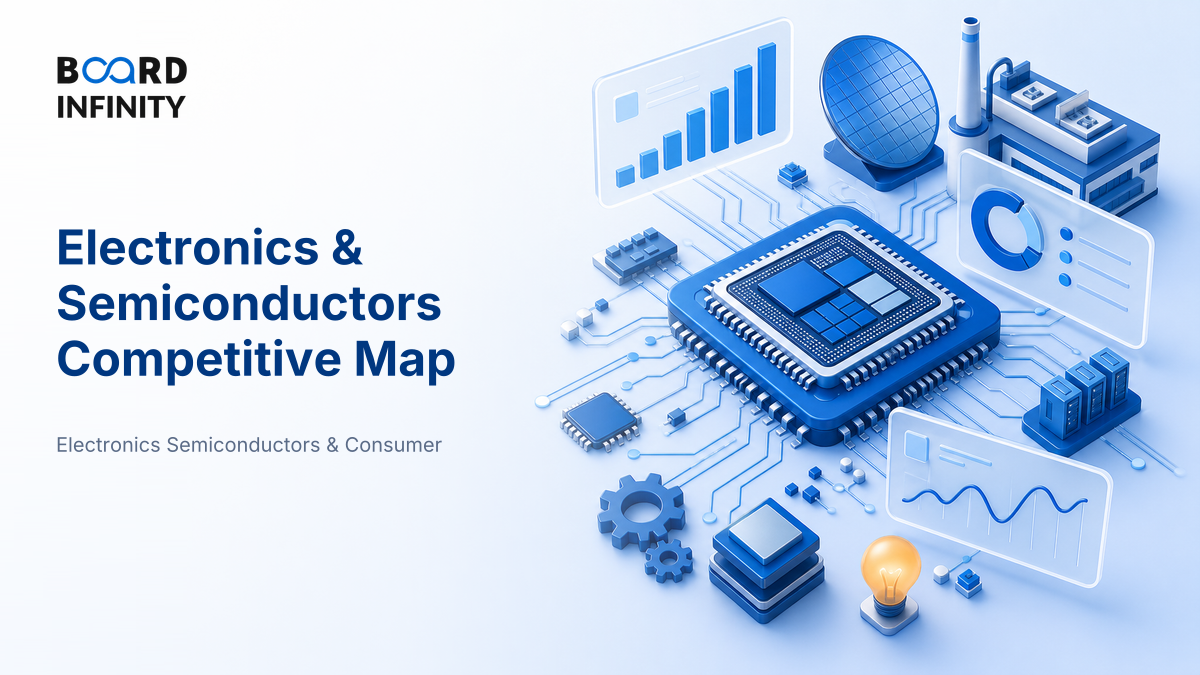
A smartphone launch can be ready, the ad film can be approved, and the retail shelves can be booked - yet one unavailable chip can freeze the entire plan. That is the real tension in electronics and semiconductors: the brand the customer sees is often not the player with the deepest power.
- Electronics is the visible product system - phones, TVs, wearables, appliances, EV electronics and industrial devices.
- Semiconductors are the critical chip layer inside electronics - processors, memory, sensors, power chips and connectivity chips.
- The industry map is best read as a stack: equipment/materials, chip design/IP, wafer fabrication, OSAT, EMS/ODM and final brands.
- The strongest players control a scarce bottleneck: advanced lithography, leading-edge foundry capacity, design IP, operating systems, distribution or trusted manufacturing scale.
- Global examples: ASML in EUV lithography, TSMC in foundry manufacturing, Arm in processor IP, Qualcomm in fabless chips, Foxconn in EMS and Apple/Samsung as system brands.
- India is stronger today in electronics assembly, EMS, design talent and policy-backed manufacturing; deep semiconductor fabrication is still emerging.
- In interviews, do not list companies randomly - map each player to its value-chain role, source of power and vulnerability.
Big Picture: The Industry Is a Layered Power Stack
The easiest way to understand electronics and semiconductors is to stop thinking like a consumer and start thinking like a supply-chain strategist. The customer sees the device; the industry earns power across hidden layers underneath it.
A premium smartphone is not made by one company in one factory. A brand may own design, software, customer trust and distribution; a fabless chip company may design the processor; a foundry may manufacture it; an OSAT firm may package and test it; an EMS company may assemble the final device. The competitive map shows who captures value, who bears asset risk, and who becomes irreplaceable.
Core Explanation: The Six Player Archetypes
For interview purposes, classify every company by its role in the value chain before judging its strength. The same company can play multiple roles, but the archetype tells you where its economics come from.
Here is the value-chain movement from invisible chip idea to visible consumer product.
Where Competitive Power Actually Comes From
In this sector, power is not simply about size. It comes from controlling a layer that others cannot quickly copy. A player becomes strategically strong when it combines scarcity, switching cost, scale, trust and timing.
ASML is a classic bottleneck example because it supplies extreme ultraviolet lithography systems used in advanced semiconductor manufacturing; ASML describes EUV lithography as enabling the creation of extremely small features on microchips (ASML EUV lithography). Arm is powerful in a different way: it licenses processor IP used by chip designers rather than manufacturing finished chips itself (Arm silicon IP). These are not the same businesses, but both sit at hard-to-replace points in the stack.
India on the Map: Strong in Electronics, Building in Semiconductors
India’s competitive story is not “India already owns the chip stack.” The stronger answer is more nuanced: India has large electronics demand, growing manufacturing policy support, design talent and EMS momentum, while high-end fabrication remains a long-cycle capability build.
The India Semiconductor Mission is the government-backed programme intended to support the semiconductor and display ecosystem, while MeitY’s production-linked incentive approach has supported large-scale electronics manufacturing (MeitY PLI for electronics manufacturing). For interviews, that means India should be mapped across two tracks: electronics manufacturing scale now and semiconductor ecosystem depth over time.
Dixon Technologies is an Indian electronics manufacturing services player operating across categories such as consumer electronics, home appliances, lighting, mobile phones and security systems (Dixon Technologies). The strategic point: India’s near-term electronics advantage is not only brand ownership; it is also manufacturing execution, supplier coordination and policy-linked scale.
Competitive Mapping Metrics: What to Track
When asked to compare players, use metrics that match the layer. A fabless chip company and an EMS manufacturer should not be judged using the same headline logic.
Use these metrics with role clarity. A high capex intensity may be a red flag for a consumer brand but normal for a foundry. A high gross margin may signal true IP power for a design company, but it may be harder for an EMS player whose model depends on scale, efficiency and working-capital discipline.
Definitions You Can Say in One Breath
- Electronics: Devices and systems that use electrical circuits to process, control or transmit information and power.
- Semiconductor: A material or chip whose conductivity enables controlled electronic switching, sensing, storage or computation.
- Competitive map: A structured view of industry players, roles, power sources, dependencies and profit pools.
- Foundry: A semiconductor manufacturer that fabricates chips designed by other companies.
- Fabless company: A chip company that designs semiconductors but outsources manufacturing.
- EMS: Electronics manufacturing services - outsourced manufacturing, assembly, testing and supply-chain execution for electronics brands.
For strategy framing, you can mention Porter’s Five Forces as the logic behind industry attractiveness: rivalry, supplier power, buyer power, substitutes and entry barriers shape profit potential.
Dixon Technologies: India’s EMS Ladder in One Business
Dixon shows how an Indian player can climb from contract manufacturing toward deeper electronics value-chain relevance.
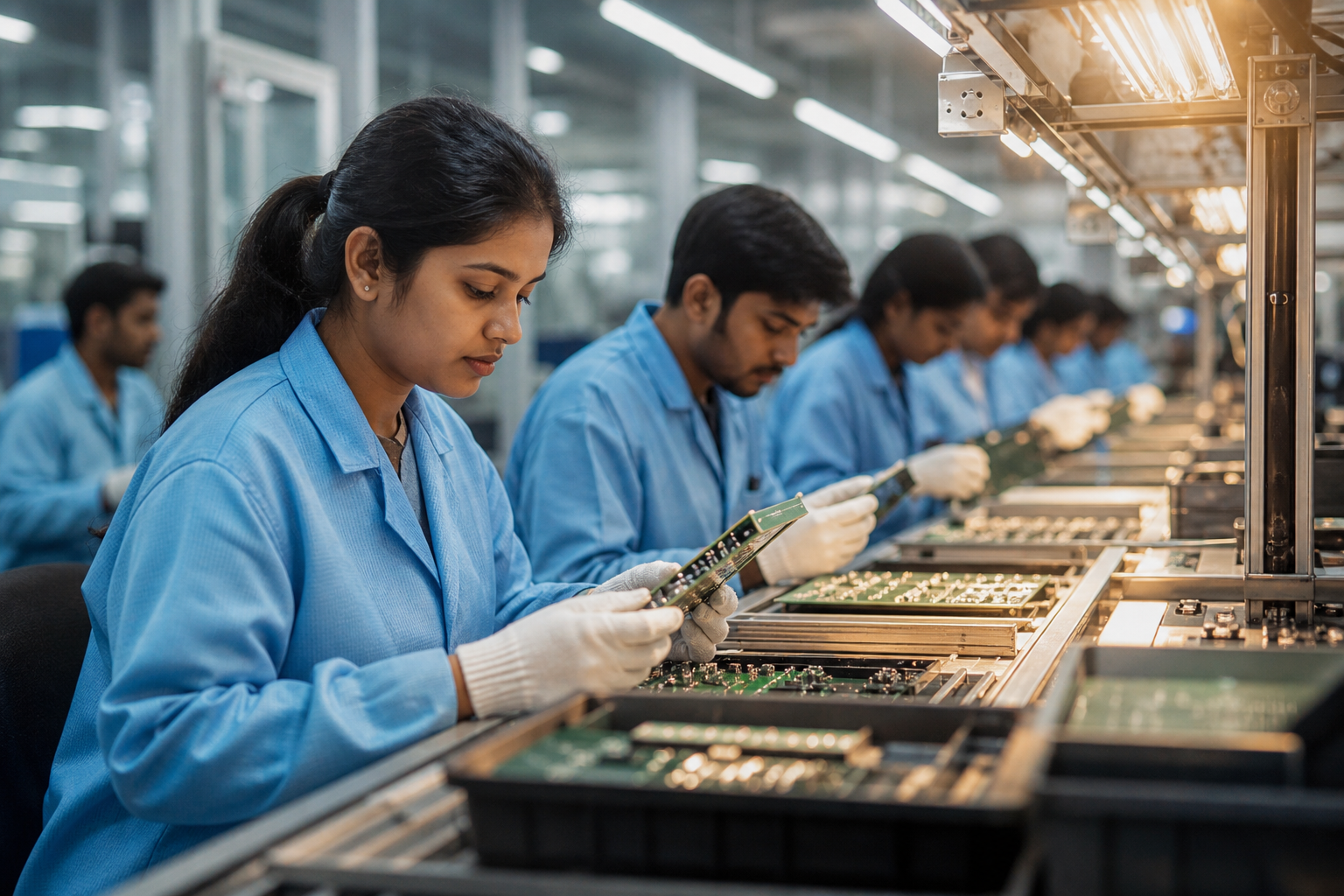
Situation: Global electronics brands need reliable manufacturing partners close to large demand markets. India also wants to reduce import dependence, expand domestic manufacturing and build electronics supply-chain depth.
The move: Dixon positioned itself as an EMS platform across multiple electronics categories rather than depending on a single product line. Its advantage comes chiefly from manufacturing execution and customer program delivery, supported by category diversification, supplier coordination, quality systems, working-capital management and India’s policy push for electronics manufacturing.
Outcome and lesson: The lesson is not that Dixon “wins because of PLI.” That would be a shallow answer. PLI and domestic demand are supporting drivers; the primary driver is execution capability at scale. In the competitive map, Dixon sits in the EMS/ODM layer - not the most glamorous layer, but one that becomes strategically important when brands want resilient, local and scalable manufacturing partners.
How AI Changes Electronics & Semiconductors Competitive Mapping
AI changes this topic in three concrete ways.
- Chip demand is being reshaped by AI workloads. Data centres, edge devices, smartphones, automobiles and industrial systems increasingly need specialized compute, memory, connectivity and power-management chips. This shifts bargaining power toward companies that can deliver performance per watt, supply assurance and software compatibility.
- AI is entering chip design and verification. EDA tools increasingly use automation to improve layout, verification and design exploration. That can compress design cycles, but it also raises the bar for talent that understands both semiconductor engineering and business trade-offs.
- Competitive intelligence is becoming faster. Teams can use AI to scan annual reports, earnings-call transcripts, import-export cues, patent filings and job postings to infer where a company is investing - but they must verify every claim against primary sources.
Student workflow: Use NotebookLM or ChatGPT to build a two-page sector brief. Load a company annual report, a government policy page and one competitor profile; ask for “player role, value-chain layer, power source, risk and interview questions.” Then verify the output manually. If you are unsure how to avoid hallucinated sector facts, revise using AI to research a sector without importing its errors.
Interview Relevance
“Map the key players in electronics and semiconductors. Where does India fit, and which part of the value chain is most attractive?”
If you are comparing electronics with another sector, use the same dimensions - value chain, profit pool, asset intensity, regulation and bargaining power. For practice, use comparing two sectors on the same framework and build a sharper answer.
Common Mistake
The costly mistake: naming famous brands like Apple, Samsung and Xiaomi and stopping there. That misses the real semiconductor power centres. Fix: always map each player to its layer, then state its power source - customer ownership, IP, fabrication, equipment, assembly scale or policy-backed local advantage.