
Emerging Trends Reshaping Electronics & Semiconductors
The biggest misconception about semiconductors is that they are just “parts inside devices.” In reality, one missing chip can delay a car, one better power device can improve an EV, and one faster AI accelerator can reshape an entire cloud business.
Electronics and semiconductors are no longer a back-office supply chain topic. They sit at the intersection of geopolitics, manufacturing strategy, AI, automotive, energy transition and consumer demand.
- Semiconductors are strategic bottlenecks because chips decide performance, supply reliability, energy efficiency and product differentiation.
- The six big trends are AI compute, chip sovereignty, advanced packaging, EV power electronics, India manufacturing, and software-defined electronics.
- The industry is a loop: end-market demand drives design, manufacturing capacity enables supply, devices create usage data, and data shapes the next chip.
- India matters less as an instant leading-edge fab story and more as an electronics manufacturing, design talent, packaging and strategic supply-chain diversification story.
- Watch metrics: fab utilization, yield, inventory days, gross margin, capex intensity and design-win conversion.
- Best interview answer: connect trend to value chain impact, business model impact, India relevance and risks.
- Common trap: discussing only “chip demand” and missing supply constraints, capital intensity, geopolitics and customer lock-in.
Big Picture: This Sector Moves in a Loop, Not a Straight Line
Electronics and semiconductors do not behave like a simple “make product, sell product” industry. End-market demand shapes chip design; chip design needs foundry and packaging capacity; capacity determines device availability; device usage creates data and performance needs; those needs feed the next design cycle.
This loop is why the sector feels volatile but strategically important. A phone slowdown can hurt memory demand; an AI boom can tighten advanced packaging capacity; EV adoption can lift power semiconductor demand; export controls can change sourcing decisions.
The Six Trends Reshaping Electronics & Semiconductors
1. AI Compute Is Turning Chips into Strategic Infrastructure
AI has shifted chip discussions from “faster processor” to “who controls compute capacity.” Training large models and running AI inference need accelerators, high-bandwidth memory, advanced packaging, efficient networking and reliable power management.
The business impact is simple: companies now compete not only on software, but on access to compute. Cloud providers, hyperscalers, chip designers, memory suppliers and packaging players all benefit differently. The primary driver is exploding AI workload demand; supporting drivers are data-center investment, model deployment at the edge, energy-efficiency pressure and software ecosystem lock-in.
2. Chip Sovereignty Is Making Policy a Competitive Force
Governments now treat semiconductors as strategic infrastructure. The United States framed semiconductor manufacturing and research as a national competitiveness issue through the CHIPS and Science Act fact sheet, while the European Commission describes the European Chips Act as a move to strengthen Europe’s semiconductor ecosystem.
For India, the relevant point is not “India will immediately dominate leading-edge fabs.” The sharper interview answer is that India is building a broader electronics and semiconductor ecosystem across manufacturing, design, assembly, testing and policy support. The India Semiconductor Mission is the institutional anchor for this ambition.
3. Advanced Packaging and Chiplets Are Becoming as Important as the Fab
For years, the industry story was mostly about making transistors smaller. That still matters, but performance is increasingly coming from how chips are packaged together. Advanced packaging connects logic, memory and specialized chiplets so systems can achieve high performance without relying only on monolithic chip scaling.
For an MBA answer, say this clearly: value is moving from “only wafer fabrication” to “system-level integration.” That changes where suppliers gain power, where bottlenecks arise and how customers evaluate vendors.
4. EVs and Energy Transition Are Lifting Power Electronics
Electric vehicles, charging infrastructure, renewable energy and industrial automation need efficient power conversion. This is where power semiconductors, including silicon carbide and gallium nitride devices, matter. Their role is not glamorous, but it is commercially powerful: they reduce energy loss, manage heat and improve system efficiency.
If you are connecting this sector to mobility, revise the business roles and employer landscape in Careers in Automotive & Mobility: Roles, Employers & Pay because automotive demand is one of the clearest bridges between electronics, semiconductors and industrial strategy.
5. India Is Moving from Assembly Story to Manufacturing Platform Story
India’s electronics story began with large-scale assembly and is moving toward a broader manufacturing platform. The realistic opportunity is layered: electronics manufacturing services, component localization, semiconductor design talent, packaging, testing and selected fabrication projects.
Companies such as Dixon Technologies and Tata Electronics illustrate the India direction qualitatively: the opportunity is not just low-cost labour, but scale manufacturing, policy support, customer proximity, supply-chain diversification and gradually deeper value addition.
6. Electronics Are Becoming Software-Defined
Products that once competed mainly on hardware specifications now compete on software updates, embedded intelligence, sensors, connectivity and ecosystem integration. Cars, wearables, appliances, industrial machines and medical devices increasingly depend on firmware, cloud integration and data feedback.
This changes profit pools. Hardware still matters, but differentiation shifts toward system architecture, software reliability, security, upgradeability and services.
Core Mental Model: Where Each Trend Hits the Value Chain
When you revise this sector, do not memorize trends as isolated headlines. Place each one on the value chain. That is what makes your answer sound managerial rather than technical.
A strong MBA answer links trend to value creation. For example, “AI chips are growing” is a weak statement. “AI compute increases demand for advanced accelerators, memory bandwidth and packaging capacity, which shifts bargaining power toward firms controlling specialized design, foundry access and system integration” is a placement-ready statement.
Key Metrics to Track in Electronics & Semiconductors
Use these metrics when reading a company annual report or building a sector note. If you need a fast method, revise Reading an Annual Report for Sector Insight before comparing two companies.
The interview trick is to compare within business models. A foundry, fabless chip designer, OSAT company and electronics manufacturing services player should not be judged with the same margin or capex expectations.
Definitions You Should Be Able to Say Cleanly
- Semiconductor: A material whose electrical conductivity sits between a conductor and an insulator and can be controlled.
- Fabless company: A chip company that designs semiconductors but outsources wafer manufacturing to foundries.
- Foundry: A manufacturing company that fabricates chips for customers using its wafer fabrication plants.
- OSAT: Outsourced semiconductor assembly and test providers that package, assemble and test chips after wafer fabrication.
- Advanced packaging: Techniques that integrate multiple chips or components into one high-performance package.
- Design win: A supplier’s chip or component being selected for a customer’s future product program.
Case Study: Renesas and the Shift from Chips to Embedded Platforms
Renesas shows how a semiconductor company can respond to automotive, industrial and AI-at-the-edge demand by moving from component selling toward embedded system platforms.
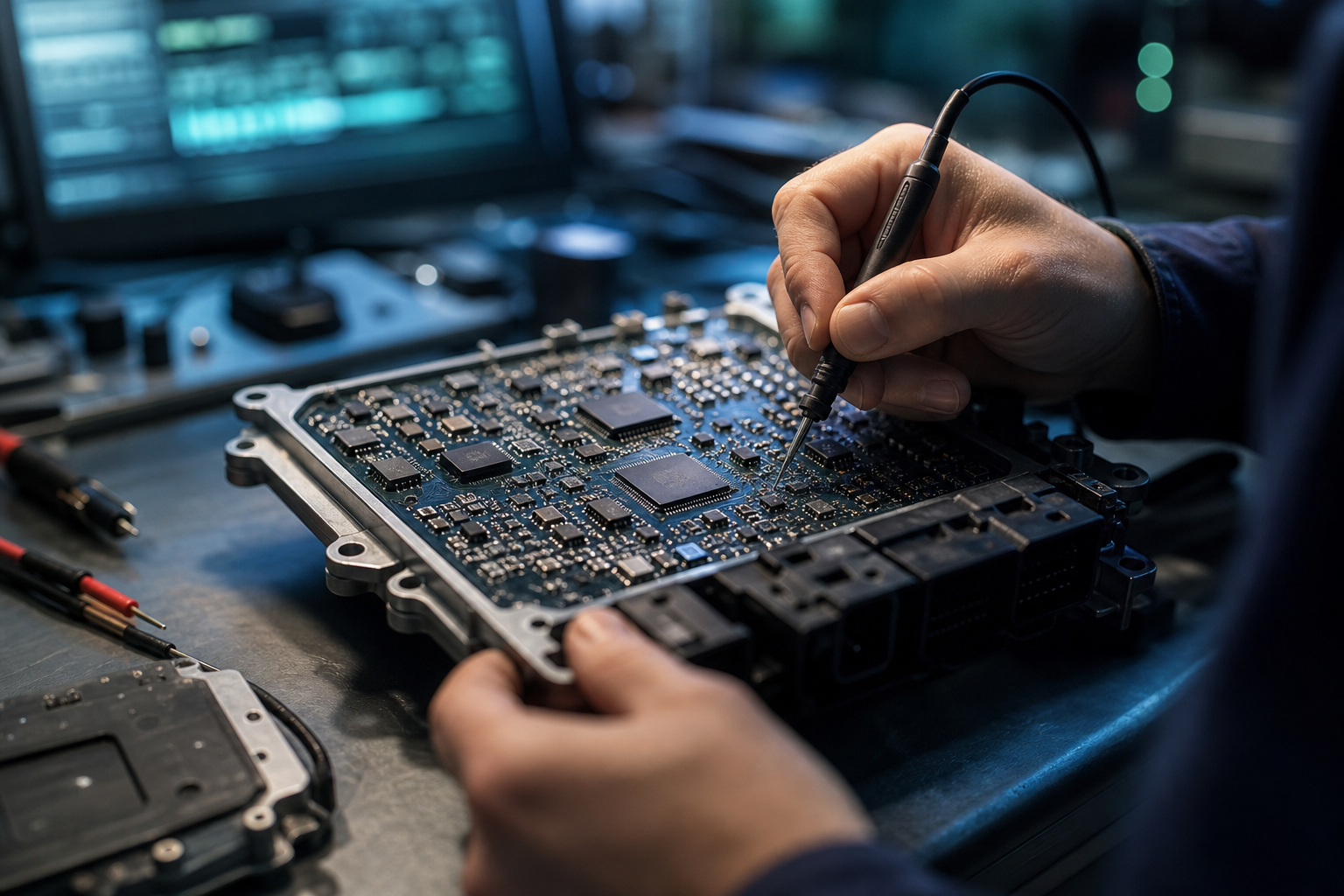
Situation: Renesas Electronics is known for automotive and industrial semiconductor markets, where reliability, long product cycles and customer trust matter. These markets are being reshaped by electric vehicles, software-defined cars, factory automation, connected devices and AI at the edge. Renesas presents its business around embedded processing, analog, power and connectivity for automotive and industrial customers on its investor relations page.
The move: Instead of competing only on individual chips, Renesas has emphasized embedded solutions: microcontrollers, processors, analog and power components, connectivity, software tools and reference designs. This makes it easier for customers to build full systems rather than assemble every component relationship from scratch.
Why it matters: The primary driver is the shift of cars and industrial machines toward software-defined, sensor-rich, connected systems. Supporting drivers include long automotive design cycles, demand for reliable suppliers, the need for power efficiency and the value of developer tools. The strategic lesson is that semiconductor advantage increasingly comes from being designed into a platform, not just shipping a component.
Outcome or lesson: A company that helps customers reduce engineering complexity can defend relationships better than one that only competes on unit price. For interviews, this is the deeper point: semiconductor competition is shifting from pure component performance to system-level problem solving.
How AI Changes Emerging Trends Reshaping Electronics & Semiconductors
AI is not just one more demand source. It changes where value is created across electronics and semiconductors.
The practical student workflow: load a semiconductor company annual report, one recent earnings call transcript and this lesson into NotebookLM or ChatGPT. Ask: “Map the company’s exposure to AI compute, automotive, India manufacturing, packaging and supply-chain risk. Separate facts from assumptions.” For safe sector research, also revise Using AI to Research a Sector Without Importing Its Errors.
Interview Relevance
“What are the most important emerging trends in electronics and semiconductors, and how should an Indian company think about them?”
Use one sentence per trend, then go deep on two. Interviewers reward prioritization more than a long list of buzzwords.
Common Mistake
The mistake: Treating electronics and semiconductors as a simple demand-growth story. Why it costs candidates: it ignores capital intensity, yield, capacity, geopolitics, design wins and manufacturing bottlenecks. One-line fix: always explain where the trend hits the value chain and which constraint it changes.