
Indian Market Nuances in Electronics & Semiconductors
A smartphone on a Jaipur shop counter, a smartwatch being repaired in Coimbatore, and a PCB line running in Noida are all part of the same story: India’s electronics opportunity looks huge, but the money is made only when a company understands the local frictions. The trap is to say “India has demand and low-cost manufacturing”; the nuance is that demand, components, policy, certification, talent and after-sales economics move together.
- Indian market nuance means a local condition that changes demand, cost, risk or go-to-market economics.
- In electronics, India is both a price-sensitive consumption market and a manufacturing localization market.
- The biggest strategy question is not “Can we assemble in India?” but “Where can India capture value - design, components, PCBA, final assembly, distribution or service?”
- Semiconductors are different from electronics: chips need deep capital, process discipline, ecosystem density and patient capability building.
- Policy matters through incentives, customs duties, standards, procurement, export rules and state-level manufacturing support.
- Winning companies manage four loops together: demand insight, supply-chain localization, compliance readiness and working-capital discipline.
- The interview-safe answer always separates demand nuance, supply nuance, policy nuance and capability nuance.
Big Picture - India Is a Market, a Factory and an Ecosystem at Once
Most sectors can be read mainly through customers or competitors. Electronics and semiconductors require a wider lens because a pricing decision in the market can be shaped by imported components, certification timelines, state incentives, repair networks and semiconductor supply constraints.
Core Explanation - The Four Nuances That Actually Change Strategy
Think of Indian electronics and semiconductor strategy as four questions. If your answer covers only one, it sounds like newspaper knowledge. If it covers all four, it sounds like a manager who can diagnose the sector.
1. Demand Nuance - India Is Value-Conscious, Not Simply Cheap
Indian buyers often optimize for a sharp equation: feature set, price, brand trust, financing, warranty and repair access. This is why two products with similar specifications can perform very differently across metro, tier-2 and rural channels.
For example, a consumer electronics brand cannot just import a global product and cut price. It may need regional-language packaging, service availability, festival-season inventory, EMI partnerships, influencer-led trust creation and SKU variants suited to Indian usage conditions.
2. Supply Nuance - Assembly Is Not the Same as Value Capture
Electronics value moves through design, component sourcing, printed circuit board assembly, box build, testing, logistics and after-sales. Final assembly creates employment and scale, but deeper value capture comes when local vendors, tooling, PCBA capability, testing labs and design-for-manufacturing improve together.
This is the most important distinction in semiconductor-linked conversations. A country can assemble devices before it has strong semiconductor fabrication. It can build ATMP or OSAT capability before advanced fabs. It can design chips without manufacturing them locally. Each layer has different capital intensity and capability requirements.
3. Policy Nuance - Incentives Help, But Compliance Decides Speed
India’s electronics push is shaped by incentive schemes, customs structures, standards, state industrial policies and procurement rules. The Production Linked Incentive framework is the best-known example of policy using output-linked incentives to encourage domestic manufacturing (Invest India on Production Linked Incentive schemes).
For semiconductors, the India Semiconductor Mission acts as a nodal institution for building semiconductor and display manufacturing ecosystems (India Semiconductor Mission). For finished electronics, product categories may also face compulsory registration or safety requirements under BIS frameworks (BIS Compulsory Registration Scheme product list). If you are revising regulation as a sector skill, use the same logic as locating the regulator and what it controls.
4. Capability Nuance - Semiconductors Need Ecosystem Density
Semiconductor competitiveness is not created by one plant. It needs design talent, EDA tools, process engineers, clean-room discipline, materials, specialty chemicals, gases, equipment maintenance, packaging, test capability and anchor customers. This is why the right interview answer should say “ecosystem build-out,” not just “fab investment.”
Definitions You Can Say Clearly
- Market nuance: A local factor that changes demand, cost, risk, regulation or route-to-market economics.
- Electronics manufacturing services: Contract manufacturers that design, assemble, test or service electronics for brand owners.
- Semiconductor value chain: The sequence from chip design to fabrication, packaging, testing, integration and end-device use.
- Localization: Increasing domestic contribution to design, sourcing, manufacturing, compliance, distribution or service.
The India-Specific Strategy Map
Use this 2x2 when an interviewer asks where opportunity lies. It separates low-value import trading from deeper electronics and semiconductor capability building.
The matrix also prevents a common overstatement: “manufacturing in India” is not one thing. Importing kits and doing final assembly is different from local PCBA, component sourcing, design ownership, testing capability and semiconductor packaging.
What to Track - Six Metrics That Reveal Whether Localization Is Real
Use metrics to avoid vague answers. A company may announce local manufacturing, but these measures show whether the business is becoming stronger or merely shifting the final assembly location.
If you want to build sector depth from company filings, practice the approach in reading an annual report for sector insight. It is especially useful for EMS companies because working capital, customer concentration and capex plans reveal more than headline growth.
Case Study - Dixon Technologies: India’s Electronics Manufacturing Nuance in One Company
Dixon Technologies shows how an Indian electronics manufacturer can move from assembly scale toward broader EMS capability, where the real edge is execution, compliance, customer trust and working-capital control.
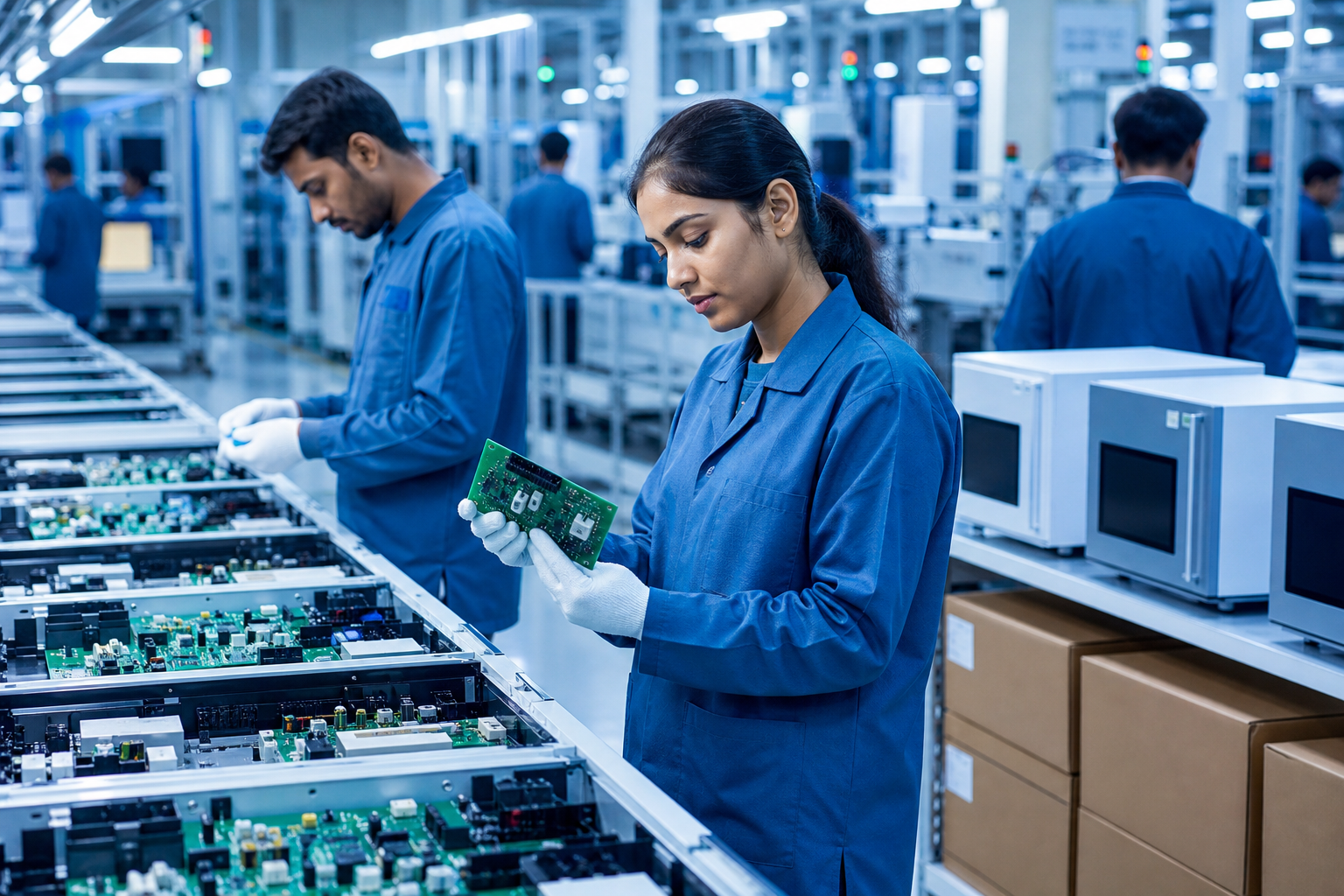
Situation: Global and Indian electronics brands wanted to serve a large Indian market while reducing import dependence and improving local responsiveness. But India’s electronics ecosystem had a familiar challenge: final demand was strong, while many high-value components and specialized subassemblies still depended on global supply chains.
The move: Dixon Technologies built its role as an electronics manufacturing services player across categories such as consumer electronics, home appliances, lighting and mobile-related manufacturing, as described on Dixon Technologies’ official company site. The strategic move was not “make products cheaply.” It was to build scale, customer relationships, manufacturing processes, compliance capability and product-category breadth.
Primary driver: Dixon’s core driver is manufacturing execution at scale for brand owners - the ability to deliver quality, timelines and cost discipline in categories where brands want asset-light or partner-led manufacturing.
Supporting drivers: The model is supported by policy tailwinds for domestic electronics manufacturing, category diversification, customer acquisition, vendor development, quality systems and working-capital management. This matters because EMS companies can grow revenue fast but still struggle if receivables, inventory or component volatility are poorly managed.
Outcome and lesson: The case teaches the correct nuance: India’s electronics opportunity is not only consumer demand or cheap assembly. The strategic prize is building reliable manufacturing capability that can handle local demand cycles, global component dependencies, policy compliance and customer-specific execution at the same time.
How AI Changes Indian Market Nuances in Electronics & Semiconductors
AI does not remove India’s market nuances; it makes them more visible and faster to act on.
Student workflow: Load one EMS company annual report, one policy page and your notes into NotebookLM, then ask: “Create a two-page interview brief on Indian electronics market nuances, separating demand, supply, policy and capability risks.” Use Perplexity only to locate fresh sources, then verify every important claim before using it. For the research discipline, revise using AI to research a sector without importing its errors.
Interview Relevance
“India is becoming important in electronics and semiconductors. What are the key Indian market nuances a company must understand before entering or scaling here?”
If asked for an example, use an Indian EMS player like Dixon Technologies rather than defaulting only to Apple or Foxconn. It shows you understand the domestic manufacturing layer, not just global brand headlines.
Common Mistake
The single biggest mistake is treating India as one simple story: “large demand plus cheap manufacturing.” That answer fails because it ignores component dependence, policy compliance, channel trust, service economics and semiconductor capability gaps. One-line fix: always answer through four lenses - demand, supply chain, policy and capability.