
Emerging Trends Reshaping Automotive & Mobility
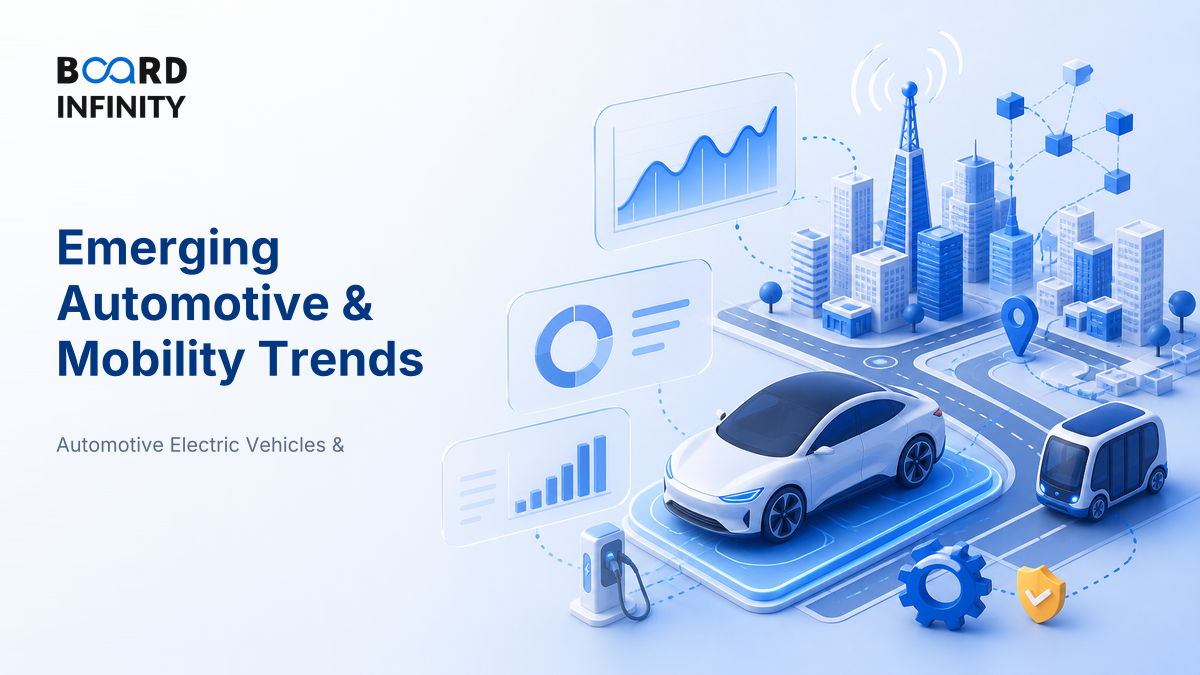
A commuter unlocks a scooter with an app, sees range on the dashboard, finds a charger on the map, and pays without speaking to a dealer, petrol pump attendant or service advisor. That one ride shows the shift: vehicles are no longer just machines sold once - they are connected platforms, energy assets and service ecosystems.
- Automotive is moving from product to platform: hardware still matters, but software, data, charging, financing and service experience now shape profit.
- The clean interview framework is CASE: Connected, Autonomous or ADAS, Shared mobility, and Electric mobility.
- The India lens is different: two-wheelers, three-wheelers, fleet use cases, affordability, charging access and policy incentives matter more than premium passenger cars alone.
- EV adoption is not just about batteries: it depends on upfront price, running cost, charging confidence, resale value, financing and service network trust.
- Software-defined vehicles change the profit pool: features, diagnostics, insurance, subscriptions and over-the-air updates can create recurring revenue.
- Track real metrics: EV penetration, battery cost per kWh, charging utilization, gross margin, fleet utilization and software attach rate.
- Best answer move: do not list trends. Link each trend to customer adoption, value-chain disruption and profit-pool migration.
Big Picture: The Industry Is Moving From Vehicle Sales to Mobility Ecosystems
The old industry logic was simple: design, manufacture, distribute, sell, service. The new logic is broader: build the vehicle, connect it, finance it, power it, update it, insure it, operate it in fleets, and learn from its data. That is why the same sector now attracts OEMs, battery companies, charging operators, software firms, insurers, logistics platforms, ride-hailing companies and AI teams.
The Core Framework: CASE Trends Reshaping Automotive and Mobility
Use CASE as your first-principles map. It is simple enough to remember under pressure and broad enough to cover most current interview questions.
Globally, electric vehicles crossed the niche stage: the International Energy Agency reported that nearly one in five cars sold in 2023 was electric in its Global EV Outlook 2024. But the interview point is not “EVs are growing.” The sharper point is: EVs change where money is made - batteries, charging, software, financing, residual value and service capability become strategic.
The EV Adoption Funnel: Why Interest Does Not Automatically Become Purchase
Most weak answers assume that if customers like EVs, EV sales will automatically rise. Real adoption is a funnel. Customers must move from awareness to economic justification to charging confidence to after-sales trust.
Where the Profit Pool Is Moving
The most important mental shift is this: traditional automakers competed mainly on product engineering, distribution and brand. Emerging mobility winners compete on ecosystem control - battery sourcing, charging access, software experience, data, financing, fleet relationships and lifecycle service.
For example, EV fleets can become attractive faster than private EVs because the vehicle runs more kilometres per day, so fuel savings show up quickly. Connected services may monetize slowly with consumers but can be powerful in logistics because downtime and route efficiency directly affect margins. Full autonomy gets attention, but in many markets near-term value comes from ADAS, driver monitoring and safety features rather than robotaxis.
Definitions You Can Say in One Breath
- Automotive industry: The ecosystem that designs, manufactures, sells, finances, services and recycles vehicles and components.
- Mobility: The movement of people or goods through vehicles, platforms, infrastructure, energy and services.
- Electric vehicle: A vehicle propelled partly or fully by electric motors using stored battery energy.
- Connected vehicle: A vehicle that exchanges data with users, infrastructure, service networks or cloud systems.
- Software-defined vehicle: A vehicle whose features, performance and user experience are significantly controlled or updated through software.
Metrics to Track When You Discuss Mobility Trends
If you want to sound practical, move from “trend spotting” to “what would I track?” Use these measures carefully because benchmarks vary by country, segment and business model. In interviews, the strongest answer is often “compare against segment peers and trend over time,” not a fake universal benchmark.
For current numbers, do not rely on social media screenshots. Build your sector view from official company reports, SIAM or Vahan-style industry data, regulator updates and credible research databases; this is exactly where a disciplined source habit from where to find current sector data and which sources to trust helps.
Case Study: Ather Energy and the EV Two-Wheeler Ecosystem
Ather shows why an EV two-wheeler company is not just selling scooters - it is building a connected product, charging layer, service experience and software-led brand promise.

Situation: India’s two-wheeler market is highly price-sensitive, service-network driven and habit-driven. For EV adoption, the barrier was not only battery range. Customers also worried about charging access, product reliability, resale, financing and whether an EV scooter felt aspirational rather than experimental.
The move: Ather positioned itself around a more integrated EV experience: smart scooters, connected dashboards, app-based controls, service touchpoints and charging support through Ather Grid, which the company describes on its Ather charging page. The primary driver was ecosystem trust - reducing customer anxiety around charging and ownership. Supporting drivers included product design, software experience, urban retail presence, performance positioning and after-sales support.
The lesson: The case proves that EV success is not a single-variable story. A lower running cost may attract attention, but adoption needs a complete ownership system. The same logic applies across mobility: the winner is often the player that removes the customer’s switching anxiety, not merely the player with the newest technology.
How AI Changes Automotive and Mobility
AI is not one separate trend in mobility. It accelerates every layer - vehicle design, manufacturing, sales, financing, operations and after-sales.
The practical caution is bias and data quality. A model trained on incomplete driving, financing or service data can misprice risk, recommend poor routes or exclude good customers. In a sector with safety, credit and regulatory implications, “AI accuracy” is not enough - governance matters.
Use NotebookLM or Perplexity to build a mobility trend brief: upload one OEM annual report, one EV policy note, and one credible market report; ask for “five interview questions on EV adoption, profit pools and risks.” Then cross-check every number using the method in using AI to research a sector without importing its errors.
Interview Relevance
“What are the top emerging trends reshaping automotive and mobility, and which one do you think will have the biggest impact in India?”
If the interviewer asks “biggest trend,” do not say “all are important.” Take a stand, then qualify it: “In India, EV adoption combined with connected software is most immediate; autonomy is important but longer horizon.”
Common Mistake
The mistake: candidates list buzzwords - EV, AI, autonomous, shared mobility - without explaining who makes money, who loses money, and what blocks adoption. Why it costs you: it sounds like a newspaper summary, not a management answer. Fix: for every trend, link customer adoption, value-chain change and profit-pool impact in one sentence.