
Where AI Is Landing in Automotive & Mobility
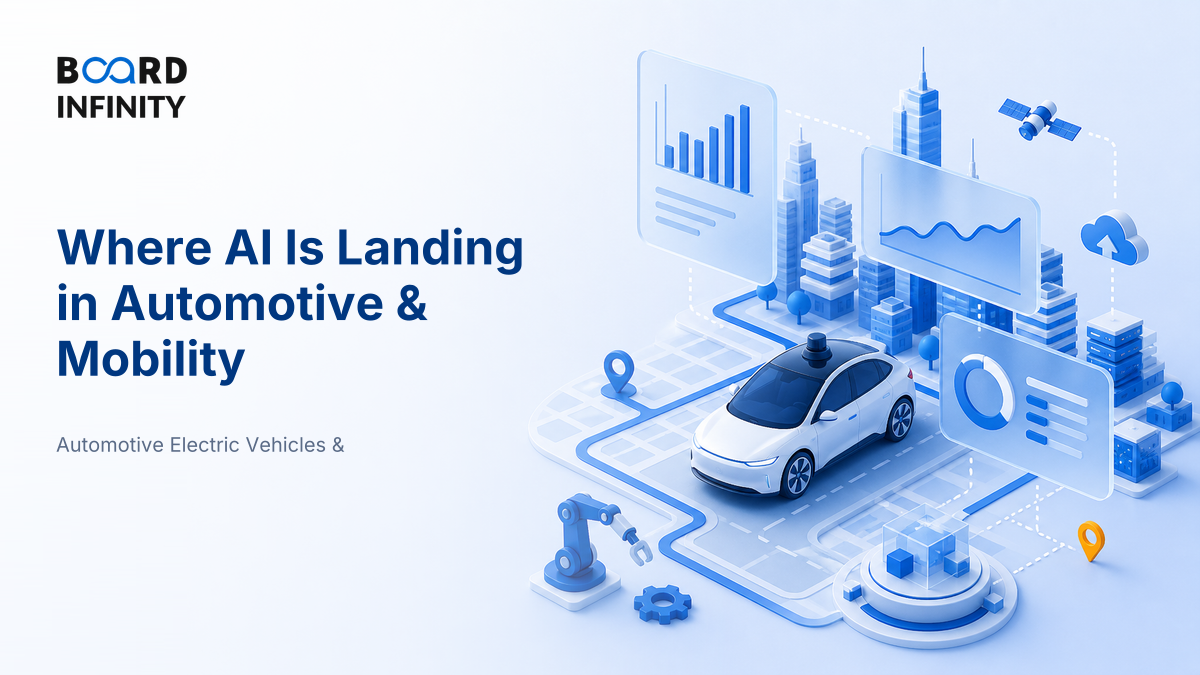
The biggest misconception is that AI in automotive means “driverless cars.” Walk into a modern vehicle plant, EV service centre, fleet control room or connected-car dashboard, and you will see a quieter truth: AI is landing first where it reduces uncertainty - safer driving, better batteries, fewer breakdowns, smarter routes and faster product decisions.
- AI in automotive is a stack, not a feature: sensors collect data, models make predictions, software triggers actions, and feedback improves the system.
- The highest-value landing zones are ADAS, EV battery intelligence, connected vehicles, fleet operations, manufacturing quality and mobility platforms.
- Full autonomy is only one corner of the map; most near-term value comes from assistive, predictive and optimisation use cases.
- Automotive AI must clear a higher bar than consumer AI: safety, latency, regulation, explainability, cyber-security and reliability matter.
- In India, AI is especially relevant in two-wheelers, EV diagnostics, commercial fleets, insurance telematics and service networks.
- The best interview answer links use case to business value: safety, cost, uptime, conversion, retention or asset utilisation.
The Big Picture: AI Is Moving from “Car Intelligence” to “Mobility Intelligence”
Think of automotive AI as four connected arenas. Some AI sits inside the vehicle. Some sits around the vehicle - in fleets, factories, charging networks, insurers and mobility apps. The real advantage comes when these arenas talk to one another.
Core Explanation: The Six Places AI Is Actually Landing
AI creates value when it can sense a situation, predict what may happen next, and recommend or trigger a better action. In automotive and mobility, that pattern appears across six use-case clusters.
1. ADAS and safer driving
Advanced Driver Assistance Systems use sensors, cameras, radar, software and control systems to support the driver. Examples include adaptive cruise control, lane-keeping assist, automatic emergency braking, blind-spot warning and driver-monitoring alerts. These are not the same as full self-driving. They are assistive layers designed to reduce risk and driver workload.
2. EV battery intelligence
Electric vehicles generate continuous data on charging, temperature, driving style, cell behaviour and range. AI helps estimate range, detect abnormal battery patterns, improve charging recommendations and support predictive maintenance. In India, where heat, traffic density and charging infrastructure vary sharply by city, battery intelligence can become a customer-experience differentiator.
3. Connected-car personalisation
Connected vehicles can learn usage patterns: commute routes, cabin preferences, service reminders, infotainment choices and driving behaviour. The business value is not only “cool features”; it is retention, service revenue, diagnostics and a tighter relationship between OEM and owner.
4. Fleet optimisation
For logistics, ride-hailing, bus operators and commercial fleets, AI can improve route planning, dispatching, driver safety, fuel or energy efficiency, tyre maintenance and vehicle uptime. The primary value is asset utilisation, supported by lower operating cost and better service reliability.
5. Manufacturing and quality control
AI vision systems can inspect welds, paint, parts and assembly defects. Predictive models can flag machine failures before downtime occurs. Planning models can help factories adjust production when demand, parts availability or logistics constraints change.
6. Mobility platforms and insurance
Mobility apps use AI for matching, ETA prediction, pricing, fraud detection and customer support. Insurers use telematics and driving behaviour to price risk more accurately, subject to privacy and regulatory constraints. If you need a structured way to research these moving parts without copying AI errors, revise using AI to research a sector without importing its errors.
The Interview Map: Use Case vs Difficulty
A strong answer does not treat every AI use case equally. Some are commercially attractive but technically easier; others are transformational but hard because they involve safety-critical real-time decisions.
Definitions You Should Be Able to Say Cleanly
- Automotive AI: AI applied to vehicle design, manufacturing, driving, ownership, service, fleets and mobility platforms.
- ADAS: Driver-assistance technologies that help drivers avoid crashes or reduce crash severity, as explained by NHTSA driver assistance technologies.
- Autonomy levels: The SAE J3016 driving automation taxonomy classifies automation from driver support to full driving automation.
- Software-defined vehicle: A vehicle whose features, performance and user experience are increasingly controlled by software rather than fixed hardware alone.
- Telematics: Vehicle data collection and transmission used for tracking, diagnostics, insurance, safety and fleet operations.
How to Measure Whether Automotive AI Is Working
In interviews, avoid saying “AI improves efficiency” unless you can name the metric. The right measure depends on the use case, but these six are safe, practical and business-linked.
Case Study: Mahindra XUV700 and the Move from Mechanical SUV to Software-Led Experience
Mahindra used advanced driver assistance, connected features and a premium digital cockpit to make software visible in a mainstream Indian SUV category.
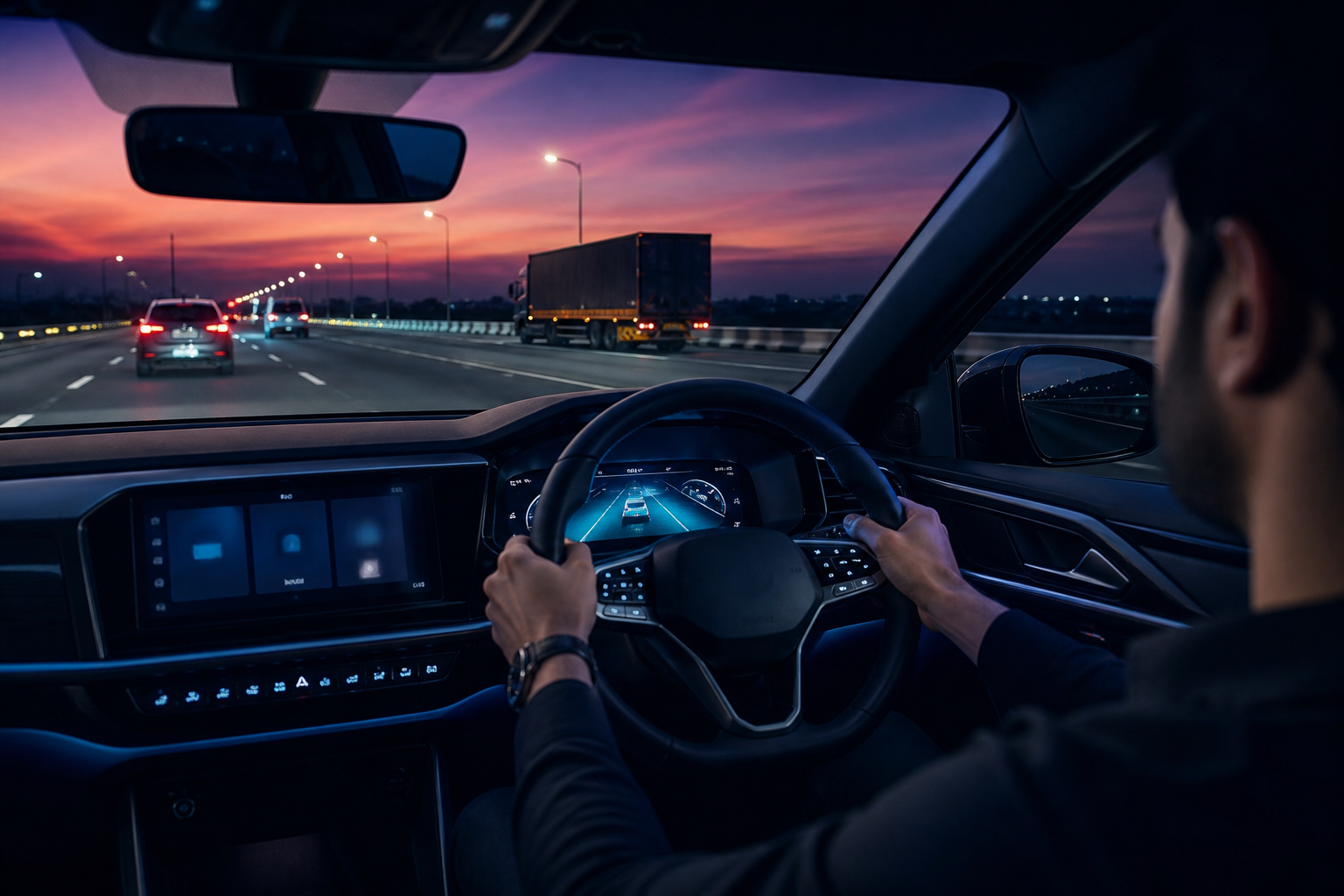
Situation: Indian SUV buyers have traditionally compared vehicles on size, engine, road presence, mileage, price and brand trust. As the segment matured, differentiation became harder. Software and electronics started becoming visible buying criteria, especially for urban and highway users.
The move: Mahindra positioned the XUV700 with a technology-forward experience, including driver-assistance features and a connected digital cabin, as shown on the official Mahindra XUV700 product page. The strategic point is not that one model “became AI.” The point is that AI-enabled and software-led features moved from luxury conversation into an Indian mass-premium SUV consideration set.
Primary driver: Mahindra made advanced safety and digital experience visible to the buyer at the product-positioning level.
Supporting drivers: This worked because it was supported by SUV brand strength, feature packaging, supplier and electronics capability, dealership explanation, and an ownership story that went beyond mechanical specifications.
Lesson: AI lands fastest when the buyer can feel the benefit - safer highway driving, smarter diagnostics, better service or lower operating cost. The technology matters, but packaging, trust and after-sales capability decide whether it becomes a real advantage.
How AI Changes Automotive & Mobility in 2026
By 2026, AI is changing automotive and mobility less through one dramatic “self-driving” leap and more through many embedded decision systems across the value chain.
Use Perplexity or NotebookLM to build a two-page brief: upload an OEM annual report, a product page and two regulator or industry notes, then ask, “Which AI use cases are visible, which are hype, and what business metric would prove impact?” Cross-check the output using reading an annual report for sector insight.
Interview Relevance
“Everyone talks about AI in mobility. Where exactly is AI creating value in automotive, and which use cases are most realistic in India?”
Use the phrase “AI lands where the decision is frequent, data-rich and economically meaningful.” It sounds simple, but it helps you separate real use cases from hype.
Common Mistake
The mistake: treating AI in automotive as a synonym for autonomous cars. Why it costs candidates: it makes your answer narrow, futuristic and disconnected from current business value. One-line fix: discuss autonomy last, after ADAS, EV batteries, fleets, factories, connected cars and mobility platforms.